Kakao Unveils Open-Source ‘Kanana-2 Vision Encoder’ to Strengthen Multimodal AI
TECHWORLD ·
✦ AI Summary
Kakao said it opened two self-developed ‘Kanana-2 Vision Encoder’ models on Hugging Face on the 21st to strengthen multimodal AI technology.
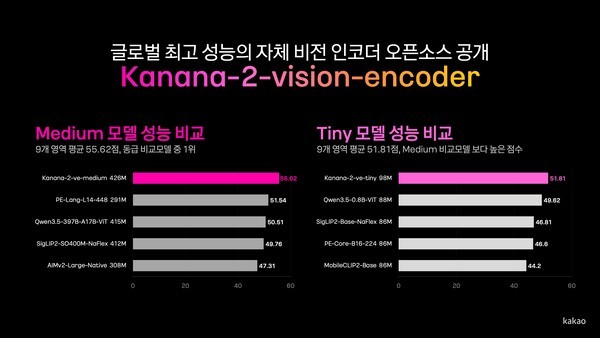
The released models are ‘Medium’ and ‘Tiny,’ with ‘Medium’ at 426 million parameters and ‘Tiny’ at 98 million parameters.
Kakao said it showed overall performance advantages in evaluations across 9 areas and 42 benchmarks, and it said the ‘Kanana Open License’ allows research, development, and commercial use.
Kakao said on the 21st that it has open-sourced two self-developed ‘Kanana-2 Vision Encoder’ models to strengthen its multimodal AI technology. The models were released on Hugging Face. The released models are ‘Medium’ and ‘Tiny,’ with ‘Medium’ at 426 million parameters and ‘Tiny’ at 98 million parameters.
A vision encoder extracts visual information from images, such as objects, text, location, and shape, and then passes it to a language model. It can be used to read the food and prices on a menu board, understand the content and layout of a document, and describe situations in an image.
Kakao also conducted performance evaluations of the ‘Kanana-2 Vision Encoder.’ The evaluation covered 9 areas and 42 benchmarks, and the areas included general visual question answering, English and Korean text recognition, document understanding, location identification in images, and fine-grained recognition.
Kakao said its model showed overall performance advantages over major global vision encoders in this evaluation. The comparison targets were Google’s ‘SigLIP 2,’ Meta’s ‘Perception Encoder,’ Apple’s ‘AIMv2,’ and Alibaba’s ‘Qwen3.5-ViT.’
Kakao said it secured performance that can stand up to larger comparison models while keeping the model size small. The Tiny model, developed with on-device use in mind, has fewer than 100 million parameters, while the comparison models are larger than 400 million. The Tiny model proved competitive in the comparison evaluation.
Kakao said it designed the training structure so that visual information can be preserved even in small text and complex document layouts. As a result, it improved text recognition and document understanding performance, and added that relatively large performance gaps appeared in the areas of location identification in images, Korean testing, Korean text recognition, and document understanding. It also said it improved the training efficiency of the vision encoder by about 4 times compared with the previous approach by leveraging its in-house language model, ‘Kanana-2.’
It also said it reduced processing latency for high-resolution images. Compared with major global vision encoders, it said it cut processing latency by more than 60%. Kakao applied knowledge distillation and lightweighting technology, and also developed the Medium model.
Kakao applied the ‘Kanana Open License’ to both models. The ‘Kanana Open License’ allows research, development, and commercial use. Based on this, Kakao plans to support the use of the models by researchers and companies in Korea and abroad, and to back progress in multimodal AI research and service development.
Kakao is also continuing the flow of developing core components of ‘Kanana-O’ in-house. Kakao’s self-developed targets are the components of the Kanana-2 Vision Encoder and the omni language model ‘Kanana-O.’ Examples of components of ‘Kanana-O’ include the language model, visual processing module, and speech processing module, and the company plans to sequentially disclose other components in the future.
Noh Byeong-seok, Kakao’s Unified Foundation Model performance leader, said the growing spread of computer-use technology is expanding the importance of vision encoders for accurate analysis of high-resolution images. Against that backdrop, he said the company is pursuing stronger competitiveness in its own AI models and expressed its determination to contribute to the development of the AI ecosystem by releasing related technologies.
Source: TECHWORLD · Kim Seung-gi
Original: https://www.epnc.co.kr/news/articleView.html?idxno=408549
References
This article was produced with the help of an automated content generation algorithm.
Source: TECHWORLD
View originalThis article was summarized and organized by BizCrush based on the original article from TECHWORLD. For exact quotations and full details, please refer to the original article.