Fileer Has 2 AI Papers Accepted to NeurIPS 2026, Improving Speech Understanding and Training Stability
TECHWORLD ·
✦ AI Summary
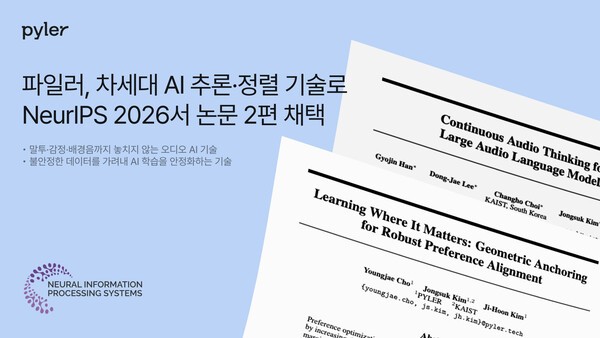
Fileer announced that two papers from its AI team, CoAT (Continuous Audio Thinking) and GAPO (Geometric Anchor Preference Optimization), were accepted to NeurIPS 2026.
CoAT is a technology that uses nonverbal speech information such as voice tremor, emotion, and intonation in analysis, while GAPO is a technology that improves AI training stability in environments with mixed errors.
Fileer said it plans to use the results of the two studies in its video-understanding AI technology.
Fileer announced on the 21st that two papers from its AI team had been accepted to NeurIPS 2026. The research focuses on analyzing nonverbal speech information and improving AI training stability in data environments that contain errors.
The two accepted papers are CoAT (Continuous Audio Thinking) and GAPO (Geometric Anchor Preference Optimization). The presentation will take place on December 10 in Sydney, Australia.
Among them, CoAT is a technology that uses nonverbal information such as voice tremor, emotion, and intonation, in addition to spoken content, for reasoning in speech analysis. The research takes note of the fact that even the same sentence can convey different emotions depending on tone and intonation.
Fileer said it began research on CoAT because conventional text-centered reasoning methods had limitations in sufficiently reflecting such speech information. GAPO, which was accepted alongside it, was presented as an achievement aimed at improving AI training stability even in data environments mixed with errors.
CoAT was designed to provide a separate representational space so AI can directly process internal voice information. Fileer said the system does not elaborate speech information into long text, but instead uses a training structure built around specialized models in five areas: acoustic reconstruction, speech content, sound type, emotion, and pitch. It also omits separate long-form generation during sound analysis and processes information internally, reducing the time burden caused by additional text generation.
CoAT was applied to three speech AI models: Qwen2-Audio, Qwen2.5-Omni, and Audio Flamingo 3. As a result, 38 of 42 performance metrics improved. In the IEMOCAP evaluation, the accuracy of Qwen2.5-Omni rose from about 55% to about 79%.
GAPO is a technology that reduces the impact of erroneous or uncertain data in the process of training AI to generate responses preferred by humans. It is intended to reduce the likelihood that AI will learn incorrectly based on secondary features such as length rather than response content when flawed evaluations are mixed into preference data.
Fileer said the method works by generating a comparison model that applies small perturbations to the model during training. At this point, it uses the evaluation difference between the two models, called the 'anchor gap,' as a metric to identify the sensitivity of each data point. Data with a large anchor gap is assigned a low weight, designing training around relatively stable data.
GAPO was validated on four AI models, including Mistral, Llama-3, and Gemma-2. The evaluation was conducted on AlpacaEval 2.0 and Arena-Hard, using AI response quality and the degree to which user preferences were reflected as criteria. The comparison set consisted of eight existing training methods, including DPO and SimPO, and the company said GAPO showed overall performance advantages.
In some experiments, user-preference-tailored responses improved, GSM8k performance was maintained or improved, and ARC-C performance was also maintained or improved. In addition, under conditions where 20% of the training data were intentionally mislabeled, the system showed more stable performance than existing robustness-focused methods.
Fileer plans to apply the results of the two studies to its video-understanding AI technology. The target applications are brand safety and content review processes. The analysis scope includes the screen, the voices of people on screen, surrounding sounds, and the context of speech. The goal of the application is to reduce model performance degradation caused by errors in training data.
Kim Jong-seok, head of Fileer's AI division, said the significance of the research lies in enabling AI to understand subtle information that people can distinguish by hearing but find difficult to explain in writing. He said that in assessing video safety, tone of voice and background noise are also important, not just what appears on screen. He added that the company plans to continue advancing the related technologies.
Source: TECHWORLD · Kim Seung-gi
Original: https://www.epnc.co.kr/news/articleView.html?idxno=408541
References
This article was produced with the help of an automated content generation algorithm.
Source: TECHWORLD
View originalThis article was summarized and organized by BizCrush based on the original article from TECHWORLD. For exact quotations and full details, please refer to the original article.