Public N2SF Transition Faces Biggest Hurdle in Classification and Policy Setting
TECHWORLD ·
✦ AI Summary
Public institutions are finding the transition to the National Network Security Framework (N2SF) difficult.
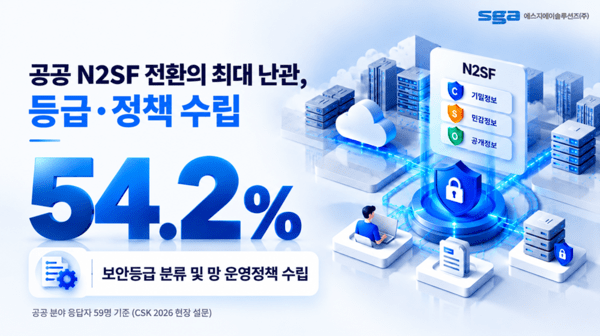
Among public respondents, the biggest challenge was "security level classification and network operation policy setting" at 54.2%, while "setting the scope of N2SF application and transition plans" came in at 35.6%.
Among public-sector respondents, 79.7% said they were in the internal review and information-gathering stage or had not established specific implementation plans.
Public institutions are finding the transition to the National Network Security Framework (N2SF) difficult. The main challenges were identified as classifying security levels by data and establishing operational policies.
SGA Solutions on the 21st released the results of an on-site survey at "Cyber Summit Korea 2026 (Cyber Summit Korea 2026, CSK 2026)." The analysis was conducted among 59 respondents from the public sector out of a total of 146 respondents.
The survey compared what public-sector respondents viewed as the biggest challenge in transitioning to N2SF. Among public respondents, the biggest difficulty in the N2SF transition was "security level classification and network operation policy setting," at 54.2%. The next biggest challenge was "setting the scope of N2SF application and transition plans," at 35.6%.
In response, SGA Solutions said the share of security level classification and network operation policy setting was higher than that of the scope of application or transition planning, and judged that establishing security standards and operational policies suited to each institution's information assets and work environment is an important task before actual technology adoption.
In the public sector, a high proportion of organizations were still in the internal review and information-gathering stage related to N2SF adoption, or had yet to draw up specific implementation plans. Among public-sector respondents, 79.7% said they were either in the internal review and information-gathering stage or had not yet established specific implementation plans for N2SF adoption.
Demand for stronger security was found to be centered on shifting to a data-centric security framework. Among public-sector respondents, 61.0% selected "C/S/O classification and document tagging" as the top area for strengthening. "Data classification and protection" and "system and server access control and server security" each came in at 32.2%.
Against this backdrop, N2SF was described as a national network security framework that moves away from the existing one-size-fits-all network separation approach. N2SF applies different security levels according to information sensitivity and work characteristics. It also classifies information into confidential (C), sensitive (S), and open (O), while emphasizing the importance of integrated links across various security domains.
Choi Young-chul, CEO of SGA Solutions, said the N2SF transition is more than simply adopting a security solution; it is a process of redefining security policies and operational systems to match data importance and work characteristics. He said SGA Solutions plans to support public institutions in making a practical transition to stronger security systems based on the company's accumulated experience in N2SF and zero-trust projects, as well as its integrated security technologies.
Source: TECHWORLD · Kim Hye-jin
Original: https://www.epnc.co.kr/news/articleView.html?idxno=408546
References
This article was produced with the help of an automated content generation algorithm.
Source: TECHWORLD
View originalThis article was summarized and organized by BizCrush based on the original article from TECHWORLD. For exact quotations and full details, please refer to the original article.