Amodei Pushes Back on Safety Rollback Criticism, Says Changes Improve Effectiveness
AI TIMES ·
✦ AI Summary
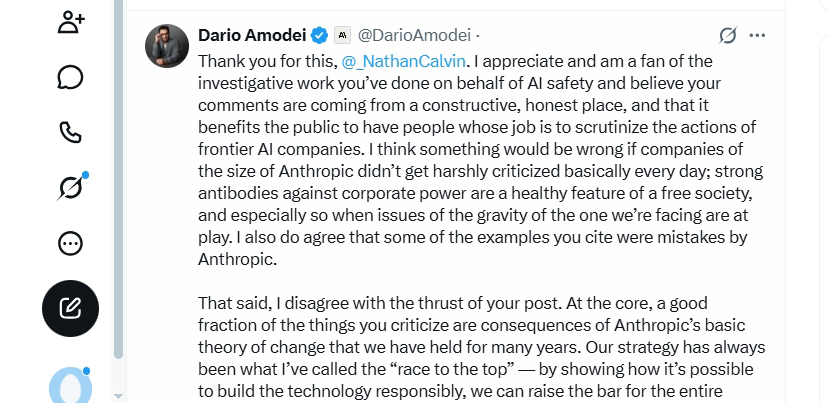
According to AI TIMES, Anthropic CEO Dario Amodei said on October 21 that, in response to criticism of a retreat in AI safety policy, the co…
According to AI TIMES, Anthropic CEO Dario Amodei said on October 21 that, in response to criticism of a retreat in AI safety policy, the company has given up business opportunities for safety and that changes to its responsible scaling policy are not a loosening of principles but an adjustment to improve effectiveness. He pointed to the company’s choices over the past year and argued that it must remain among the leaders in the frontier race in order to raise safety standards across the industry. At the heart of the controversy is how to tell whether a company’s changes to its own safety rules are reasonable improvements or a weakening of responsibility. Anthropic said it has prioritized risk control over commercial gain by strengthening biological safeguards, delaying model releases, and restricting services tied to certain countries. It also said the existing policy required less important procedures while falling short on responses to core risks, and that it has now revised the policy to strengthen risk reporting, roadmap disclosures, and external review. It acknowledged mistakes in its policy announcements and external communications, but said the debate ultimately leaves open the task of proving credibility through transparency, independent verification, and actual risk reduction.
Perspective
This issue matters because it is a test of whether AI companies’ safety commitments will remain declarations or become operational rules that can actually be revised. If the argument that companies can keep raising standards while staying in the frontier race is to gain traction, process and verifiability are likely to become more important benchmarks than intent. In the end, the industry will likely judge trust less by who talks toughest about principles and more by what is disclosed and what controls are accepted when policies change.
This perspective is BizCrush's own commentary and is not part of the reporting by AI TIMES.
This article was produced with the help of an automated content generation algorithm.
Source: AI TIMES
View originalThis article was summarized and organized by BizCrush based on the original article from AI TIMES. For exact quotations and full details, please refer to the original article.