ThinkingAI to Host “TAS 2026,” Share Agentic AI Work Application and Validation Strategies
TECHWORLD ·
✦ AI Summary
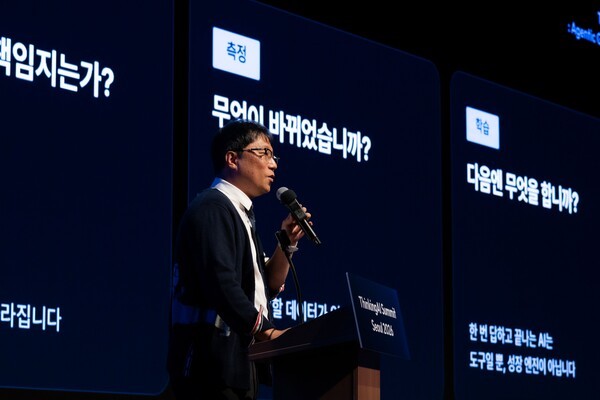
ThinkingAI held “ThinkingAI Summit Seoul (TAS) 2026” at the Textile Center in Gangnam District, Seoul, on the 20th, sharing strategies and case studies for connecting AI agent use to business results.
The event focused on linking a single workflow of analysis, execution, and validation rather than simply increasing analysis speed, and introduced a structure in which people set direction and approve, while agents handle execution.
Class101, Underdogs, Bluehole Studio, and Next Securities presented AI use cases along with the need for validation criteria, role separation, and the accumulation of records.
ThinkingAI held “ThinkingAI Summit Seoul (TAS) 2026” on the 20th at the Textile Center in Gangnam District, Seoul. The event was designed as a venue to share strategies and case studies for linking companies’ use of AI agents to tangible business results.
The event focused on how to turn AI use into actual business outcomes, rather than simply improving speed. The emphasis was not just on faster AI processing, but on connecting a single workflow of analysis, execution, and validation.
ThinkingAI described the theme of the event as “Agentic Growth.” Against the backdrop of the concern that even when AI speeds up analysis, delays in reinterpreting results, handing them off across departments, and waiting for approval can limit real improvements in product development and customer response speed, the company highlighted the importance of a flow that links analysis, execution, and validation.
The event brought together practitioners using AI agents across a range of industries, including finance, gaming, and education. They shared changes in work processes, application examples, and operational challenges.
ThinkingAI presented a workflow that starts with detecting data changes, analyzing causes, and feeding execution results into the next action. Seo Kwang-deok, head of ThinkingAI’s Korea office, said the human role is to set direction and approve, while the agent is the actor. He said the meaning of data, as well as authority and responsibility by task, must be established, and that a system is needed in which work is carried out within the scope approved by AI.
ThinkingAI also introduced the “Agentic Engine” that supports this approach. Lee Seung-joo, sales director at ThinkingAI, explained that the structure connects customer analysis, campaign design, execution following human approval, and result review into a single flow.
ThinkingAI then presented a case study involving Honestree, a direct-to-consumer health supplement brand. In the Honestree case, advertising, behavior, and order data were integrated at the customer level. Based on this, the company showed a flow for distinguishing between targets for recontact and those to exclude.
Lee Seung-joo, sales director at ThinkingAI, said using an LLM has become easier. However, he said building and maintaining the structure in which an LLM works is a human role.
Real-world AI use cases from companies were also introduced. Class101 said it uses AI to analyze experiment results by referring to planning documents, discussion content, and even code. It said this has reduced the time required to derive key insights from 3 days to 1 day.
Ha Gil-woo, lead of the product strategy team at Class101, introduced a case in which the company analyzed why customers were hesitant to make payments and connected the analysis results to follow-up actions. However, he said that if the direction of an experiment result is unclear, AI can amplify that ambiguity. Accordingly, he stressed the importance of team-level validation criteria.
Underdogs shared its experience using AI in a small development organization. The company said it used AI to analyze the causes of user churn and verified the relationship between in-game combat losses and user attrition. It then planned content in which fallen soldiers return, and said it took 3 days to plan the improvement measures.
Kang Min-seok, cofounder of Underdogs, said development is handled by agents, while review and service implementation are handled by people. He also said that even after the person in charge leaves, the know-how remains as the agent’s knowledge. He added that an organization can preserve its experience through the accumulation of the agent’s knowledge.
Bluehole Studio introduced a case showing how AI has changed collaboration in game development. It said collaboration took place in a way that the game designer first produced playable outputs with AI and then the team conducted a joint review. As a result, it said differences in interpretation in the document-centered planning process decreased.
Lee Seung-hyun, seed director at Bluehole Studio, said the time required to add one new weapon was reduced from 20 days to 1 day in elapsed-time terms. He said the reason for this change was that the bottleneck lay not in production speed but in communication time needed for understanding and discussion.
In the finance sector, there was an opinion that as AI-related responsibilities expand, it is necessary to establish standards for validation and accountability. Seo Dong-jin, team leader of the AI data platform team at Next Securities, introduced a case from the data platform build process and proposed recording the intent behind requests and the reasons for selection, while blocking changes that deviate from the rules through automated checks.
The presentation emphasized that the key to adopting AI lies not in simply using more AI, but in how tasks are assigned and how results are made accountable. Seo also stressed the importance of task allocation and result accountability rather than AI usage volume, and shared examples of organizational operations.
The event then introduced role separation among agents and repeated-work operating methods through company case studies. In the One Store case, the company presented an operating model that separates a drafting agent and a review agent, along with a structure in which approval and feedback are reflected in the next task. In the Joshua & Company case, it was explained that a team of 6 operates with 11 agents handling repeated tasks.
At the event, participants discussed the task of recording judgment criteria, reasons for choices, and validation results within the organization so that such AI use can continue even when the person in charge changes or the model changes. The need for continuity in existing work knowledge and experience was also raised. As a way to secure such continuity, it was suggested that not only AI outputs but also the decision-making process should be accumulated.
Seo Kwang-deok said companies need to continue using data and work knowledge accumulated by the enterprise, regardless of changes in the AI model. He also expressed his determination to support the application of corporate AI analysis to product improvement and customer response, so that it leads to actual business results.
Source: TECHWORLD · Kim Seung-gi
Original: https://www.epnc.co.kr/news/articleView.html?idxno=408520
References
This article was produced with the help of an automated content generation algorithm.
Source: TECHWORLD
View originalThis article was summarized and organized by BizCrush based on the original article from TECHWORLD. For exact quotations and full details, please refer to the original article.