Zoom Connects Meeting and Document Context to Help AI Carry Out Workflows
TECHWORLD ·
✦ AI Summary
Zoom unveiled a Unified Context Layer that connects meeting and chat content with corporate documents and work data.
The feature helps AI agents carry out follow-up tasks and integrate with external systems without separately analyzing documents and transcripts.
Zoom also announced release timelines for a range of features that expand AI use across meetings, customer service, sales, and events.
Zoom said it will support AI agents in carrying out work by connecting meeting and chat conversations with corporate documents and work data. It said this expands the use of AI from meeting summaries to follow-up work and integration with external systems.
On the 14th, Zoom held an online pre-briefing in Asia-Pacific (APAC) for "Zoomtopia 2026" and introduced new AI features and collaboration solution updates. At the briefing, the company unveiled how it is expanding capabilities so AI agents can continue handling real work by linking information from meetings and chats with corporate documents and work data.
Attending the briefing were Velchamy Sankarlingam, president of product and engineering, Russell Dicker, chief product officer (CPO), Leo Boulton, head of product solutions and industry marketing, and Michelle Couture, head of customer experience marketing.
Zoomtopia 2026, the company's annual customer event, will be held in the United States on the 20th, and in Asia-Pacific, including Korea, on the 22nd.
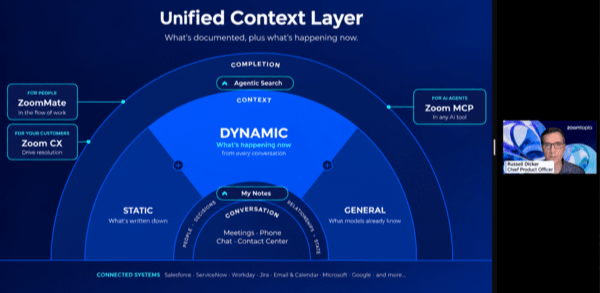
Zoom presented the "Unified Context Layer" as the centerpiece of this announcement. The technology combines meeting, phone, chat, and customer service conversations with corporate documents and information from external work systems, helping employees and AI agents understand work progress and decision-making details.
Zoom explained the context used by AI as dynamic, static, and general. Dynamic context refers to information generated during conversations, such as decisions made in meetings or customer requests received during calls. Static context is records stored in documents and work systems, while general context is the knowledge already held by AI models.
The Unified Context Layer connects each type of contextual information while managing people, topics, decisions, and relationships that appear in conversations. Zoom said the layer was designed so that AI agents can use the necessary context when carrying out work without separately analyzing documents and transcripts.
Zoom explained the related technology on the premise that important information inside companies exists in conversations. Dicker, the CPO, said some high-value corporate information is not recorded in documents but exists within conversations.
Based on its own benchmark, Zoom said AI processing costs using the Unified Context Layer are reduced by 45% to 65% compared with a method that analyzes information separately.
Zoom presented the technology as the foundation of its push for a "System of Action" strategy. The goal of this strategy is to connect information obtained through conversations with work systems and support AI in carrying out follow-up tasks.
Sankarlingam said the key shift in AI is not just better conversational support, but helping companies carry out real work based on the content of those conversations.
Boulton explained that the company has continuously collected data such as meeting recordings, chat logs, and call transcripts, but collecting data and turning it into usable knowledge are separate matters. He added that AI agents can carry out work using this integrated information.
The Unified Context Layer is used to link meeting records with follow-up work. Its purpose is to allow what was discussed in meetings to carry over into later work processes.
This month, "My Notes Workflows" is scheduled for release. The feature delivers meeting summaries to external work tools such as Zoom Chat and Salesforce, and also supports automated handling of related tasks. It offers workflows tailored to sales, marketing, and IT, and users can build automation procedures based on natural-language descriptions.
Then in November, "Enriched Notes" is scheduled for release. The feature links shared screens, slides, charts, and chat to the corresponding points in the transcript, allowing users to review the context of a meeting as it happened. In December, "Follow the Meeting" is scheduled for release, providing individual notes and summaries for users who did not attend a meeting or attended only part of it.
Recording coverage will expand from online meetings to in-person conversations. To support this, a standalone My Notes mobile app is scheduled for release in December, and it will provide recording and transcription for in-person meetings even when the Zoom Workplace app is not running. In November, integration with DTEN's card-type recording device, "Action Card," is also planned, and integration with Bota's card-type and wearable devices is planned for the first quarter of next year.
Based on the recorded information secured this way, Zoom will offer a range of AI agent collaboration features. At present, "ZoomMate AI Agent Teams" is available. In this structure, a lead agent distributes tasks and specialized agents carry them out before compiling the results.
Boulton gave an example involving a marketing campaign. In this case, an AI in the role of a marketing director distributes work across content creation, campaign planning, SEO, and brand analysis, then supports the reviewer by integrating the results after multiple tasks are carried out simultaneously.
Zoom is expanding its information discovery capabilities. It currently offers agentic search, and the search targets more than 40 external applications, including Zoom meetings, phone, and chat, as well as ServiceNow, Workday, and Google Drive. It also uses MCP as a way to connect external AI services, and it is using MCP servers and search and query APIs. Through this, external agents can look up Zoom information and execute support functions.
Zoom also plans to expand the scope of actual task execution by AI agents through integration between Zoom Chat and external AI services. A redesign of Zoom Chat is planned for December, and after the redesign, AI agents are expected to join conversations in Zoom Chat. The scope of tasks AI agents can handle will be limited to what administrators allow.
Claude, Codex, and Copilot are among the services included in the expanded integration plan. Starting in November, Zoom plans to support direct execution of Zoom workflows from Claude and Codex.
In the same context, Zoom is applying the Unified Context Layer to customer service. In November, "Customer Profiles" is scheduled for release. The feature connects customer service histories across channels such as phone and chat, enabling agents and AI agents to refer to previous conversations. The aim is to reduce the burden on customers of having to repeat themselves.
The company has strengthened its customer service record analysis capabilities. In the same month, it will unveil "CX Insights Transcript Intelligence," which classifies voice, chat, and email conversations and supports natural-language search. It can also analyze operational data such as service handling time, queue data, and service outcomes. The company also plans to respond to customer requests in offline stores through "Zoom Virtual Agent Kiosk," which is scheduled for release in November.
In sales, AI is being used for lead generation, customer information enrichment, follow-up outreach, and scheduling consultations. Zoom Revenue Accelerator also includes an agentic workflow builder that executes necessary follow-up tasks based on CRM system information.
Zoom is pushing ahead with additional AI features for its existing meeting service. First, it will unveil "Translate Me" this month, and the feature supports speaker voice synthesis and translated voice delivery in other languages. It will then release camera eye-contact correction and real-time voice tone correction in December, and it plans to launch "Live Meeting AI Agent," a feature that helps search for needed information, respond, and manage the meeting in real time, in the first quarter of next year.
Zoom is also strengthening security and management functions as AI use of information expands. It supports integration with Microsoft Purview sensitivity labels and also supports its own label settings. In addition, it supports the application of access policies by information classification for meetings and content, and the feature is currently being offered to some Zoom Workplace customers.
Zoom has also added an administrator feature for checking AI agent activity and a policy-based feature for limiting AI agent use. In addition, it plans to provide centralized AI management and deepfake risk detection in December, and in the first quarter of next year it plans to introduce "AI Guardrails," a feature that controls the use of AI responses and generated information.
The company is also applying AI to its event business, saying it plans to release "Content Studio" this month first. "Content Studio" has the ability to turn event recordings into content in multiple languages and formats. In November, it plans to add "Agentic Event Setup," which includes support for event preparation such as session configuration and attendee registration. The company plans to expand support from event operations to post-event content use through these features.
Source: TECHWORLD · Kim Seung-ki
Original: https://www.epnc.co.kr/news/articleView.html?idxno=408498
References
This article was produced with the help of an automated content generation algorithm.
Source: TECHWORLD
View originalThis article was summarized and organized by BizCrush based on the original article from TECHWORLD. For exact quotations and full details, please refer to the original article.