In the Age of AI Autonomy, Controllable Systems Are Key
TECHWORLD ·
✦ AI Summary
Gartner has released its 10 strategic technology trends for 2027.
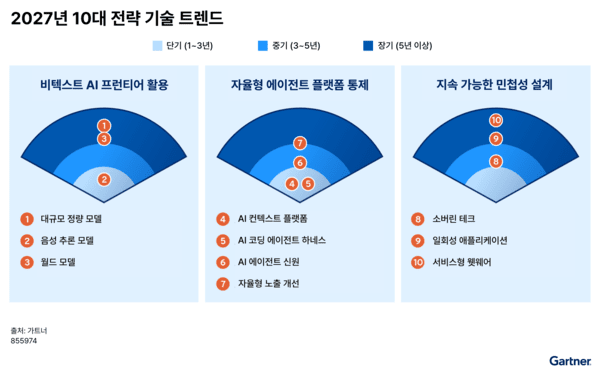
The list includes Large Quantitative Models, voice reasoning models, world models, AI context platforms, AI coding agent harnesses, AI agent identities, Autonomous Exposure Remediation, SovTech, one-off applications, and Wetware as a Service.
Gene Alvarez, Gartner VP Analyst, pointed to the lack of systematic architecture as the problem with current AI systems and explained the need to use technologies such as LQM, voice reasoning models, and world models as alternatives.
Gartner has announced the 10 strategic technology trends businesses should watch in 2027. The list includes Large Quantitative Models, voice reasoning models, world models, AI context platforms, AI coding agent harnesses, AI agent identities, Autonomous Exposure Remediation, SovTech, one-off applications, and Wetware as a Service.
Gene Alvarez, Gartner VP Analyst, said the biggest problem with current AI systems is the lack of a systematic architecture. He noted that AI is generating software faster than humans can review it, resulting in unmanaged credential paths and processes becoming tied to a single vendor. He stressed that organizations need to move away from manually observing model capabilities in order to prevent systemic risk. He also said there is a need to actively design boundaries between organizations, people, and machines.
When general-purpose language models are used for numerical tasks, probabilistic estimation occurs. As a result, serious risks emerge in terms of accuracy and regulatory compliance.
As an alternative to address these limitations, Large Quantitative Models (LQM) have been proposed. LQM is designed for quantitative data processing and analysis, and it has a modular hybrid neural network architecture. It also supports proactive, simulation-based decision-making rather than reactive problem solving.
Analyst Alvarez said this sophisticated approach delivers an unprecedented level of business agility. He also said it enables the safe adoption of autonomous predictive capabilities even in heavily regulated industries such as finance and health care.
Another type of AI, separate from this, is the voice reasoning model. This model analyzes audio directly, understands the context and intent across a conversation, and determines the next action. Voice reasoning models are classified as voice AI systems.
Analyst Alvarez said voice is the most common channel of interaction within companies. However, even though customer support automation has advanced over the past decade, accuracy, speed, and problem-resolution rates have remained below enterprise requirements.
On that point, Analyst Alvarez said voice reasoning models are a means of closing that gap at scale. He also said voice reasoning models make it possible to automate conversations that require complex, high-level judgment.
Meanwhile, world models take a physics-first approach and support machines in understanding space, time, and causality. With world models, autonomous agents can simulate possible future scenarios, predict outcomes, and understand results before taking real-world action. As investment surges in robotics, autonomous vehicles, and spatial computing, the development of advanced technologies such as world models is also accelerating.
An AI context platform provides the context information needed for AI agents to interpret inputs, make decisions, and act in line with business goals. Analyst Alvarez said that without a dedicated context layer, companies face operational risks.
These operational risks include overprivileged agents, compliance failures, low trustworthiness, and excessive token consumption. Gartner forecasts that by 2027, agentic AI accuracy at semantic-first enterprises with AI-ready data could improve by as much as 80%, while costs could fall by up to 60%.
The AI coding agent harness is a closed-loop control system for managing the behavior of development agents that operate autonomously across the software development lifecycle. It is presented as a mechanism for controlling the autonomous behavior of development agents.
Without a dedicated harness, developers must verify AI-generated outputs themselves. In this process, governance inversion may occur, which can increase costs and offset the productivity gains from AI adoption.
AI agents play a role in performing tasks independently on behalf of multiple people, but existing systems have a limitation in that they cannot provide just-in-time access rights. This limitation in legacy systems can lead to the risk of serious security vulnerabilities.
Related to this, Analyst Alvarez said that applying dynamic identity controls can replace high-risk static credentials with policy-based dynamic access rights. He also explained that AI agent identities link models, prompts, and credentials to agent behavior, and that this connection can secure trust and accountability.
Gartner expects that by 2028, 25% of enterprise security breaches will stem from misuse of AI agents due to unmanaged machine privileges and legacy credential practices.
Separately, Autonomous Exposure Remediation (AER) was described as combining AI technology with automation. AER detects security vulnerabilities across an enterprise's digital environment, prioritizes and resolves them, then automatically tests patches or virtual patches before deploying them to production environments.
SovTech is presented as a technical and legal design target for providing a practical exit strategy from dependence on core vendors. SovTech consists of hardware, software, databases, and AI models. Its defining characteristics include preventing vendor lock-in and ensuring a level of sustained usability that can guarantee full operational continuity.
Gartner predicts that by 2030, more than 75% of companies outside the U.S. will adopt digital sovereignty strategies. It also expects core workloads to be moved for the purpose of reducing geopolitical risks and vendor dependence risks.
One-off applications refer to software applications developed for a specific business purpose. The design principle of these applications is to intentionally discontinue use once the purpose has been achieved or they are no longer valid.
Analyst Alvarez said the shift to one-off applications means a complete change in how software is purchased, designed, and budgeted. He also noted that application portfolios must move away from long-term legacy investments and toward dynamic systems.
Traditional silicon-based computing hardware has limits on the unlimited scaling of enterprise AI because of the unsustainability of environmental and energy demands. As an alternative, a new operating model called Wetware as a Service is being proposed, providing cloud-based remote access to biological or synthetic biology systems for computing purposes.
The hosted organic processors in this model leverage the natural plasticity of biochemical networks. They also run complex algorithms with very high energy efficiency.
Source: TECHWORLD · Lee Gwang-jae
Original: https://www.epnc.co.kr/news/articleView.html?idxno=408517
References
This article was produced with the help of an automated content generation algorithm.
Source: TECHWORLD
View originalThis article was summarized and organized by BizCrush based on the original article from TECHWORLD. For exact quotations and full details, please refer to the original article.