[AI Brief] SelectStar and Cisco Team Up on AI Security, Trustworthiness
IT DAILY ·
✦ AI Summary
SelectStar and Cisco signed a letter of intent (LOI) for strategic cooperation in AI security and trustworthiness.
The two companies plan to jointly support enterprise customers' AI adoption and use by leveraging their technologies and experience, and to combine AI security and evaluation technologies.
They also plan to pursue joint seminars and marketing collaboration and expand the scope of their cooperation.
SelectStar and Cisco have teamed up to respond to demand for AI security and trustworthiness verification.
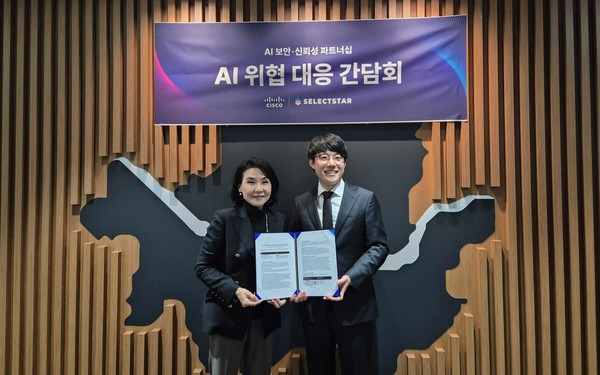
SelectStar announced on the 21st that it had signed a letter of intent (LOI) with Cisco for strategic cooperation in AI security and trustworthiness.
An LOI signing ceremony was held on the 20th at Cisco Korea's headquarters.
The two companies agreed to jointly support enterprise customers' AI adoption and use by leveraging their respective technologies and experience, and plan to combine AI security and evaluation technologies.
Through this, the two companies plan to support safe AI adoption and operation for enterprise customers. The photo shows SelectStar CEO Kim Se-yeop and Cisco Korea CEO Choi Ji-hee posing for a commemorative photo after the LOI signing ceremony.
SelectStar has participated in national AI projects such as 'Independent AI Foundation Model' and 'Everyone's AI,' and has carried out AI training and evaluation data development in specialized fields including finance, legal services, and public sector projects, while also handling a variety of model evaluation consulting projects. SelectStar's self-developed AI trustworthiness evaluation platform, the 'DATUMO Platform,' supports everything from evaluation data generation to model performance evaluation, model safety evaluation, red teaming, and results analysis.
Based on these capabilities, the two companies plan to discuss ways to combine Cisco's 'AI Defense' with SelectStar's evaluation technologies and know-how. 'AI Defense' supports AI model vulnerability assessment and responses to security threats during operation, and the two companies plan to explore AI security and trustworthiness verification measures tailored to enterprise customer needs. They also plan to pursue joint seminars and marketing collaboration, and expand the scope of their cooperation.
The photo shows the Xenon AI solution, which features ship document analysis and automated report generation capabilities.
Xenon said on the 21st that it is accelerating the expansion of its AI-based quality inspection and production automation business at manufacturing sites in Indonesia, and that after passing mass-production verification in its Indonesian AI manufacturing automation business, it has continuously won follow-up projects as it accelerates overseas business expansion.
Last year, Xenon began work on an AI vision inspection project for Nike outsole production. The technology development is aimed at automatically determining whether a product is defective.
The inspection method involves capturing the product surface with industrial high-resolution cameras and dedicated lighting, after which AI analyzes the images. This made it possible to identify defective areas and distinguish good products from defective ones based on product-specific quality standards.
This year, Xenon conducted mass-production verification for two product styles, recording defect detection rates of 99.7% and 99.2%, respectively. As a result, it passed Nike footwear final verification.
This verification by Xenon went beyond a simple technical performance test and was carried out with actual production line application in mind. Xenon is currently carrying out preliminary work for developing a mass-production model and plans to begin development within this year.
Xenon plans to begin deployment at production sites starting next year and will gradually expand the products and production lines to which it is applied. Through this, it aims to accelerate the commercialization of AI vision inspection technology and connect the results of mass-production verification to follow-up business orders.
Amid this trend, Xenon won an additional AI vision inspection project this year to identify subtle defects in stitching and bonding areas of shoe uppers. The project will develop technology that uses ultra-high-resolution cameras and multi-angle lighting to identify the complex structure and subtle defects of the upper.
Meanwhile, the photo caption is Oracle. Oracle said on the 21st that it will pursue healthcare research cooperation with AstraZeneca based on AI and real-world data (RWD).
The purpose of the agreement is to help clinicians identify patients eligible for clinical trials and to explore ways to apply research results in clinical settings.
This collaboration between AstraZeneca and Oracle combines AstraZeneca's expertise in science and therapeutics with Oracle's capabilities in healthcare data, cloud, AI, analytics, and support for clinical workflows. The agreement is non-binding.
Based on this agreement, the two companies plan to review use cases involving the latest applications, AI use, and improved clinical trial efficiency. Through this, they aim to help clinicians quickly identify patients eligible for clinical trials, improve patient access to clinical trials, and address patient recruitment challenges. Initial areas under review are oncology, cardiovascular, kidney and metabolic diseases, respiratory and immune diseases, and rare diseases.
Mike Sicilia, Oracle CEO, said that combining AstraZeneca's scientific expertise with Oracle's data, cloud, AI, and healthcare capabilities could accelerate research, expand clinical trial participation opportunities for more patients, and speed the delivery of related insights to clinical settings.
Flex signed a memorandum of understanding (MOU) with Microsoft Korea on the 20th to accelerate AX for domestic companies. Flex announced the signing on the 21st.
Flex CEO Jang Hae-nam and Microsoft Korea CEO Cho Won-woo attended the signing ceremony. The agreement was pushed ahead with a focus on cooperation for domestic enterprise customers.
The two companies agreed to conduct joint sales targeting domestic enterprise customers. Cooperation also includes reviewing integration between Flex and Microsoft products and technologies, as well as mutual application of solutions from both companies.
Flex registered as a Microsoft partner last September. Based on this agreement, Flex plans to work with Microsoft Korea to target the large enterprise and mid-market segments and support the expansion of the Copilot ecosystem.
The large enterprise and mid-market strategy includes establishing a joint value proposition, selecting target customers, and setting up a sales support system. In addition, the companies plan to jointly propose Flex to companies using Microsoft 365 Copilot.
Flex is also exploring a cooperation model with Microsoft based on Copilot and Work IQ integration. The goal is to expand the use of Copilot in more companies' work processes.
Flex and Microsoft are reviewing a 'customer zero' approach to confirm the potential value and applicability of both companies' solutions. Flex is examining ways to apply Microsoft 365 in its own environment, and is also reviewing how Microsoft Azure, centered on AI infrastructure, can be applied to its environment. Flex plans to use the experience gained from these application reviews in its customer business and pursue stronger cooperation through that use.
Source: IT DAILY · Yang Seung-gap
Original: https://www.itdaily.kr/news/articleView.html?idxno=242335
References
This article was produced with the help of an automated content generation algorithm.
Source: IT DAILY
View originalThis article was summarized and organized by BizCrush based on the original article from IT DAILY. For exact quotations and full details, please refer to the original article.