88% of Korean Corporate Executives Say Failed Data Sovereignty Could Affect Their Jobs
TECHWORLD ·
✦ AI Summary
Everpure released the results of its '2026 Global Data Sovereignty Report' survey, which included 2,100 business leaders in 8 countries and 200 respondents in Korea.
In the survey, 91% of global respondents and 89% of Korean respondents said data sovereignty issues could cause financial damage or reputational damage to their companies.
Responses showing no official data sovereignty strategy stood at 70% for Korean companies and 64% for global companies, and the survey also found difficulty securing executive support and a lack of full visibility.
Everpure released the results of a global survey on data sovereignty. The survey found widespread concern that data sovereignty issues could affect executives' positions as well as companies' finances and reputations. Among C-level leaders at major companies worldwide, including in Korea, 88% said they feared senior decision-makers could lose their jobs if a data sovereignty issue arose.
In addition, 91% of global respondents said a data sovereignty issue could lead to financial damage or reputational damage for their company. In Korea, 89% of respondents also said such issues could cause financial damage or reputational damage. Data sovereignty is emerging as a core business risk, ranging from data transfers at the request of overseas authorities to potential DoS attacks.
However, most companies in Korea and globally have yet to put in place an official response strategy. The survey found that 70% of Korean companies do not have an official data sovereignty strategy. Globally, 64% of companies also reported having no official data sovereignty strategy.
The survey highlighted the vulnerability of corporate data management in an uncertain geopolitical environment. As concern grows that risks surrounding data sovereignty could affect executives and companies more broadly, the findings showed that many companies still lack an official strategy.
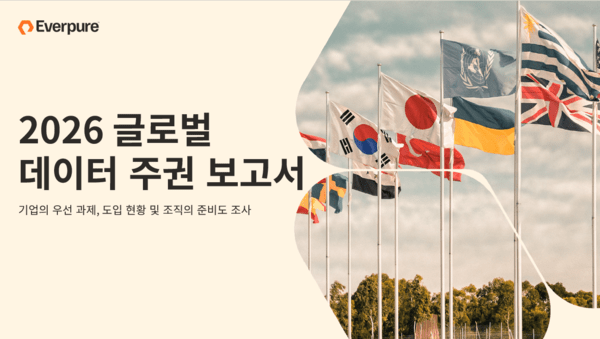
Everpure released the '2026 Global Data Sovereignty Report.' The survey covered 2,100 business leaders in 8 countries, including 200 respondents in Korea. The report compared and evaluated companies' strategic commitment to data sovereignty with their actual operational readiness.
The survey found that 90% of global companies and 85% of Korean companies view data sovereignty as a business issue. It also found an overwhelming majority of respondents expected serious financial damage or executive-level consequences if a data sovereignty issue were to occur.
This awareness was also reflected in vendor selection and service usage. The share of respondents willing to give up some advanced features and performance in order to use local or sovereign vendors stood at 85% globally and 91% in Korea. The share saying they were restricting use of SaaS vendors that rely on infrastructure outside their own country came to 40% globally and 41% in Korea.
By contrast, actual operational readiness showed shortcomings. The proportion operating without an official data sovereignty strategy was 70% for Korean companies and 64% for all companies surveyed. The share that had not achieved full visibility into who can access their data and who can control and manage it was also 62% globally and 60% in Korea.
The survey also pointed to a lack of contingency planning for geopolitical risks, insufficient execution capabilities and resources, and difficulty securing executive support. Overall, 56% of companies said they had no mitigation plan in place for data transfers or service interruptions caused by geopolitical factors, while 53% of Korean companies gave the same response. Another 56% of global companies said they lacked the capabilities and resources needed to carry out data sovereignty initiatives.
There were also many respondents who said it was difficult to secure executive support. 36% of global companies and 41% of Korean companies cited difficulty in winning executive backing. By contrast, only 9% globally and 8% in Korea said protecting data from access by foreign jurisdictions was their top priority.
Everpure said the survey results show a data sovereignty gap between executive risk perception and actual operational readiness. It said many companies treat data sovereignty as a general cybersecurity and compliance issue, and as a result are failing to maintain control over their data. It added that inadequate responses to geopolitical threats could lead to serious consequences.
Kim Ho-jun, country manager of Everpure Korea, said Korean companies rank among the highest in the world in terms of prioritizing data sovereignty, while also pointing out that they lack practical implementation systems. He said 91% of respondents were willing to give up some advanced features to use local or sovereign vendors, but 7 out of 10 companies have no official data sovereignty strategy, meaning Korean companies show strong intent on data sovereignty but lack a concrete strategy for execution. He added that data sovereignty is not just about where data is stored, but also about who can access it, which laws apply, and how business operations would be affected if core services were interrupted. He also said visibility and control must be built in from the design stage, and that this would prevent data sovereignty from becoming a business constraint and help turn it into a competitive advantage.
Source: TECHWORLD · Lee Gwang-jae
Original: https://www.epnc.co.kr/news/articleView.html?idxno=408514
References
This article was produced with the help of an automated content generation algorithm.
Source: TECHWORLD
View originalThis article was summarized and organized by BizCrush based on the original article from TECHWORLD. For exact quotations and full details, please refer to the original article.