What Differentiates Presenters in the AI Era?
TECHWORLD ·
✦ AI Summary
The Canva study said AI has made presentation preparation easier, but 74% of office workers still feel nervous when presenting.
Globally, 91% of office workers create slides with AI every month, and 96% of Korean office workers said they used AI to prepare presentations in the past month.
The survey showed that even as AI use expands, the core of presentation remains human capability such as connection with the audience and the presenter’s presence.
Canva research has introduced a new paradox around presentations. Presentations have long been seen as a core skill for office workers. Advances in AI technology have made presentation preparation easier.
But 74% of office workers said they continue to feel anxious when giving presentations. The study also showed that, even though AI has made presentation preparation easier, many workers still feel nervous about presenting.
Presentations are a key means of communication with customers, team members, and executives. In this context, the simplification of AI-based presentation creation is leading to changes in how presentations are made.
Globally, 91% of office workers were found to create slides with AI every month. The most common use of AI was design at 57%, followed by idea generation at 56% and content drafting at 49%.
Among presenters who use AI, 48% said they save more than 1 hour per presentation. AI is being used to reduce slide-production and preparation time, and that is changing the way presentations are delivered.
The survey found that AI is widely used in the presentation-preparation process among Korean office workers. Of the Korean office workers surveyed, 96% said they used AI to prepare presentations in the past month. Among them, 66% said AI saved them more than 1 hour of work time, and the use of AI was also linked to higher productivity and better work efficiency.
The study also found that AI use for presentation preparation is expanding globally. Canva said more than 100 million people create presentations on its platform every month.
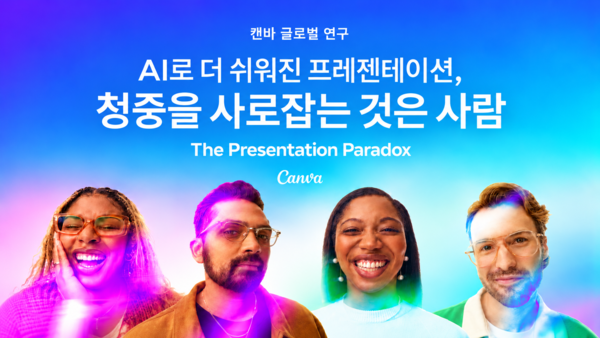
Canva has released a new global study, "The Presentation Paradox," examining how AI presentation tools are affecting the way people work. Against this backdrop, Canva said that even as AI tools spread, human capability remains critical to whether a presentation succeeds.
Ally McKie, Head of Canva Visual Suite, said that while presentation creation has become easier, the key is not the slides but human capability. She added that persuasion, education, inspiration, and driving action still require human skill, and that slides are only a support tool for presentations, not something that requires the presenter to support them. She said that point is even more important today.
The survey found that as AI makes slide creation easier, presentation skill itself is becoming more closely tied to career advancement. According to the findings, the greater ease of making slides with AI has also increased the importance of confident presentation skills for career growth. Globally, 77% of office workers said their presentation confidence over the past year contributed to career growth. Globally, 68% said strong presentation skills are associated with promotions or pay raises. In Korea, 72% said presentation skills are linked to promotions or pay raises, a higher figure than the global number.
AI is changing the entire presentation-creation process. The study found that people are distinguishing between areas where AI can help and areas they want to lead themselves. 51% of presentation creators said they start every presentation with an AI-generated draft. 76% of presenters said they use AI during the preparation process.
However, the actual presentation remains a human domain. 86% of respondents identified connection with the audience and the presenter’s presence as the core of a great presentation. These factors were cited as the reason that human roles remain in place during live delivery even as AI use has spread widely in the creation stage.
The live presentation stage showed a more complex pattern than the preparation stage. The survey found both expanded AI use in the creation stage and a continued human role in actual presentations, while connection with the audience and the presenter’s presence were highlighted as core elements of a presentation.
The survey found that while AI is recognized for helping create materials, the core of trust-building and delivery strength still lies with people. 75% of respondents said humans are still the ones who build trust with audiences. Also, 71% said they trust AI for slide creation, but not for presentations or storytelling.
This perception was the same among Korean office workers. Korean workers cited connection with the audience and the presenter’s presence as the factors that separate a decent presentation from a great one, with 77% saying so. In the end, the findings showed that human connection is important for winning over an audience.
At the same time, as AI lowers the barrier to slide creation, the standard expected of presenters is also rising. The easier it becomes to make slides, the more important actual presentation skill becomes. More than two-thirds of respondents, or 68%, said that if AI-created materials do not fit the actual delivery style, they could have a negative effect on the presentation.
But human connection does not always form naturally. Separate from the belief that connecting with an audience is important, the survey also showed that human rapport does not always happen naturally in real presentation settings.
According to Canva research, many office workers put on a different persona to hide nervousness and lack of confidence. This also pointed to the fact that even if human connection matters in presentations, creating it naturally in practice is not easy for everyone.
In Canva’s presenter confidence survey, 95% of respondents said they intentionally change the way they communicate when presenting, and 85% said they shift into a completely different "Presenter Persona." The rates varied sharply by generation: 94% for Gen Z, 90% for Millennials, and 70% for Baby Boomers.
This switch to a different "presenter self" has helped many people improve their performance. 67% of respondents said they appear more outgoing and confident when presenting, while 53% said they become lower-energy or more introverted, showing that the "presenter self" can also have the opposite effect.
Canva also highlighted the impact of COVID-19 in this survey. The background included years of remote work, continued virtual communication, and fewer opportunities to practice presentations.
The survey found that presentation anxiety and confidence differences by presentation environment varied across generations. 74% said they feel nervous when presenting. Presentation anxiety was 90% among Gen Z and 56% among Baby Boomers.
Confidence also differed depending on the presentation setting. 34% said remote work has weakened their presentation instincts. By contrast, 51% said they feel more confident presenting in front of a screen than in a physical room. This varied by generation: 62% of Gen Z said they feel confident presenting in front of a screen, while the figure for Baby Boomers was 32%.
This confidence gap is tied to presentation skill and was raised as a possible factor that could hinder career growth for some workers. Globally, 80% of office workers viewed in-person presentation skill as a competitive advantage in the AI era. Also, 54% of office workers worldwide said in-person presentation skill suggests leadership potential.
In Korea, this perception was even stronger than the global average. In Korea, 82% viewed in-person presentation skill as a competitive advantage in the AI era. In addition, confident presenters tended to already secure the benefits that come with it.
In Korea, 72% said strong presentation skills are directly linked to pay raises and promotions. Another 72% said presentation confidence directly contributed to career growth over the past year.
Against this backdrop and amid the expansion of remote work, AI is being used as a new rehearsal space. Among office workers worldwide, 53% said they use AI as a presentation coach or to improve delivery skills, while the figure in Korea was 56%.
A U.S. respondent in the Canva study said that ideally AI would give the presentation in their place, and if that is not possible, they would like to receive real-time feedback while practicing.
Source: TECHWORLD · Lee Gwang-jae
Original: https://www.epnc.co.kr/news/articleView.html?idxno=408493
References
This article was produced with the help of an automated content generation algorithm.
Source: TECHWORLD
View originalThis article was summarized and organized by BizCrush based on the original article from TECHWORLD. For exact quotations and full details, please refer to the original article.