AI Pushes Into Marketplace and Search, the Starting Points of E-Commerce
IT DAILY ·
✦ AI Summary
Korean consumers said marketplaces were the starting point for product discovery at 59%, search engines at 20%, and only 7% said they use AI shopping assistants as a primary shopping tool.
Naver launched its AI shopping agent in late February, and in August its average daily conversations were about 5 times higher than in March, while transaction value via the agent was about 4 times higher.
Coupang and Kakao are applying AI to existing shopping processes such as product-description summaries, review summaries, and product analysis and summarization, while surveys showed expectations for reducing the burden of discovery and comparison.
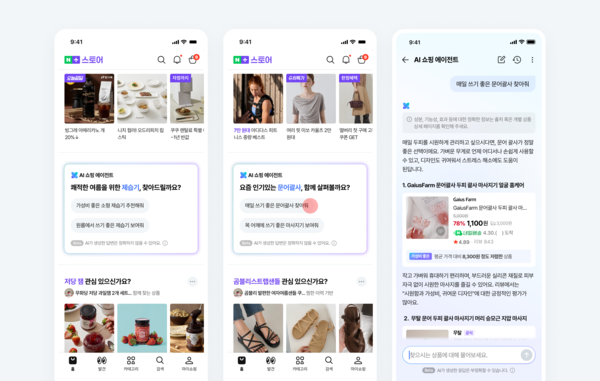
Along with an example image of Naver's AI shopping agent, marketplaces and search engines emerged as the main starting points for consumers browsing products online. E-commerce companies are applying AI to the existing shopping journey and using it to support product discovery and comparison. Naver is using AI for product recommendations and conversational search, while Coupang is suggesting comparable products based on users' browsing history.
This trend is also borne out by a Criteo survey. Criteo surveyed 6,379 consumers across 6 countries, including 1,107 consumers in South Korea, and released its "2026 Commerce and AI Trends Report" in June.
According to the survey, 59% of Korean consumers said they start product discovery on marketplaces, while 20% said they start with search engines. By contrast, just 7% said they use AI shopping assistants as a primary shopping tool.
As AI expands its role by moving into product discovery and comparison on commerce platforms, Naver said a significant share of transactions were coming through AI recommendations. In May, Naver announced that AI recommendations accounted for more than 50% of total transaction value on the Naver Plus Store app for the first time. Click-through rates in the AI recommendation area were also more than 50% higher than in general shopping search results. Naver said AI recommendations have boosted transactions and click-through rates.
Naver launched its AI shopping agent in late February. The AI shopping agent narrows purchase conditions through conversations with users and is designed to infer purchase intent based on product, purchase, search, and content data. In August, the average daily number of conversations with the AI shopping agent was about 5 times higher than in March, while average daily transaction value via the agent rose about 4 times over the same period.
This kind of conversational search has mainly been used for products with many comparison variables. Naver said about 40% of transaction value generated through the AI shopping agent came from digital and home appliances. The company said conversational search is being used for products that need to be evaluated by specifications, features, and intended use, and for categories such as digital and home appliances that involve many comparison factors.
Recommendation features are also expanding beyond users' shopping activity history to incorporate delivery information such as order cutoff times and estimated arrival dates. Based on that, Naver is expanding its proactive conversation suggestion feature for the agent.
Naver is also applying the agent to gift purchases that require consideration of multiple conditions. Regarding the application of the shopping agent to gift-giving, Lee Jeong-tae, leader of Naver Shopping Search & AI, said gift purchases are a high-involvement activity that requires comprehensive consideration of taste, budget, and event context.
Coupang is applying AI to its existing product discovery process. In August, Coupang unveiled "At a Glance Product View," a feature that summarizes the key points of product descriptions.
Coupang also unveiled a feature that summarizes the frequent positive and negative assessments in user reviews. In addition, it applied "AI Infographics" to Rocket Delivery products in major home appliance categories, and "AI Infographics" is a feature that visualizes key product information.
Retail and platform companies are rolling out cases of applying AI to product comparison and discovery stages. In home appliance and digital categories, "AI Product Comparison" has been in operation since early this year. "AI Product Comparison" suggests highly relevant comparison products based on users' browsing history and product information, and organizes each product's features and differences. Comparison information can be checked directly on the product detail page without asking a separate chatbot. However, the announcement did not provide quantitative results such as transaction value or purchase conversion rates by feature.
AI-powered product discovery features have also been applied to gift-giving. When Kakao revamped its gift-giving service in January, it announced that it would pilot AI product analysis and summarization features, focusing on the beauty, food, and health categories. The feature provides product attributes, gift recipient, and purpose tags, and summarizes the product's characteristics and recommended recipients in one line.
These companies' areas of AI application align with the roles consumers expect from AI shopping agents. The explanation is that in the product comparison and discovery stage, filtering and showing relevant products, organizing features and differences, or summarizing recommended recipients are functions that match what consumers expect from AI shopping agents.
Survey results backing this up have also emerged. Embrain Trendmonitor conducted an "awareness survey on AI shopping agents" among 1,000 men and women aged 19 to 69 nationwide, and the survey was released in August. Of respondents, 78.4% said they intend to use AI shopping agents in the future.
The survey responses showed that expectations for AI shopping were mainly centered on reducing the burden of price comparisons and information checks. The most common response, at 44.9%, was wanting to compare prices across multiple sites and search for the lowest-priced products, followed by 35.1% who found it cumbersome to check product specifications and reviews individually. The responses allowed multiple answers. Trendmonitor said this suggests that, rather than wanting to delegate purchase decisions, consumers mainly expect AI to reduce the burden of searching for and comparing purchase information.
By contrast, respondents drew a clear line at leaving everything, including payment and final selection, to AI. In the same survey, 74.0% said a person should make the final payment even if AI services become more convenient, and 68.6% said there will still be areas where people directly choose and purchase products even after AI advances. This reflects consumers' desire to let AI handle discovery and comparison while retaining direct control over final purchase decisions.
Source: IT DAILY · Kim Byoung-ju
Original: https://www.itdaily.kr/news/articleView.html?idxno=242326
References
This article was produced with the help of an automated content generation algorithm.
Source: IT DAILY
View originalThis article was summarized and organized by BizCrush based on the original article from IT DAILY. For exact quotations and full details, please refer to the original article.