SAP Korea to Support ERP and AI Transition at 100 Small and Mid-Sized Companies, Easing Adoption Barriers
TECHWORLD ·
✦ AI Summary
SAP Korea announced the "SAP NEXT 100" program to support ERP adoption and AI transition at 100 domestic small and mid-sized companies.
The program is divided into 8 months of growth diagnosis, system design, ERP implementation, and operational stabilization, and offers a package worth KRW 25 million, special SAP license pricing, and partner support.
Eligible companies are small and mid-sized firms under NICE evaluation information standards that want to adopt SAP Public Cloud ERP, and the selection criteria are growth potential, the need for innovation, and willingness to accept standard processes.
SAP Korea unveiled a plan to support ERP adoption and AI transition for 100 domestic small and mid-sized companies, and announced the "SAP NEXT 100" program at a press briefing held on the 20th at The Forum in IFC, Yeouido, Seoul. SAP Korea said the goal of the support is to ease initial build costs and operating burdens while helping companies establish the management systems needed for growth.
At the event, Hana Bank, PwC Korea, ASPN, and Blueword participated as partners. The four partners introduced cooperation plans in finance, consulting, and ERP implementation.
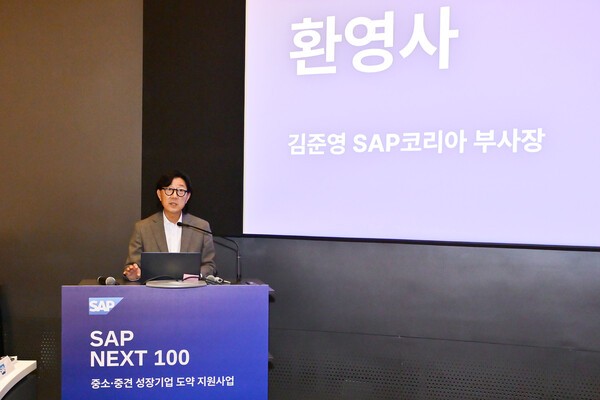
At the briefing, Kim Jun-young, vice president of SAP Korea, delivered the welcome remarks. He stressed the importance of building a digital foundation for companies in their early growth stage, and said that even companies with rapidly rising sales could struggle to attract investment, go public, or expand overseas if they lacked a systematic management system.
In his remarks, Kim said many companies see sales rise quickly thanks to innovative ideas but face difficulties in attracting investment, listing through IPO, and expanding overseas because their management systems are inadequate. He explained that he concluded such problems would be difficult to solve with SAP alone.
Kim said SAP NEXT 100 was developed with partners in the finance, payments, and consulting sectors. Under the program, 100 growth companies will be selected and supported in stages over 8 months.
Next, Kang Ji-hoon, head of SAP Korea's mid-sized and small business client division, explained the background behind SAP NEXT 100 and its main support measures. Kang introduced cases in which companies delayed ERP adoption and later saw their burden increase during growth.
The company Kang cited struggled to determine project-by-project profitability as its business structure became more complex. Monthly closing took about 14 days, and a settlement system that had originally been planned for 6 months ended up taking 1 year and 6 months to complete.
Kang said the reason small and mid-sized companies delay digital transformation is not a lack of awareness of its necessity. He said funding priorities are placed on sales growth, product development, and hiring, while there is also a shortage of personnel to drive digital transformation. He added that as companies expand, the cost of reorganizing existing work and systems rises, and employees also face greater burdens in adapting to new ways of working.
Kang said that when companies grow rapidly, they need to reorganize existing systems and organizations, and that additional costs arise from such rapid growth. He explained that for these reasons, small and mid-sized companies end up putting digital transformation off.
Accordingly, SAP NEXT 100 offers staged support over a total of 8 months: 1 month for growth diagnosis, 1 month for system design, 4 months for ERP implementation, and 2 months for operational stabilization. In addition, it provides a package worth KRW 25 million free of charge, including help with creating a digital transformation roadmap and assessing readiness for AI adoption.
During the ERP implementation phase, the program offers special pricing for SAP licenses and partner support, with benefits worth up to hundreds of millions of won. Kang said SAP had negotiated with global headquarters for more than 1 year to secure the special pricing. However, due to cost conditions, the initial diagnosis is provided free of charge, while separate costs are incurred for ERP implementation and license adoption.
The speaker said SAP NEXT 100 is not intended as an ERP sales promotion program. He said it is a win-win program in which SAP and its partners identify 100 companies with growth potential and support management diagnosis, AI adoption, and the establishment of management systems.
Eligible companies are small and mid-sized firms under NICE evaluation information standards that want to adopt SAP Public Cloud ERP. There are no industry restrictions.
Selection criteria are based on assessments of growth potential, the need for innovation, and willingness to accept standard processes.
A partner discussion was also held on the theme of combining finance, consulting, and ERP implementation and building a foundation for AI use. Four companies — Hana Bank, PwC Korea, ASPN, and Blueword — participated, introducing the background for joining SAP NEXT 100 and each company's support role.
Among them, Hana Bank said it will play a role in linking SAP Business Technology Platform (BTP)-based host-to-host banking services with cloud ERP. Through this, it plans to reduce the burden of developing separate financial systems and improve efficiency in cash management and internal control operations.
Hana Bank said that as small and mid-sized companies grow, the number of branches and overseas subsidiaries increases, while the personnel available for cash management remains limited. Park Tae-jun, head of Hana Bank, said that if an ERP-linked host-to-host banking system is used, a small number of employees can efficiently manage affiliate funds and strengthen internal controls as well.
PwC Korea said it has accumulated consulting experience with large companies and supports ERP adoption by small and mid-sized companies based on its own "Grow Fast" methodology. It also explained that it applies a standardized implementation method to reduce time and costs, and that it is also pursuing a change-management plan to help establish new ways of working after ERP adoption.
Chun Jae-moon, executive director at PwC Korea, said ERP adoption is not simply system implementation but a process of changing and innovating management practices. He added that to maximize investment returns, companies must move away from existing practices and accept standard business processes, and that continuous change management is needed from system implementation through operation.
ASPN is supporting companies in gradually expanding the scope of ERP application based on more than 20 years of SAP consulting experience. The scope of expansion is moving from financial management to logistics, production, and other areas.
ASPN is also pursuing automation of repetitive tasks using AI. Tasks targeted for automation include automatic journal entry creation, expense processing, and inventory discrepancy checks.
Lee Sung-hoon, executive director at ASPN, said growth companies worry about implementation schedules and costs during ERP adoption. He added that based on consulting experience accumulated over more than 20 years, the company plans to propose adoption directions tailored to each company's situation.
Blueword is providing support for cloud ERP implementation and operation, cash management solutions, and linkage with AI agents. Cheon Seok-beom, head of Blueword, explained that developing enterprise systems directly with AI creates additional issues such as data management and access permission settings. He also noted that even when AI is used only to develop the necessary functions, questions of data-sharing scope, governance, and platform implementation arise. In addition, he said many companies face difficulties in the process of simultaneously developing AI agents and SAP systems.
SAP emphasized AI utilization while also stressing a strategy of linking the work data accumulated in ERP with external AI technologies as its foundation. It also raised the point that, as a prerequisite for using AI agents, companies need accurate financial and accounting data and an internal control system. Kang Ji-hoon said ERP's role is to integrate information distributed across departments and connect the work of the entire company.
Kang Ji-hoon also explained that to use AI properly, companies must first build their business processes and data foundation. Under this direction, SAP presented a flow in which data and work systems must be reorganized in advance before AI use.
Under this approach, the first recruitment period for SAP NEXT 100 runs through the 31st, and the second recruitment period begins on the 1st of next month. SAP Korea plans to support growth companies in adopting ERP. It also plans to expand the scope of use into AI, manufacturing, logistics, and other areas in the future.
Source: TECHWORLD · Kim Seung-gi
Original: https://www.epnc.co.kr/news/articleView.html?idxno=408475
References
This article was produced with the help of an automated content generation algorithm.
Source: TECHWORLD
View originalThis article was summarized and organized by BizCrush based on the original article from TECHWORLD. For exact quotations and full details, please refer to the original article.