K-Sign to Unveil EV Charging Infrastructure Security Solution at KOAA SHOW
TECHWORLD ·
✦ AI Summary
K-Sign announced on the 20th that it will participate in the 23rd International Mobility Industry Exhibition (KOAA SHOW).
At the exhibition in Ilsan Kintex from the 21st to the 23rd, it plans to unveil an "EV Charging Infrastructure Security Solution" with vulnerability detection and attack threat verification functions.
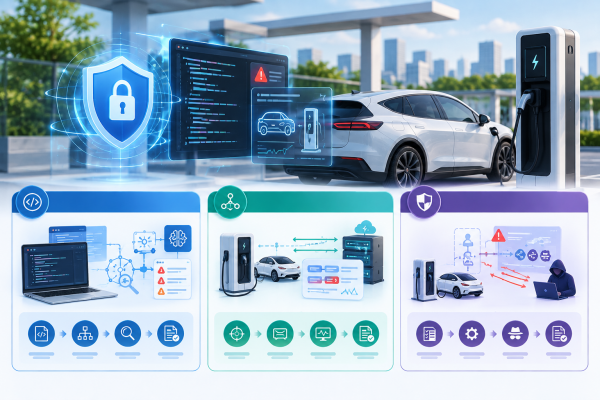
The solution aims to detect potential security threats in EV charging infrastructure and verify actual threat levels, and is composed of software analysis, protocol inspection and attack simulation.
As the adoption of electric vehicles has recently expanded and charging infrastructure has grown, the importance of cybersecurity for related systems has also increased. The need to strengthen security across EV charging infrastructure, where vehicles, chargers, control servers and power grids are all connected, is also rising.
Against this backdrop, K-Sign announced on the 20th that it will participate in the 23rd International Mobility Industry Exhibition (KOAA SHOW). At the event, which will be held for three days from the 21st to the 23rd at Kintex in Ilsan, K-Sign plans to unveil its "EV Charging Infrastructure Security Solution," which features vulnerability detection and attack threat verification functions.
EV charging infrastructure is highly exposed to cyberattacks because it is built on a connected structure involving vehicles, chargers, control servers and power grids. Such attacks can lead to personal data leaks and disruptions in charging services, and could also undermine the stability of local power grids. For that reason, there are calls for stronger security for EV charging infrastructure.
At this exhibition, K-Sign unveiled a solution that was developed as part of the Ministry of Science and ICT and the Institute for Information & Communications Technology Planning & Evaluation (IITP) project, "Information Security Core Source Technology Development Project (Development of Technologies to Respond to Security Threats in EV Chargers)." The solution is designed to identify potential security threats to EV charging infrastructure and verify actual threat levels. It detects potential security threats in charging infrastructure through charging protocol fuzzing and also through AI-based SW code analysis. It also verifies actual threat levels based on BAS (breach and attack simulation). The core technologies consist of three areas: software analysis, protocol inspection and attack simulation.
Among them, the SW vulnerability analysis platform analyzes charging SW source code and binaries, and operates by closely comparing and analyzing them against known vulnerability patterns and 4-channel hybrid similarity. When source code is input, it analyzes the code flow, compares 4-channel similarity, and provides TOP-K similarity explanations, presenting the basis for its judgment through XAI. This makes it possible to detect the same vulnerability even when variable names and code structures differ.
K-Sign plans to demonstrate software analysis and protocol inspection at the exhibition. Among them, the EV charging protocol fuzzer works by altering and sending communication messages to chargers and control servers, while tracking the state machine at each charging stage to automatically detect state-dependent vulnerabilities.
The fuzzing process proceeds in order: it specifies and connects to the target, generates and sends mutated messages, observes the resulting responses and states, and then produces an analysis report. Through this process, it inspects communication and state-based vulnerabilities in chargers and control servers.
Another method is an EV charging infrastructure attack simulation carried out on an EV charging infrastructure testbed. The simulation aims to directly verify vulnerabilities and defensive capabilities by reproducing real attack scenarios. After selecting an attack scenario, it proceeds to agent installation, attack execution and emulation of APT attacker behavior, and produces a defense performance report as the final output.
Kim Seok-hwi, a senior researcher on K-Sign's R&D team, said that as EV charging infrastructure expands, the need to inspect the security of chargers, control servers and charging SW overall is also growing. He added that he hopes visitors will directly see the process of detecting vulnerabilities in charging SW and communication protocols at this exhibition.
Source: TECHWORLD · Kim Hye-jin
Original: https://www.epnc.co.kr/news/articleView.html?idxno=408480
References
This article was produced with the help of an automated content generation algorithm.
Source: TECHWORLD
View originalThis article was summarized and organized by BizCrush based on the original article from TECHWORLD. For exact quotations and full details, please refer to the original article.