Barcode Scanner Hacked as Attack Vector, Potential Logistics Network Attack Path Found
IT DAILY ·
✦ AI Summary
Kaspersky said it confirmed the potential abuse of an attack path in wireless barcode scanners for warehouses through its research.
According to the study, an attacker can obtain a Bluetooth address and send a malicious payload that mimics keyboard input to induce command execution on a PC.
Kaspersky shared the findings at SAS 2026 and recommended verifying new devices, disabling Bluetooth, strengthening authentication, and segmenting networks.
Kaspersky said it confirmed the potential abuse of a cyberattack path in wireless barcode scanners used in warehouses through this study, which it carried out while analyzing attack routes against logistics warehouse infrastructure. The study examined the possibility of sending arbitrary commands to computers connected to scanners via wireless communications, as well as the possibility of infiltrating internal networks.
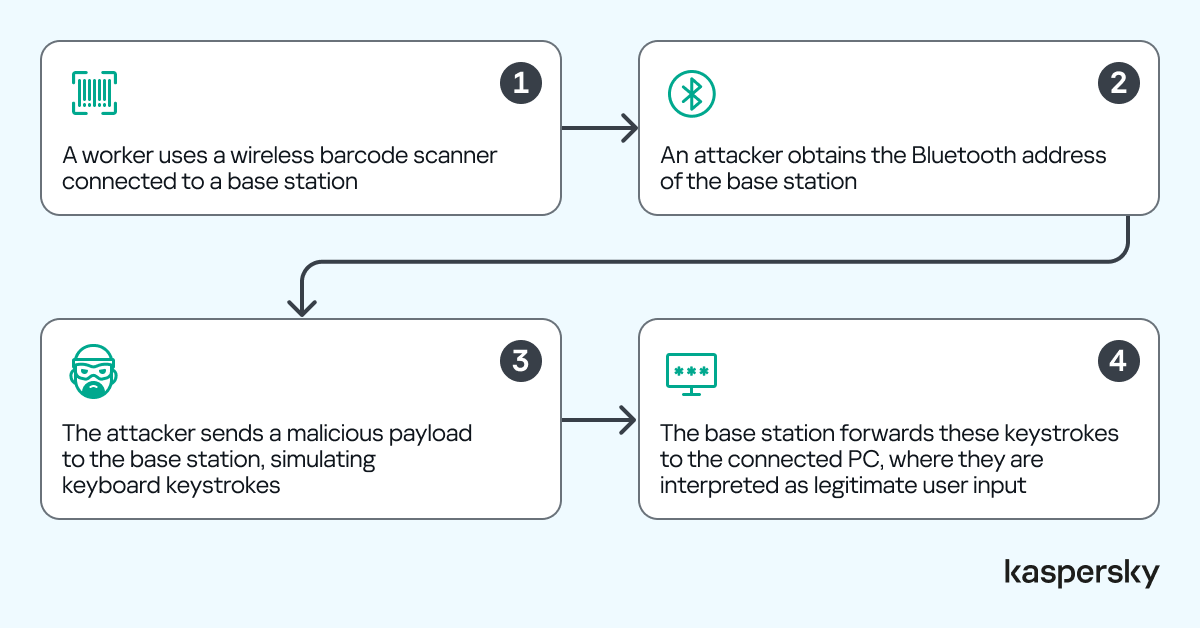
According to the analysis, an attacker can first obtain the Bluetooth address of the connected device and then send a malicious payload that mimics keyboard input. In that case, the connected PC may recognize the input as legitimate user input, making command execution possible.
Kaspersky shared the results of its security assessment of the logistics warehouse digital ecosystem at Security Analyst Summit 2026 (SAS 2026). The event runs from the 20th to the 23rd in Bali, Indonesia.
Kaspersky said its researchers found vulnerabilities in barcode scanner models from major manufacturers. These devices are widely used in warehouses and retail, but Kaspersky did not disclose the specific manufacturers or model names. The core issue identified by the researchers is the absence of an authentication process between the scanner and the base station (connected device).
In warehouse environments, handheld barcode scanners communicate wirelessly with a connected device, which in turn is connected to a work PC or another system. Kaspersky presented an attack scenario in which this connection structure could be abused. An attacker could eavesdrop on Bluetooth communications to obtain the connected device's address, and then, within wireless range, send a malicious payload that mimics keyboard input.
The connected device then relays the received input to the PC, which recognizes it as input from a legitimate user's keyboard. As a result, the command intended by the attacker can be executed. Kaspersky's researchers said they confirmed the possibility of remote code execution without user intervention through the lack of authentication and input spoofing.
Such attack patterns were not limited to a specific product line. The researchers said they observed the same type of pattern across devices from multiple manufacturers. Kaspersky's researchers said they confirmed the possibility of remote code execution through the absence of authentication and input spoofing.
The scope of attacks stemming from barcode scanner vulnerabilities may not be limited to barcode scanners alone. An attacker could take over PCs connected to a warehouse network and use the compromised PC as an initial foothold. That foothold could then be used to access other systems. Because work PCs are connected to key infrastructure such as warehouse management systems (WMS), they could be abused as a path for attack propagation.
Kaspersky analyzed handheld data terminals and thermal printers as devices that could be targeted by similar attack methods. As a result, similar attacks may also be possible against other devices used in warehouses. Beyond logistics, they could pose a potential security threat across industries that use related devices, including retail.
Sergey Sidorov, head of industrial security services at Kaspersky, said that modern retail and logistics industries are digitalized from management platforms to individual devices. He said that in such a broad connected environment, any device can become an entry point for cyberattacks that threaten the entire ecosystem.
The findings from this study also raised the possibility that even a single barcode scanner could become an entry point for an attack. Accordingly, the need to make cybersecurity a top priority across all operational stages of the logistics industry was emphasized.
Kaspersky also recommended verifying new warehouse devices before connecting them to the network. It further advised disabling unused Bluetooth interfaces, establishing a strong authentication framework, and segmenting the network to allow only necessary connections.
It also said security updates for devices and warehouse management systems should be applied promptly. It called for measures to minimize account privileges and suggested that the possibility of insiders with legitimate credentials participating in an attack should also be considered. It also recommended conducting regular drills.
Source: IT DAILY · Kim Ho-jun
Original: https://www.itdaily.kr/news/articleView.html?idxno=242299
References
This article was produced with the help of an automated content generation algorithm.
Source: IT DAILY
View originalThis article was summarized and organized by BizCrush based on the original article from IT DAILY. For exact quotations and full details, please refer to the original article.