Korea Enters AI Pioneers for First Time, Drawing Attention to Model Development and Computing Investment
IT DAILY ·
✦ AI Summary
BCG newly classified South Korea and Japan as "AI Pioneers" in its "AI Maturity Matrix 2026."
South Korea entered the top-tier "AI Pioneers" group for the first time, with its own AI model development, computing infrastructure investment and AI ecosystem investment cited as the reasons.
BCG said South Korea's next challenge is to connect AI readiness to manufacturing competitiveness and business results.
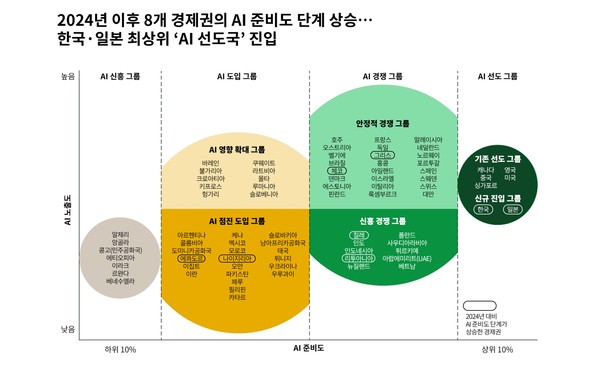
BCG released its "AI Maturity Matrix 2026" on the 20th. The assessment compared AI maturity by analyzing more than 75 economies around the world. BCG newly classified South Korea and Japan as "AI Pioneers," expanding the pioneer group to 7 economies with the addition of South Korea and Japan to the United States, China, the United Kingdom, Singapore and Canada.
South Korea entered the top-tier "AI Pioneers" category for the first time in the BCG AI maturity assessment. BCG said the country's entry into the pioneer group was driven by the development of its own AI models, investment in computing infrastructure and investment in the AI ecosystem. South Korea and Japan were the only economies to newly enter the pioneer group after the first survey in 2024.
BCG said South Korea's next challenge is to connect its higher AI readiness to industrial competitiveness on the factory floor, including in manufacturing. It also said another challenge is translating that higher AI readiness into business results.
South Korea was included in the top 25% group for AI readiness in the 2024 survey and was assessed as ranking just below the pioneer group. The 5 pioneer economies in 2024 were the United States, China, the United Kingdom, Singapore and Canada. BCG cited South Korea's strong performance in developing its own AI models, as well as its pursuit of large-scale public investment in building computing infrastructure and the AI ecosystem.
That assessment is also reflected in figures from Stanford University's Human-Centered AI Institute (HAI) for its "2026 AI Index." South Korea developed 5 "notable AI models" in 2025, while the United States had 50 and China had 30 under the same criteria. South Korea's figure was behind only the United States and China.
However, the Stanford statistics do not constitute a full census of all AI models. The tally covers models selected by Epoch AI, based on technical advances, historical significance and citation counts. In addition, co-developed models may be counted multiple times across countries depending on the authors' affiliated institutions.
BCG classifies economies' conditions for AI adoption by considering both the impact AI will have on the economy and the capability to take advantage of those opportunities. BCG's classification of "AI Pioneers" is based on a combination of "AI Exposure" and "AI Readiness." "AI Exposure" refers to AI's potential impact on industries and jobs, while "AI Readiness" refers to the level at which economies can capitalize on the opportunities AI creates. BCG began evaluating economies' AI adoption conditions in 2024, and its methodology combines these two axes.
The readiness assessment is conducted under the ASPIRE framework. ASPIRE consists of 6 areas: national ambition, talent capability, policy, regulation, investment, research, innovation and ecosystem. The number of readiness indicators in 2026 is 33.
In 2026, 3 additional indicators were added. The new indicator areas are computing capability, domestic AI model development and regulation. As a result, the composition of the readiness assessment framework changed.
For that reason, changes in the groups between 2024 and this year cannot be compared on a completely identical indicator basis. That is because recent factors important to AI competition were added to the assessment framework alongside South Korea's improved AI readiness. BCG said, however, that taking 2024 as the reference point, the readiness type of 8 economies, including South Korea and Japan, improved.
BCG said that, with many countries already having AI strategies, the turning point for national competitiveness lies not in formulating a strategy but in executing it quickly. It identified the main tasks for doing so as securing advanced AI talent, expanding computing, power and network infrastructure, and creating a policy environment that encourages private investment.
In this context, BCG said South Korea's next challenge is to connect its AI base to industrial competitiveness and business results. Hwang Hyeong-jun, head of BCG Korea, also said a key task for Korean companies is to turn existing foundations into industrial competitiveness and business performance.
At present, AI's impact is concentrated in knowledge-based industries such as information and communications and financial services. However, the report said its scope is expected to widen with the development of physical AI, citing humanoid robots and industrial automation as examples of physical AI. Manufacturing, logistics and agriculture were identified as sectors where application is expected to expand.
Hwang Hyeong-jun, head of BCG Korea, said South Korea's strengths include a globally competitive manufacturing base and data and operating know-how accumulated on the industrial floor. Based on that, he said the country can seek new growth opportunities in industrial AI and physical AI.
The report divided the components of AI sovereignty into 4 categories: semiconductors, computing and cloud, AI models and applications. It also noted that economies that independently secure all 4 elements are very rare.
Accordingly, it suggested that each country needs to make strategic choices between building its own capabilities and securing supply through global cooperation. It also said that as AI spreads, the government's role is expected to expand from facilitating technology adoption to managing economic and social impacts. BCG identified changes in employment, social trust and resource demand as management tasks for governments in this regard.
Source: IT DAILY · Kim Byung-joo
Original: https://www.itdaily.kr/news/articleView.html?idxno=242327
References
This article was produced with the help of an automated content generation algorithm.
Source: IT DAILY
View originalThis article was summarized and organized by BizCrush based on the original article from IT DAILY. For exact quotations and full details, please refer to the original article.