BCG Says Korea Has Joined Top-Tier “AI Pioneer” Group
TECHWORLD ·
✦ AI Summary
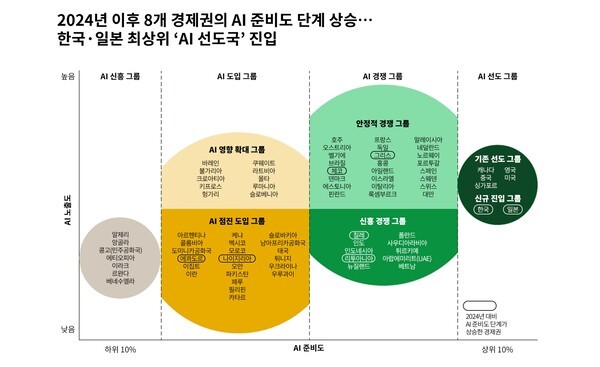
BCG said it has released "The AI Maturity Matrix 2026" covering more than 75 economies and classified Korea as a top-tier "AI Pioneers" economy alongside the U.S., China, the U.K., Singapore and Canada.
BCG said Korea was among the economies newly entering the AI Pioneers group since the first survey in 2024, with only Korea and Japan added.
BCG cited Korea's in-house AI model development, large-scale public investment in computing infrastructure and the AI ecosystem, and its top-five global ranking in the notable AI model development category of Stanford HAI's "2026 AI Index."
Boston Consulting Group (BCG) said it has released "The AI Maturity Matrix 2026," which covers more than 75 economies, and classified Korea alongside the U.S., China, the U.K., Singapore and Canada as a top-tier "AI Pioneers" group.
According to BCG, Korea was among the economies newly added to the AI Pioneers group since the first survey in 2024. BCG said only two economies, Korea and Japan, have newly entered the AI Pioneers group since that first survey.
BCG said Korea's entry into the AI Pioneers group was driven by its strong performance in developing its own AI models. It also said Korea is pushing ahead with large-scale public investment to build computing infrastructure and the AI ecosystem.
Korea was also cited as ranking in the global top five in the notable AI model development category of Stanford HAI's "2026 AI Index." BCG said it announced Korea's entry into the AI Pioneers group based on those factors.
The report examined AI maturity across economies using two criteria: "AI Exposure" and "AI Readiness." "AI Exposure" refers to the potential impact of AI on key industries and jobs, while "AI Readiness" refers to the level of readiness to use the opportunities created by AI.
AI Readiness was analyzed through the "ASPIRE" framework. "ASPIRE" consists of six areas: national goals, talent capabilities, policy, regulation, investment, research and innovation, and ecosystem.
The survey found that nearly all economies made progress in at least one of the six AI Readiness areas. Eight economies, including Korea and Japan, saw their AI Readiness assessment level rise from 2024.
According to BCG analysis, AI strategy formulation has become commonplace in most economies. BCG said the speed of execution that connects strategy to actual AI capabilities and economy-wide change has emerged as a key factor in countries' AI competitiveness.
The report identified the core of AI competitiveness in the link between policy execution and industrial transformation. Jorg Hildebrandt, BCG's global leader for the public sector and a coauthor of the report, said this year's cases of economies with improved AI Readiness confirmed that government execution capability is key to turning AI strategy into tangible capability. He said economies that secure competitiveness in the future will be those that accelerate the AI transformation of key industries, and added that securing competitiveness requires both securing advanced AI talent and expanding private investment.
The report analyzed that AI's current impact is concentrated in knowledge-based industries such as information and communications and financial services. It then projected that, as physical AI develops, AI's impact will spread to physical industries such as manufacturing, logistics and agriculture. Examples of physical AI included humanoid robots and industrial automation.
Against this backdrop, the report said Japan and China are focusing on strengthening physical AI capabilities based on their strengths in manufacturing and industrial robots.
Hwang Hyung-jun, CEO of BCG Korea, said Korea's newly entering the global AI Pioneers group proves meaningful progress in AI capabilities and ecosystem building. As a challenge for Korean companies, he pointed to connecting existing foundations to industrial competitiveness and business results.
He said Korea has a manufacturing base with global competitiveness, as well as accumulated data and operational know-how on the industrial front lines. He added that combining that manufacturing base, data and know-how with AI could create growth opportunities in industrial AI and physical AI. He also stressed that AI transformation goes beyond simply introducing technology; it is a process of redesigning core work and reorganizing how organizations operate. He said Korean companies need to apply AI quickly on site and focus on the ability to connect AI adoption to actual results.
BCG also outlined four major strategies for economies rapidly improving AI Readiness. It cited securing strategic capabilities through global partnerships, removing bottlenecks in AI infrastructure such as computing, power and networks, securing and developing AI specialists, and creating a clear policy environment to encourage private investment.
The report listed semiconductors, computing and cloud, AI models and applications as the components of AI sovereignty. It also assessed that it is extremely rare for an economy to independently secure all four AI sovereignty elements. Accordingly, it suggested that countries need strategic choices between capabilities they can secure on their own and those they can obtain through global partnerships.
The report called for a greater government role as AI diffusion accelerates. It said the government's function must go beyond facilitating technology adoption, and that the focus of its role should shift from promoting adoption to managing economic and social impacts. Those impacts include job changes, social trust and resource demand.
Source: TECHWORLD · Lee Gwang-jae
Original: https://www.epnc.co.kr/news/articleView.html?idxno=408474
References
This article was produced with the help of an automated content generation algorithm.
Source: TECHWORLD
View originalThis article was summarized and organized by BizCrush based on the original article from TECHWORLD. For exact quotations and full details, please refer to the original article.