Samsung's First Clip-On 'Buds On' Uses Two Woofers to Boost Bass
IT DAILY ·
✦ AI Summary
Samsung Electronics has released its first clip-on wireless earphones, the Galaxy Buds On.
Buds On features a clip-on structure that hooks onto the ear and an open design that does not block the ear, and it also includes bass reinforcement and noise leakage reduction technology.
The product was unveiled on the 1st of this month and will be released domestically on the 27th, with black as the only color and a price of KRW 299,000.
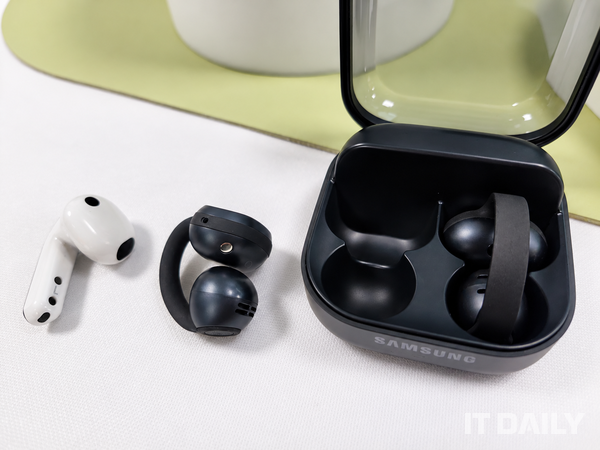
Samsung Electronics has released its first clip-on wireless earphones, the Galaxy Buds On. As the first clip-on product in the Galaxy Buds series, Buds On features a clip-on structure that hooks onto the ear and an open design that does not block the ear. To achieve a comfortable fit with the open clip structure, Samsung Electronics used about 190 million ear-related data points in designing the wearing structure. It also reinforced bass, which can weaken with an open design, with two woofer speakers, and applied noise leakage reduction technology for the first time in the Galaxy Buds series.
Samsung Electronics held a domestic media briefing on the 20th and introduced the development process and key technologies of Buds On. The briefing explained the background behind the development of Buds On and its core technologies.
Buds On was unveiled on the 1st of this month and will be released domestically on the 27th. It comes in black only and is priced at KRW 299,000.
Unlike existing Buds models that are inserted into the ear, Buds On has a clip-on structure that hooks onto the ear with front and rear units. Because it does not block the ear canal, it was designed so users can remain aware of surrounding sounds even while listening to music.
Samsung Electronics cited long-duration earphone use in situations such as running and the office, where awareness of surroundings matters, as a key use case for Buds On. Because Buds On does not support ANC, outside sounds can enter in high-noise environments such as subways.
A Samsung Electronics official explained that in-ear models are better suited for blocking outside noise and immersing users in music. Accordingly, Buds On is intended for environments where awareness of surroundings is more important than noise isolation.
Samsung Electronics applied an acoustic design differentiated from the Buds4 Pro to compensate for the possibility that the distance between the speaker and the eardrum in a clip-on design could weaken low-frequency expression. For that purpose, it introduced a "Twin Boost Speaker" that uses two identical woofers, and also applied noise leakage reduction for the first time.
The Buds4 Pro and Buds On have clearly different acoustic designs. The Buds4 Pro consists of one woofer and one flat-panel tweeter, with the woofer handling bass and the flat-panel tweeter handling treble. Buds On, by contrast, is made up of two woofers.
Buds On was designed with a focus on reinforcing the bass range, which can be weakened in a clip-on form factor. It also addresses the possibility of sound leakage that can occur because of its non-sealed structure, which does not close off the ear.
Buds On is the first in the Galaxy Buds series to apply Audio Leakage Reduction technology. A Samsung Electronics official said the two grooves on the back of the product are designed to reduce sound leakage. However, it is impossible to block leakage completely. Samsung Electronics explained that some sound may leak outside depending on playback volume, ear shape, ambient noise and wearing condition, and that leakage may be more noticeable in quiet environments.
Buds On also supports a function that automatically adjusts playback volume in response to surrounding noise. When ambient noise increases, the function gradually raises the volume, and when the surroundings become quiet again, it returns to the previous volume level.
The product is equipped with three microphones for calls to improve call quality. It also uses a bone-conduction-based vibration sensor for call functions. This vibration sensor detects vibrations generated by the user's speech.
It also combines machine learning technology with the call function. The name of the related technology is "Intelligent Clear Call." The technology separates the user's voice from background noise. The separated user voice is then delivered to the other party.
At the same time, the product was designed to address both comfort and stability, which are seen as challenges for clip-on designs. Behind these challenges is the fact that ear shapes differ from person to person. It also reflects the need for stable fixation even during movement, since it is not an in-ear product.
A Samsung Electronics official said the wearing structure was designed using about 190 million ear-related data points. Simulation was also conducted with 4D-computing-based AI optimization technology. The simulation results were reflected in adjustments to the structure and placement of internal components such as the battery, speaker and wires.
The ear contact area was designed with attention to contact surface area and pressure distribution. Shape-memory alloy was used for the band connecting the front and rear units. This shape-memory alloy has the property of flexibly moving according to the shape of the ear. This allows the product to be worn stably without being pushed deeply into the ear.
Samsung Electronics' Galaxy Buds On weighs 6.65g per earbud. The Buds4 weighs 4.6g, meaning Buds On is heavier than Buds4.
Buds On has an IP54 dust and water resistance rating. Music playback lasts up to 9.5 hours on a single charge, and up to 38 hours including the charging case.
The Buds4's music playback time is up to 6 hours with ANC off and using the earbuds alone, and up to 30 hours including the charging case. However, because Buds On and Buds4 differ in wearing structure, comfort cannot be judged by simple weight comparison alone.
Buds On can be worn without distinguishing between the left and right earbuds. Built-in accelerometers detect the direction of gravity and determine which ear is being worn, automatically assigning the left and right channels.
When connected to a smartphone or tablet that supports Galaxy AI, users can summon Gemini Live by voice. The photo shows Samsung Electronics' Galaxy Buds On linked with a Galaxy smartphone.
Buds On also recognizes head movement through "head gestures." Nodding can accept a call, while shaking your head can decline one.
The Galaxy Buds On supports "Quick Voice Memo." Users can use it by pressing and holding the touch area on the back of the earbud and then speaking, and what they say is saved immediately. The saved content can be searched through Bixby.
Nam Hyun-jung, a pro on Samsung Electronics' MX Division Wearable Product Planning Group, said that more users have recently been wanting to listen to surrounding sounds while enjoying content. She added that Galaxy Buds On was planned with that use case in mind and is a product that aims for comfortable audio listening without blocking the ears.
Source: IT DAILY · Kim Byeong-ju
Original: https://www.itdaily.kr/news/articleView.html?idxno=242310
References
This article was produced with the help of an automated content generation algorithm.
Source: IT DAILY
View originalThis article was summarized and organized by BizCrush based on the original article from IT DAILY. For exact quotations and full details, please refer to the original article.