AWS Lowers the Barrier to Trainium With PyTorch Code
AI TIMES ·
✦ AI Summary
According to AI TIMES, AWS will unveil on October 20 an open-source software called "TorchNeuron" that lets AI models based on PyTorch run o…
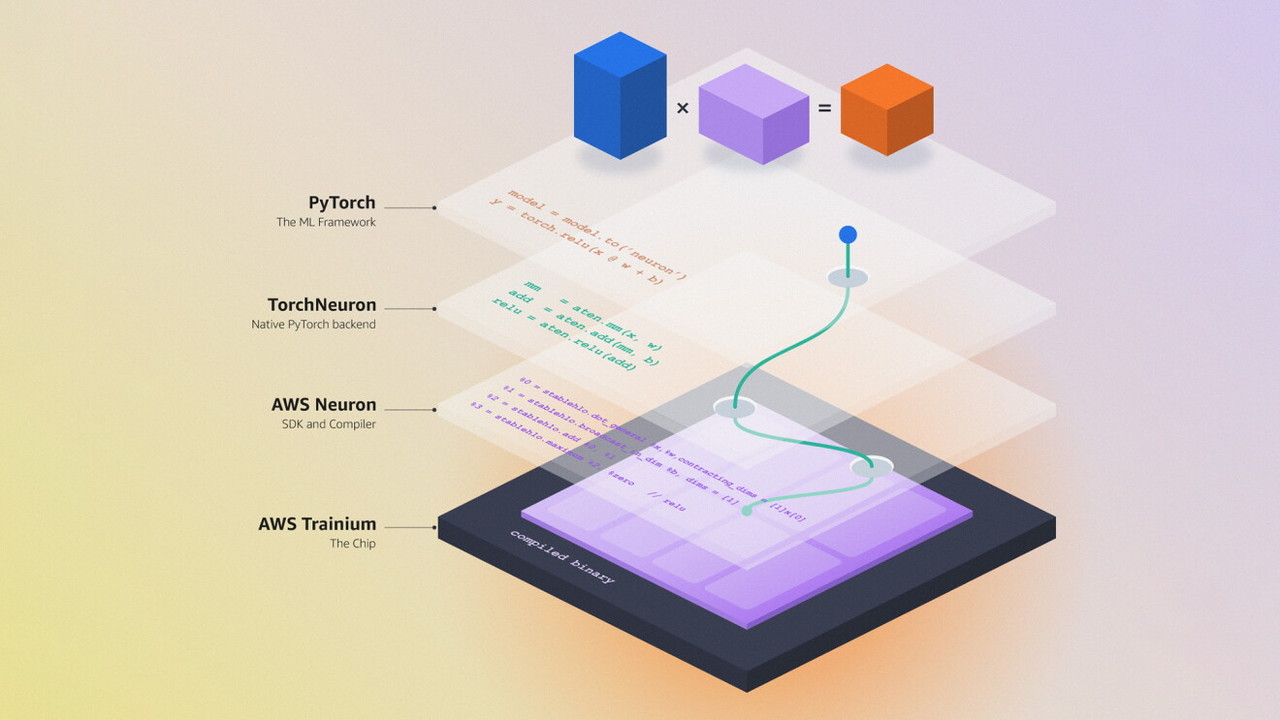
According to AI TIMES, AWS will unveil on October 20 an open-source software called "TorchNeuron" that lets AI models based on PyTorch run on its in-house Trainium chips without rewriting code. Amazon’s goal is to reduce the burden of switching hardware by allowing existing workloads to be moved with only configuration changes in the PyTorch environment used by about 85% of AI researchers and developers. The key is that it minimizes separate porting work for the new chip while preserving existing testing, debugging, and validation workflows as much as possible. That could help startups save development time and give large infrastructure operators more room to use their existing resources. The use cases are also expanding into compute-intensive fields such as voice AI, world models, autonomous driving, and drug development. In the end, the release shows that competition in AI semiconductors is shifting from chip performance alone to whether developers can keep using the tools they are already familiar with.
Perspective
The significance of this issue does not stop at making a specific piece of hardware easier to use. When development teams move to a new environment, one of the biggest considerations is not just chip price, but the time required for porting and validation, as well as the risk of failure. This approach is an attempt to reduce that friction and change the basis for choosing hardware. If this trend takes hold, developers will be less tied to a single platform, and hardware vendors will have to compete not only on performance but also on ecosystem compatibility and ease of transition. In the end, it can be read as a signal that the battleground in the AI infrastructure market is expanding from semiconductor spec sheets to the overall developer experience.
This perspective is BizCrush's own commentary and is not part of the reporting by AI TIMES.
This article was produced with the help of an automated content generation algorithm.
Source: AI TIMES
View originalThis article was summarized and organized by BizCrush based on the original article from AI TIMES. For exact quotations and full details, please refer to the original article.