Data Built Through Product Sales Is Turning Into Ad Revenue
IT DAILY ·
✦ AI Summary
Retail and e-commerce companies are monetizing purchase data accumulated during product sales as advertising revenue.
Domestic online shopping transaction value rose from KRW 242.2068 trillion in 2023 to KRW 262.4256 trillion in 2024 and KRW 274.9442 trillion in 2025, with growth rates of 8.3% in 2024 and 4.8% in 2025.
E-Mart is expanding RMN and Media Cube, while Naver is combining search, view, save, and purchase data with AI for advertising.
Retail and e-commerce companies are turning purchase data accumulated through the product sales process into advertising revenue. E-Mart is using store visit data and actual purchase data for advertising, while Naver is using online behavior data such as searches, product views, saves, and purchases for ad targeting. In advertising cases as well, ad spending is concentrating on commerce platforms where product sales are robust.
The online shopping market continues to expand. Based on the National Data Service, domestic online shopping transaction value rose from KRW 242.2068 trillion in 2023 to KRW 262.4256 trillion in 2024 and KRW 274.9442 trillion in 2025. However, the annual growth rate of domestic online shopping transaction value came in at 8.3% in 2024 and 4.8% in 2025.
Accordingly, retail and e-commerce companies are expanding their revenue streams through additional businesses beyond product transactions amid slowing growth. The resources they are using for those additional revenue businesses are their existing customers and data.
As consumption shifts online, data for advertising businesses is accumulating. Online product transaction value as a share of total retail sales rose from 28.5% last year to 30.0% in the second quarter of this year. As consumer search, browsing, and actual purchase history data accumulate, they are becoming the foundation of the RMN business.
RMN uses consumer search, browsing, and actual purchase history to select ad targets and measure ad performance. In particular, it can measure the link between ad exposure and actual purchases. Accordingly, retail and e-commerce companies are using existing customers and purchase data as monetization targets for RMN.
Against this backdrop, E-Mart is operating RMN at many stores. E-Mart has 151 RMN-operating stores, consisting of 127 E-Mart stores and 24 Traders stores. E-Mart's monthly visitors across its online and offline channels number about 30 million. E-Mart's RMN-related revenue in 2025 rose about 20% from a year earlier.
Retailers segment ad targets based on actual purchase history, visit frequency, interest products, and shopping path data. They also measure effectiveness by checking whether customers exposed to ads actually purchased the product.
This process is expanding into cross-channel measurement that checks whether customers exposed to online ads made purchases at offline stores. Ad exposure spaces are also broadening across online and offline channels.
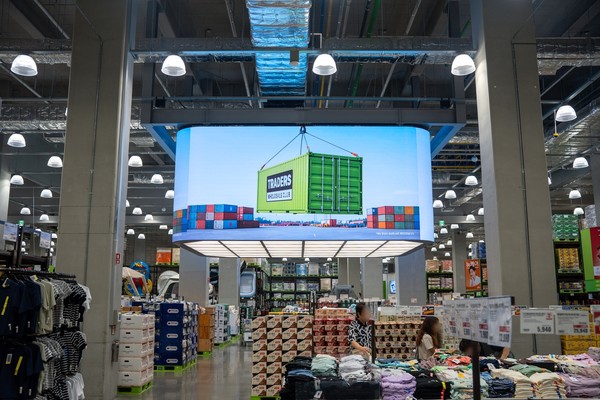
This year, E-Mart installed four-sided large electronic displays, called 'Media Cube,' at six Traders stores in Hanam, Ilsan, Bucheon, Goyang, Wolgye, and Guwol. E-Mart plans to add four more stores in the second half of the year and expand 'Media Cube' to 10 stores by year-end. It is also using in-store digital signage ad inventory and E-Mart app ad inventory, while advancing the build of an RMN platform that integrates online and offline ad products.
Naver accumulates data starting before product purchase. The range of consumer behavior data includes search, content-based product discovery, views, saves, and purchases. The ad data Naver disclosed to this newspaper includes search, product views, save and purchase history, and interest brands, and it uses these for advertising by combining the interest and purchase intent revealed through search terms, product views, and saves with actual purchase history.
Naver offers personalized ads by combining users' search, purchase history, and interest data with AI. AI is applied to ad targeting, ad creative production, and ad operations. Naver said it has confirmed the effect of AI application on ad performance.
This structure aligns with the integration of search, shopping, and payments on a single platform. Information used for advertising is accumulated throughout the purchase process. Naver can verify the viewed products, saved products, and actual purchases of users who search for specific products.
Naver officially launched AI Briefing ads at the end of July. The click-through conversion rate for AI Briefing ads is more than 30% higher than that of existing search ads, and the purchase conversion rate is more than three times higher. Naver's ad revenue in the second quarter of this year was KRW 1.4472 trillion, up 7.5% from a year earlier. Naver said AI accounted for more than 60% of the increase in second-quarter ad revenue.
Sales performance affects how advertisers allocate their budgets. An industry source said that, as a basic principle of the performance marketing market, ad spend is allocated based on the performance of each sales channel and operations are optimized accordingly. As a result, ad spending tends to be allocated according to where revenue is generated.
Advertisers that sell through commerce platform stores have significantly expanded the share and importance of platform advertising over the past two to three years. On the other hand, advertisers that do not have stores on commerce platforms have seen the share and importance of commerce platform advertising remain relatively low. An advertising industry source said that for advertisers with strong sales on Naver and Coupang, there are cases where more than 90% of the ad budget is allocated to those channels.
In this way, ad spend composition varies by sales channel. In particular, in fashion industry cases, when sales are made through multiple channels such as own malls, Naver, Musinsa, and SSG.com, the share of advertising on specific commerce platforms has declined. Instead, when selling across multiple channels, the share of search, SNS, display, and video ads has been high.
An advertising industry source said that advertisers operating with a single commerce platform as their sales channel are extremely rare. Accordingly, as advertisers' sales channels become more dispersed across multiple outlets, reliance on specific platform advertising is decreasing, while the share of other digital ad types continues to rise.
In the overseas retail and e-commerce industry, advertising is emerging as a business pillar separate from the core business. Amazon's advertising services revenue in the second quarter of this year reached USD 19.809 billion, up 26% from a year earlier. Over the same period, third-party seller services revenue was USD 46.78 billion.
Walmart classifies its advertising business as a highly profitable business. In its quarterly report as of the end of July this year, Walmart designated digital advertising as one of its higher margin areas. Over the same period, Walmart's gross margin rose 0.96 percentage point from a year earlier.
Walmart cited tariff refunds and other factors as major reasons for the rise in gross margin, while explaining that the continued growth of high-margin businesses, including advertising, contributed to the improvement in gross margin. Walmart's total advertising revenue for the quarter rose 38% from a year earlier, and Walmart Connect, its U.S. advertising business, increased 43% from a year earlier.
As the retail media market expands, the standards for measuring advertising performance are also changing. The Interactive Advertising Bureau (IAB) and IAB, a global digital advertising industry group, released commerce media guidelines in April this year, and IAB said the market is shifting from a stage of rapid expansion of ad networks to a stage of proving business performance. In line with this shift, IAB and IAB Europe have drawn up guidelines for measuring 'incrementality,' which is the standard for determining the additional effect created by advertising by comparing the expected outcome without advertising and the actual outcome after the ad runs.
Source: IT DAILY · Kim Byoung-joo
Original: https://www.itdaily.kr/news/articleView.html?idxno=242297
References
This article was produced with the help of an automated content generation algorithm.
Source: IT DAILY
View originalThis article was summarized and organized by BizCrush based on the original article from IT DAILY. For exact quotations and full details, please refer to the original article.