Hyundai Motor, Kia Test Level 4 Autonomous Heavy Trucks for Commercialization on Logistics Routes
TECHWORLD ·
✦ AI Summary
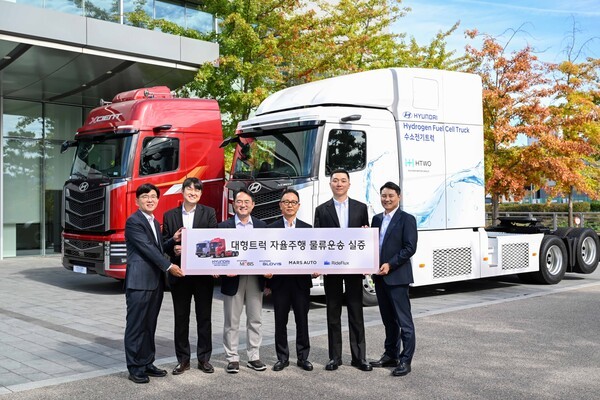
Hyundai Motor, Kia, Hyundai Mobis, Hyundai Glovis, Mars Auto, and RideFlux signed a memorandum of understanding on the "Level 4 Autonomous Truck Logistics Transportation Business Demonstration" at the Namyang R&D Center on the 20th.
The demonstration will deploy Level 4 autonomous heavy trucks on Hyundai Motor Group logistics routes to verify vehicle control technology and autonomous driving system integration performance.
Hyundai Motor and Kia plan to develop 2 specialized demonstration vehicles, including 1 Xcient hydrogen electric truck and 1 Xcient, and deliver them in early next year.
Hyundai Motor and Kia have signed a demonstration agreement with affiliates and partners to pursue the commercialization of Level 4 autonomous heavy trucks. Hyundai Motor, Kia, Hyundai Mobis, Hyundai Glovis, Mars Auto, and RideFlux signed a memorandum of understanding on the "Level 4 Autonomous Truck Logistics Transportation Business Demonstration" at the Namyang R&D Center on the 20th.
Under the agreement, the companies plan to deploy Level 4 autonomous heavy trucks on logistics routes operated by the Hyundai Motor Group. Through this, they aim to verify vehicle control technology and driving stability on actual logistics routes.
The verification items are vehicle control technology and the performance of integration with the autonomous driving system. The goal is to secure driving data needed for commercialization.
Hyundai Motor and Kia plan to develop a total of 2 specialized demonstration vehicles. The vehicles will consist of 1 Xcient hydrogen electric truck and 1 Xcient, and are scheduled to be delivered in early next year. The vehicles will be equipped with customized controllers and vehicle interfaces for linking with external autonomous driving systems.
The full-scale demonstration period will run through the end of next year, and the test will be conducted on 2 logistics routes. Test section 1 is an approximately 100 km mixed highway-urban route, and test section 2 is an approximately 400 km long-distance highway-centered route. The demonstration will verify autonomous driving performance based on real freight transport conditions on 2 logistics routes with different characteristics.
The participating companies will each take on different roles in the demonstration. Mars Auto and RideFlux will apply autonomous driving systems to the demonstration vehicles. Hyundai Mobis and Hyundai Glovis will support the demonstration by utilizing existing logistics routes and operating environments.
Hyundai Motor and Kia plan to carry out their own advanced development work in parallel with collaborations with external autonomous driving software companies. The goal is to secure capabilities for linking autonomous driving systems with vehicle control technology. The focus is not limited to any specific autonomous driving system, and it also centers on accumulating vehicle-based technology that can interface with a range of software.
Data gathered during the demonstration will be used to advance vehicle control technology and safety redundancy technology. Safety redundancy refers to keeping the vehicle in a safe state by having a backup system take over function when some systems malfunction. Such safety redundancy is presented as a core technology for autonomous driving in heavy trucks, which often operate over long distances and at night.
Park Sang-hyun, executive vice president in charge of commercial LCM at Hyundai Motor and Kia, said autonomous trucks are a key future mobility solution that will improve the safety and efficiency of logistics transportation. He said the collaboration will help secure vehicle control technology and operational data for actual logistics environments, and that the company plans to gradually lay the technological foundation for mass production of Level 4 autonomous heavy trucks based on that work.
Hyundai Motor and Kia previously signed a memorandum of understanding with Seoul on the commercialization of Level 4 autonomous city buses and the establishment of an industrial ecosystem on the 1st, and are pursuing the development of specialized vehicles and a control platform. By adding large-truck logistics demonstrations, the company is expanding commercial autonomous driving technology and operational experience spanning buses and trucks.
Source: TECHWORLD · Kim Seung-gi
Original: https://www.epnc.co.kr/news/articleView.html?idxno=408425
References
This article was produced with the help of an automated content generation algorithm.
Source: TECHWORLD
View originalThis article was summarized and organized by BizCrush based on the original article from TECHWORLD. For exact quotations and full details, please refer to the original article.