Cyber Threats Targeting Small Businesses on the Rise, Calling for Security Tailored to Company Size and Budget
TECHWORLD ·
✦ AI Summary
Kaspersky said it had investigated cyberincidents targeting global SMBs over the past year.
86% of SMBs worldwide were found to have experienced at least one cyberincident over the past year.
The main threats were phishing attacks, exploitation of software vulnerabilities, large-scale malware attacks, ransomware and attacks targeting AI vulnerabilities.
Kaspersky said it had investigated the main damage and attacks in global SMB cyberincidents over the past year. The survey targeted IT and IT security professionals at small and midsize businesses (SMBs), and it found that the risk of cyberattacks against SMBs has increased.
Survey results showed that 86% of SMBs worldwide experienced at least one cyberincident over the past year. The same survey also found that 86% said they had experienced at least one cyberincident over the past year.
The main threats cited were phishing attacks, exploitation of software vulnerabilities, large-scale malware attacks, ransomware and attacks targeting AI vulnerabilities. Kaspersky said these attack methods were identified as major threats that increased losses for global SMBs.
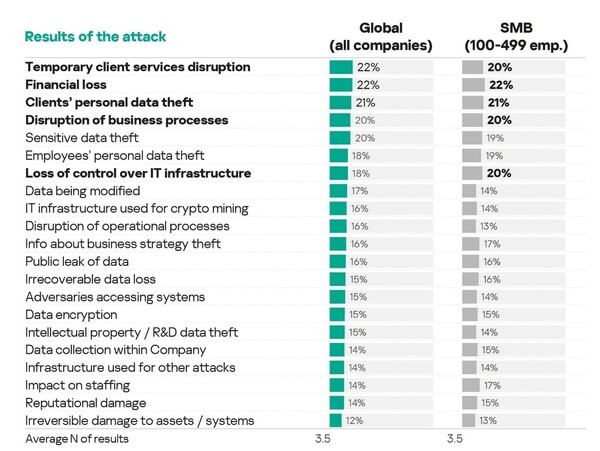
The most serious losses were financial, accounting for 22%. Some losses were also irreversible: 16% of companies said they experienced irrecoverable data loss, and 13% said they suffered irreparable damage to company assets.
Looking at the main types of losses companies experienced, about 1 in 5 said customer data had been stolen. About 1 in 5 also said customer-facing services such as websites and online stores had been temporarily disrupted. The share reporting a loss of control over IT infrastructure was also about 1 in 5, and about 1 in 5 said their overall business processes had been interrupted.
Kaspersky said attackers are focusing on data exfiltration. The purpose of the data theft was to secure data that could be used later for financial gain or additional attacks.
The most frequently targeted information was customer data, at 32%. That was followed by sensitive internal information such as financial credentials and legal documents, at 28%, then employee credentials, at 25%, and business strategy, at 23%.
Attacks targeting SMBs were concentrated on IT and IT security departments. Among the most serious attacks, 50% targeted IT departments and 46% targeted IT security departments. Accounting and finance departments were the third most frequently targeted, at 24%. In the most serious cyberincidents, an average of three departments were compromised at the same time.
Ilya Markelov, head of the integrated platform product line at Kaspersky, said the severity of losses from cyberincidents can be greater for SMBs than in well-known security breaches at large companies. He explained that cyberincidents can even threaten the survival of companies with limited resources.
He added that SMBs face the challenge of responding to a range of high-intensity threats, operational constraints and each company's growth goals at the same time. He stressed that the security needed by SMBs must be scalable and designed for specific purposes.
Kaspersky offers a range of security solutions. Its offerings include Kaspersky Next Optimum, Kaspersky Small Office Security Premium and Kaspersky Automated Security Awareness Platform.
Lee Hyo-eun, head of Kaspersky's Korea office, said that as digital transformation continues among Korean SMBs, limited security budgets and operating staff can become vulnerabilities that make them easy targets for cyberattackers. She added that rather than relying on individual security measures, companies need to establish a security framework suited to their size. She also stressed the need to apply technical defenses, access controls and employee security awareness training together, and to mitigate the serious risks caused by cyberincidents through such measures.
Source: TECHWORLD · Kim Hye-jin
Original: https://www.epnc.co.kr/news/articleView.html?idxno=408421
References
This article was produced with the help of an automated content generation algorithm.
Source: TECHWORLD
View originalThis article was summarized and organized by BizCrush based on the original article from TECHWORLD. For exact quotations and full details, please refer to the original article.