Gbike: 83.1% Say Daily Life Would Be Disrupted if Shared Mobility Disappeared
TECHWORLD ·
✦ AI Summary
Gbike conducted a survey in September of 332 citizens who had used its service on the impact of the absence of shared mobility.
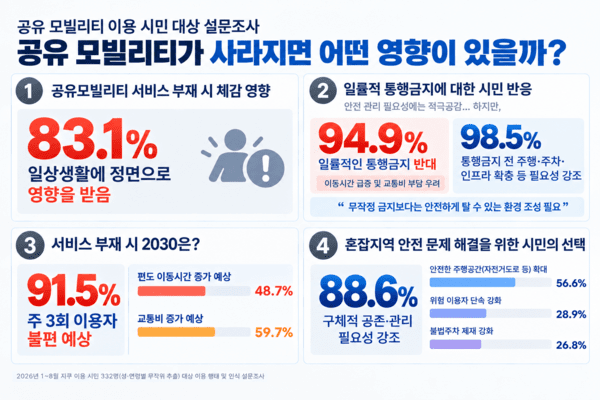
83.1% said daily life would be inconvenient if shared mobility disappeared, and 75.3% said they expected one-way travel time to increase.
For safety measures in congested areas, more respondents chose expanding safe travel space, cracking down on risky users, and strengthening penalties for illegal parking than a blanket ban.
Gbike, the operator of the shared mobility platform GCOO, announced the results of a survey in September on the impact of the absence of shared mobility among citizens who had used its service. The survey was conducted among 332 citizens who had used the service from January to August this year.
The survey found that respondents expected disruptions to daily life, such as longer travel times and higher transportation costs, if shared mobility use were restricted. 83.1% said daily life would be inconvenient if shared mobility disappeared. By degree of inconvenience, 45.5% said it would be 'slightly inconvenient,' 25.3% said it would be 'quite inconvenient,' 9.9% said it would be 'quite difficult,' and 2.4% said it would be 'so difficult that it would be hard to maintain daily life.'
75.3% said that if their current shared mobility routes were replaced by other modes of transportation, their one-way travel time would increase.
Walking ranked first as the alternative mode of transportation at 47.6%. It was followed by buses and subways at 26.8%, and taxis at 10.2%.
The results showed that respondents were more likely to choose improvements such as separate travel space, parking management, and crackdowns on risky users rather than simply blocking the service itself as a solution to safety issues in congested areas. According to Gbike's announcement, 88.6% of respondents chose separate travel space, crackdowns on risky users, and illegal parking management over a blanket ban as safety measures in congested areas. In detail, 56.6% chose expanded safe travel space such as bike lanes, 28.9% chose stronger crackdowns on risky users, and 26.8% chose tougher penalties for illegal parking.
This perception led to responses that infrastructure expansion for riding and parking, along with stronger enforcement, is needed before traffic bans or device removals. 98.5% said that infrastructure expansion for riding and parking and stronger enforcement are needed rather than traffic bans or device removals.
This trend was similar among users in their 20s and 30s. Among respondents in their 20s and 30s who use shared mobility at least three times a week, 91.5% said inconvenience would be expected if the service disappeared, and 51.1% said it would be difficult to maintain daily life.
Respondents saw a high likelihood that transportation costs and travel times would rise if shared mobility use were restricted. 59.7% expected transportation costs to increase. 48.7% expected one-way travel time to increase by at least 10 minutes, and 13.6% expected it to increase by at least 20 minutes.
The distribution of reasons for use showed strong demand for medium- to short-distance travel. The top reason for using shared mobility was that it is suitable for short-distance travel that is too far to walk but too short for other modes of transportation, at 60.5%. It was followed by quick travel at 32.8% and immediate use without waiting or transfers at 28.9%.
Daily mobility needs were also evident in the main purposes of use. The top purpose was traveling to appointments at 33.1%. School commutes accounted for 30.4%, errands such as grocery shopping and hospital visits for 25.6%, and commuting to work for 23.8%. Gbike said this shows that the main role of shared mobility lies in short-distance travel and first- and last-mile connections rather than replacing existing public transportation.
Yoon Jong-soo, CEO of Gbike, said that a binary choice between pedestrian safety and users' mobility rights should be avoided. He said the premise should be to maintain necessary travel. He also said it is necessary to design in parallel safe riding spaces, orderly parking spaces, and clear standards of responsibility.
Source: TECHWORLD · Kim Seung-ki
Original: https://www.epnc.co.kr/news/articleView.html?idxno=408401
References
This article was produced with the help of an automated content generation algorithm.
Source: TECHWORLD
View originalThis article was summarized and organized by BizCrush based on the original article from TECHWORLD. For exact quotations and full details, please refer to the original article.