[Public Project Zoom-In] National Data Office to Overhaul Census System Ahead of Population and Agriculture, Forestry and Fisheries Censuses
IT DAILY ·
✦ AI Summary
The National Data Office is pushing ahead with the "2027 Next-Generation Census Integrated Management System Maintenance Project." The project aims to maintain and improve national census systems used for the Population and Housing Census and the Agriculture, Forestry and Fisheries Census, while supporting advance surveys before the 2029 Household and Housing Basic Survey and the 2030 Population and Housing and Agriculture, Forestry and Fisheries Census. The budget is KRW 1.319 billion, and the project period runs from January 1 to December 31, 2027.
The National Data Office is pushing ahead with the "2027 Next-Generation Census Integrated Management System Maintenance Project." As of the Public Procurement Service's KONEPS portal on the 19th, the project is being pursued.
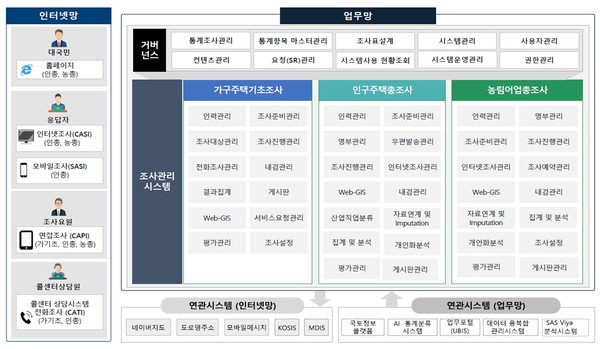
The project aims to maintain and improve the national census systems used for the Population and Housing Census and the Agriculture, Forestry and Fisheries Census. The background for the project cites support for advance surveys before the 2029 Household and Housing Basic Survey and the 2030 Population and Housing and Agriculture, Forestry and Fisheries Census. The source is listed as the overall system architecture diagram for the Population and Housing Census, Agriculture, Forestry and Fisheries Census, and Household and Housing Basic Survey / KONEPS.
The next-generation Census integrated management system established its information system planning (ISP) in 2021 and was built from 2022 to 2024. The system was used in the 2024 Household and Housing Basic Survey and also in the main survey for the 2025 Population and Housing and Agriculture, Forestry and Fisheries Census.
System improvements are under way this year. The benchmark schedule for improvements is the first pilot survey for the 2029 Household and Housing Basic Survey, and the purpose of that first pilot survey is to be used in setting census enumeration districts for the Population and Housing Census.
The National Data Office said that survey items are changing every year. It added that if coordination of schedules with agencies and vendors falls short, there may not be enough time to reflect changes in the system after the questionnaire is finalized. It also pointed to concerns about operating a system based on the latest technology without sufficient analysis. As a result, it said there is a risk of maintenance becoming a patchwork effort.
It also has a schedule in place to focus on the second pilot survey for the 2029 Household and Housing Basic Survey from September to December next year. During the same period next year, it is also scheduled to focus on preparing for and carrying out the first pilot survey for the 2030 Population and Housing and Agriculture, Forestry and Fisheries Census. The National Data Office said staffing shortages during that period are possible.
As part of its response plan, the National Data Office proposed finalizing questionnaire items early. It also proposed reflecting the participation of questionnaire design specialists from the contractor. In addition, it called for establishing a maintenance strategy and staffing plan.
The budget for the project is KRW 1.319 billion. The project period runs from January 1 to December 31, 2027.
The project’s main task is maintenance and improvement of application software. The targets are the governance system in charge of questionnaire design and the integrated management system for personnel, electronic maps, and survey progress management. The collection system covers internet (CASI) surveys, mobile (SASI) surveys, tablet-based face-to-face (CAPI) surveys, and telephone (CATI) surveys. The collection system must be operated according to the pilot survey schedule.
It also includes functional enhancements by survey type. For the Household and Housing Basic Survey, the function will be changed so enumerators can directly designate vulnerable enumeration district types on their tablets; examples of vulnerable enumeration districts include densely packed commercial areas and densely packed foreign resident areas. For the Population and Housing Census, the system will reflect workload changes caused by resignations and task transfers, calculate and display allowances in real time based on the changed workload, and tally the number of nonresponses by enumerator. For the Agriculture, Forestry and Fisheries Census, it will reflect questionnaire changes such as the integration of rice paddy, field, and facility area items and the deletion of sensitive items such as marital status.
As performance standards, the service uptime must be maintained at 99% or higher annually, based on 24 hours a day. The target for user satisfaction is 3.7 or higher out of 5. The user satisfaction survey will cover city, county, and district officials, enumerators, and respondent households.
The National Data Office said this project will serve as a foundation for systematically preparing for the 2029 Household and Housing Basic Survey and for the 2030 Population and Housing and Agriculture, Forestry and Fisheries Census systems, while also helping secure a stable operating environment for those systems.
Source: IT DAILY · Yang Seung-gap
Original: https://www.itdaily.kr/news/articleView.html?idxno=242295
References
This article was produced with the help of an automated content generation algorithm.
Source: IT DAILY
View originalThis article was summarized and organized by BizCrush based on the original article from IT DAILY. For exact quotations and full details, please refer to the original article.