Lablup Pursues Kosdaq Listing in November, Aiming to Lead Enterprise and Sovereign AI Infrastructure Markets
IT DAILY ·
✦ AI Summary
Lablup said at an IPO press conference on the 19th that it would present its growth strategy and vision after its November Kosdaq listing.
The company said it aims to target the global AI infrastructure software market and outlined expansion plans built around its flagship platform, Backend.AI, and its enterprise full-stack platform.
Lablup also highlighted its supply to more than 120 sites in Korea and overseas, experience operating more than 2,000 GPUs, and its planned Kosdaq listing on November 3, along with how it plans to use the offering proceeds.
Lablup held an IPO press conference on the 19th. At the briefing, it presented its growth strategy and vision after a Kosdaq listing. Lablup is pursuing a Kosdaq listing in November.
Lablup outlined plans to ramp up its push into the global AI infrastructure software market. The company said it plans to expand its market reach with its flagship platform, Backend.AI. Backend.AI was presented as a core platform for solving the complexity of AI infrastructure.
Lablup has accumulated large-scale operational validation assets over the past 12 years. The company plans to leverage those assets and Backend.AI to expand in the global AI infrastructure software market.
CEO Shin Jeong-gyu said the AI market is shifting from the "age of science" and the "age of engineering" to the "age of industry." He cited large-scale capital and cost efficiency as the key elements of the "age of industry."
Shin said AI infrastructure differs from conventional CPU-centered infrastructure in both characteristics and operations. He cited GPU-centered high-density computing, the use of heterogeneous accelerators, and constant hardware failures as defining features of AI infrastructure. As a result, he said, the operational difficulty of AI infrastructure is fundamentally different.
Shin said that even a failure or performance fluctuation in a single node can halt training across an entire cluster. He explained that in such an environment, software-based distributed virtualization and orchestration have become core competitive advantages in infrastructure operations.
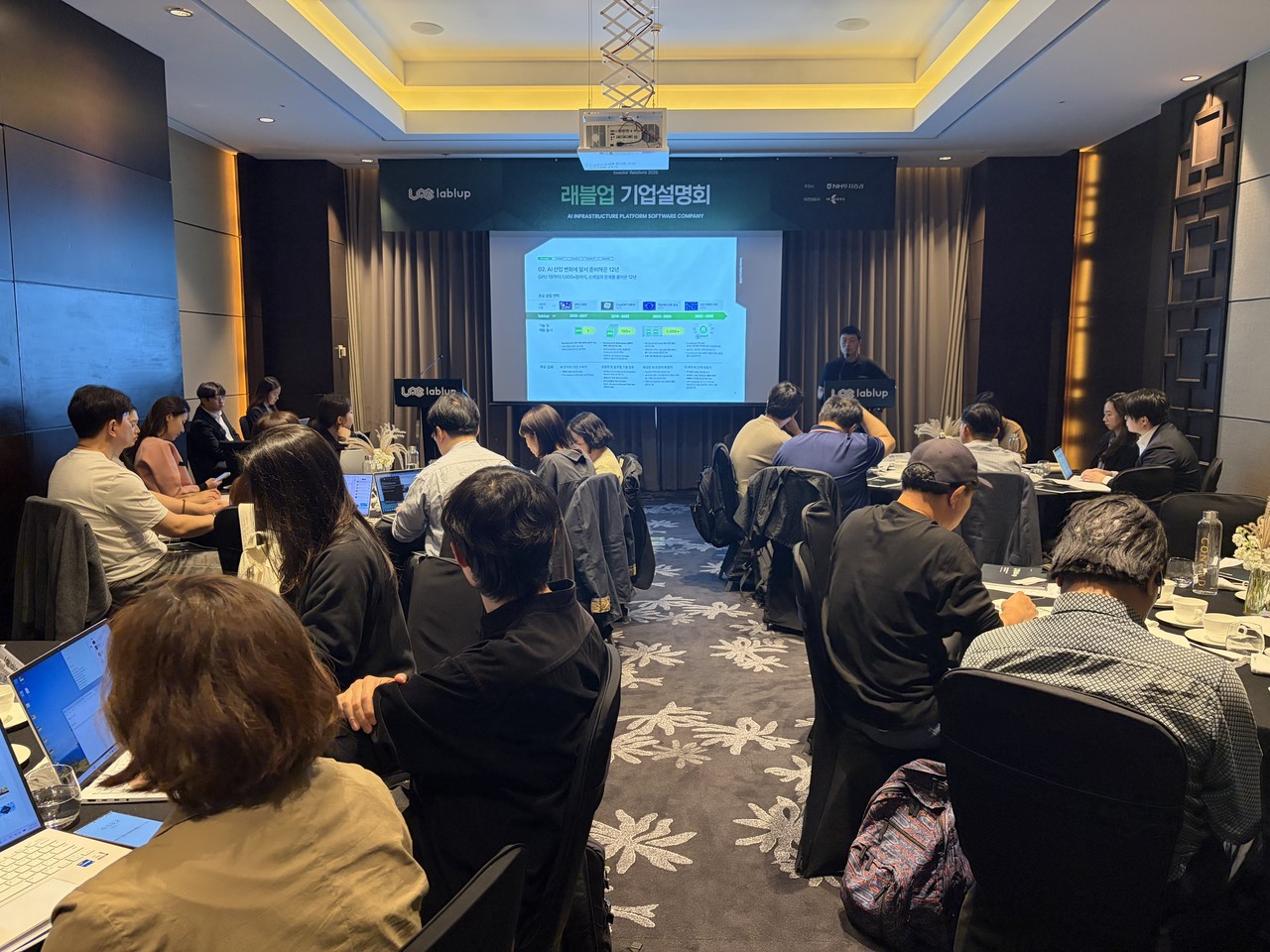
Lablup CEO Shin Jeong-gyu speaks at the event about concerns in some quarters over an AI bubble and overinvestment in infrastructure. The photo is courtesy of Lablup.
Shin explained that Lablup is not an infrastructure leasing operator that buys hardware directly and then rents it back out. He added that Lablup is free from CAPEX volatility risk.
Shin then said that as the pressure to achieve the break-even point (BEP) on hardware investments and to cut costs intensifies, demand for optimization software that maximizes utilization of existing equipment and reduces power and operating costs rises sharply. On that basis, he added, Lablup is positioning itself as both a buffer in the market and a beneficiary of it.
Shin pointed to Lablup's core competitive edge, the enterprise full-stack platform Backend.AI Enterprise Suite, as the foundation of that competitiveness. The platform integrates and delivers accelerator resource management, AI model development and training, inference and serving, and agent and token operations in a single platform.
Lablup said that regarding concerns over an AI bubble and infrastructure overinvestment, it is not an infrastructure re-leasing business model, so it is free from CAPEX volatility risk. The company added that as the burden of hardware investment grows, it absorbs rising demand for software that helps improve the efficiency of existing equipment and reduce power and operating costs.
Lablup highlighted its independently developed GPU partition virtualization (fGPU) and workload orchestrator Sokovan as the core of its technological moat, saying these underpin both integrated accelerator resource management and operational stability. Lablup said it holds partition virtualization patents in Korea, the U.S., and Japan, and that this partition virtualization technology is distinct from vendor lock-in approaches. It also said its management scope is within a single cluster, and that the unified management target includes more than 11 types of accelerators, including Nvidia, AMD, Intel, FuriosaAI, Rebellions, and domestic NPU.
Lablup said it applies its proprietary dual-orchestration structure based on Sokovan to cut recovery time in half in the event of a failure and ensure continuity without work stoppages. In storage virtualization, it is working with Vast Data, Dell Technologies, and Pure Storage, and it said the purpose of that collaboration is to remove data-movement bottlenecks.
Lablup said this technology has already been validated in large-scale real-world environments. The company said it has supplied its platform to more than 120 sites in Korea and overseas and has experience operating more than 2,000 GPUs at a single site. In one case involving Company A, GPU utilization rose from 30% to 85%, GPU utilization improved 2.8 times, wait times were cut from 2 days to under 2 hours, and the budget was reduced by 40%.
Lablup said it participated in the government's "Independent AI Foundation Model Project" as a partner in the Upstage consortium. In that process, it completed 73 days of uninterrupted continuous training using an Nvidia B200 cluster environment with 504 units. The original estimate for the pretraining period was 120 days, but in practice the pretraining period was shortened by 66 days. As a result, it achieved a reduction of about 40% in the pretraining period.
Lablup CEO Shin Jeong-gyu presented this information at the event. The photo was taken by reporter Kwon Young-suk.
After its Kosdaq listing, Lablup plans to accelerate its expansion into global markets and also speed up product-line expansion. Its target market includes a total of 163 companies, including neoclouds and sovereign neoclouds. The direction of product expansion was presented as data center to edge and GPU to token.
For overseas expansion, it has formed partnerships with Insight and AMAX in the U.S. and with BOSTON in the U.K. In Singapore, it is pursuing partnerships with PTC System and Knovel. It is also working to expand indirect sales channels through cooperation with large local SI firms and resellers.
On the product side, AI:GO provides solutions supporting PC and on-device AI environments, and through this the company is expanding its execution scope to edge devices. Continuum Router handles AI model request optimization and automatic routing, while Continuum Hub is responsible for token metering and billing management by user. Continuum Suite, which combines Continuum Router and Continuum Hub, is currently in operation.
As its future integrated product roadmap, the company presented Lablup Token Factory Suite. Through this, it plans to provide an integrated offering covering the full process of AI infrastructure operations, model serving, token usage management, and cost management.
Lablup's total number of shares to be offered is 2.18 million. The expected offering price range per share is KRW 19,000–22,000, and the total amount to be raised is KRW 41.4–48 billion. The expected market capitalization after listing is KRW 276.3–320 billion. The largest shareholder and key executives have set voluntary lock-up periods of 2 to 3 years in addition to the 1-year mandatory holding period under the rules. Proceeds from the offering will be used to build a "hardware validation farm" for verifying compatibility with new accelerators, expand global bases, and advance R&D.
Bookbuilding closes on the 19th. General subscriptions will be held on the 22nd and 23rd. The company is scheduled to list on the Kosdaq market on November 3, and NH Investment & Securities is the lead underwriter.
Source: IT DAILY · Kwon Young-suk
Original: https://www.itdaily.kr/news/articleView.html?idxno=242290
References
This article was produced with the help of an automated content generation algorithm.
Source: IT DAILY
View originalThis article was summarized and organized by BizCrush based on the original article from IT DAILY. For exact quotations and full details, please refer to the original article.