Funjin Expands Defense AI Field Validation and R&D Results, Demonstrates Capabilities at Army TIGER Training and ICTC
TECHWORLD ·
✦ AI Summary
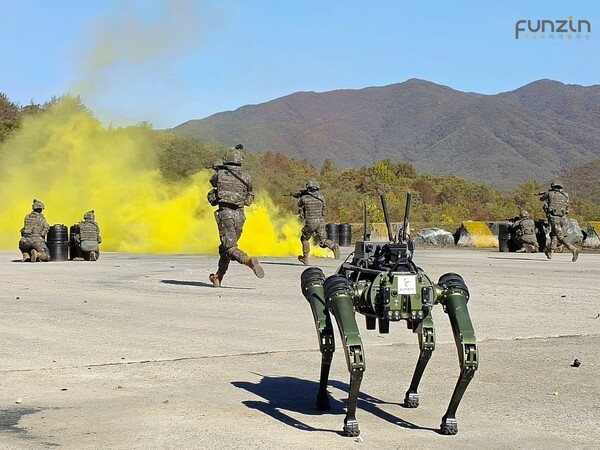
Funjin participated in the Army's Army TIGER+ future warfare integrated combat training held on the 14th at the Yangpyeong Training Center in Gyeonggi Province, where it demonstrated defense AI technologies.
Funjin verified the field operation of its AI-based command decision support system, KWM(Kill-Web Matching), and the cloud-based KWM-CL and edge-cloud-based KWM-onP used AI to identify and fuse target information from reconnaissance assets, analyze battlefield situations, and recommend response measures and available assets.
Funjin won the Best Workshop Paper Award for RF-based target localization research at ICTC 2026(International Conference on ICT Convergence), held in Jeju on the 15th, and plans to link the results to KWM-Ocelot and KWM-onP.
Funjin is expanding its defense AI field applications and R&D results. On the 14th, Funjin participated in the Army's Army TIGER+ future warfare integrated combat training held at the Yangpyeong Training Center in Gyeonggi Province, where it showcased defense AI technologies intended for field deployment. During the event, Funjin said it had verified field operations of its AI-based command decision support system, KWM(Kill-Web Matching).
An AI command decision support system was operated during this Army future warfare training. The exercise deployed the cloud-based KWM-CL and the edge-cloud-based KWM-onP, which can be applied to mobile command posts. KWM-CL and KWM-onP identified and fused target information collected by reconnaissance assets using AI, analyzed battlefield situations, and recommended response measures and available assets.
Funjin also won an award for RF-based target localization research at an international academic conference. As a result, Funjin has shown a trend of expanding both field validation and R&D achievements, following the real-world operation and verification of its AI command decision support system in the Army's future warfare training and adding its conference award to those results.
KWM-onP was designed to operate independently even when communication with higher-level command posts is limited. Funjin deployed developers and field personnel on site from the preparation stage of the training, and it also formed a dedicated field deployment engineer(FDE) team. The FDE team handled system operations, network operations, and technical support.
Problems arising during the training and military requirements were reflected through an agile approach. Funjin explained that, in actual military environments, various variables arise, including communication networks, equipment integration, and changes in operational situations. It also said that repeated unit-level verification and field improvements are important in the defense AI deployment process.
The company proposed the early adoption of proven civilian AI technologies through a fast-track project. It then said these technologies need to undergo unit-level validation and verification of military applicability before being linked to follow-on force deployment. It also said that roles for military and civilian experts are needed to ensure the continuous operation of AI systems in both wartime and peacetime, and that a support framework for this purpose is also necessary.
Beyond its field operation results, the company secured research achievements in the electromagnetic spectrum field. Funjin participated in the international conference ICTC 2026(International Conference on ICT Convergence), held in Jeju on the 15th.
Funjin received the Best Workshop Paper Award for its RF-based target localization research. The awarded paper was titled 'UAV-Based RF Signal Source Localization in Manned-Unmanned Combined Systems.' Six people, including Funjin's Kim Hyun-cheol, Gam Min, and Park Jae-joon, took part in the paper.
The award-winning research studied how to collect RF signals using an on-device AI model mounted on a drone and how to estimate the location of signal sources based on RSSI. The study applied a Top-K method to select valid signals for localization, used a weighted centroid estimation technique for localization, and compared and analyzed localization performance by drone flight pattern. Its purpose was to improve the accuracy of RF signal detection using unmanned reconnaissance assets.
Funjin plans to link the research to KWM-Ocelot, its AI-based electromagnetic spectrum analysis and location detection solution. KWM-Ocelot supports RF signal detection, RF signal classification, RF signal analysis, and localization. It is also used to analyze radio-wave information collected by various reconnaissance assets, including drones.
Funjin is pursuing a plan to connect information secured during the reconnaissance phase with the AI command decision support system KWM. The goal is to strengthen a structure that extends from situational awareness to response measure recommendations. It is also pursuing linkage with KWM-onP and plans to advance the technology so that target information collected by multiple reconnaissance assets can be fused and used for tactical field decision-making.
Kim Deuk-hwa, CEO of Funjin, said the company received recognition for its research achievements in RF signal analysis and localization technology, according to the company. He also said the company plans to further strengthen links between KWM-Ocelot and KWM-onP. He added that Funjin also expressed its commitment to advancing defense AI technologies that can be used in manned-unmanned combined systems and tactical field environments.
Source: TECHWORLD · Kim Seung-gi
Original: https://www.epnc.co.kr/news/articleView.html?idxno=408376
References
This article was produced with the help of an automated content generation algorithm.
Source: TECHWORLD
View originalThis article was summarized and organized by BizCrush based on the original article from TECHWORLD. For exact quotations and full details, please refer to the original article.