Naver Launches 'Trend' to Show Products and Places Frequently Translated by Foreign Visitors
IT DAILY ·
✦ AI Summary
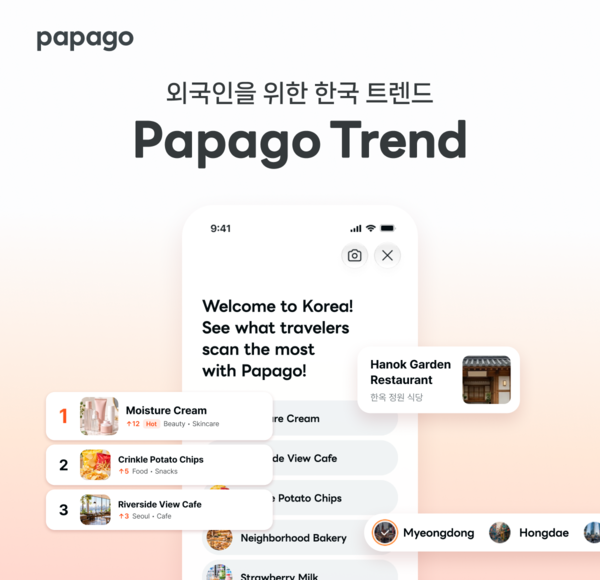
Naver said on the 19th that it has launched a 'Trend' service for foreign visitors to Korea in the Papago application.
Trend shows products and places frequently viewed in Korea, as well as items with recently rising interest, based on foreign users' Papago image translation data.
The service is available to users whose device language is set to a foreign language and supports four languages: English, Japanese, Simplified Chinese and Traditional Chinese.
Naver said on the 19th that it has launched a 'Trend' service for foreign visitors to Korea in the Papago application. The new service was built on data aggregated from foreign users' Papago image translation activity.
The service uses items photographed and translated by foreign users in Korea as travel information for other foreign users. Naver has rolled out a feature that shows products and places generating strong interest in Korea by collecting foreign users' Papago image translation history.
Trend provides products and places that have been frequently viewed through image translation. It also offers items that have recently seen rising interest.
The data used for the service consists of real user data from photographing and translating Korean signs and products. It also delivers blog and Place information accumulated in Korean in the user's language.
A Naver official said image translation is widely used among foreign users. The official added that the service was compiled based on data from users photographing Korean signs and products.
Papago links image translation data with product and place information held by Naver to provide a function for discovering products and places based on translation usage data. The place-information linkage works by matching information accumulated in Place. Naver said it does not use personal information or individually identifiable user information in the process.
The products section consists of 'TOP 100' products with high image translation usage, 'Rising' products with recently increasing interest, and categories such as beauty, food and health. When a product is selected, users can check an AI briefing provided in their device language. They can then receive domestic user reviews and detailed information based on Naver Blog and Shopping in the user's language.
The places section provides places with high image translation usage and places that have recently drawn more interest. Under 'Hot Spots,' it offers popular places by area, including Myeong-dong, Hongdae, Seongsu, Jeju and Busan.
When a place is selected, users can check business hours, location, menu and user reviews in the device language through Naver Place. They can then also use directions and reservation features.
Naver said Trend was designed not merely to surface rankings, but to help foreign users access Korean-language content. Naver said the focus of Trend is not the rankings themselves, but the ease with which foreign users can use Korean content.
Accordingly, Trend is available to users whose device language is set to a foreign language. Trend supports four languages: English, Japanese, Simplified Chinese and Traditional Chinese, and English is provided for other foreign-language environments.
A Naver official said that when users select a product and check the AI briefing, linked blog content is translated and provided in the user's language, such as English or Chinese. The official added that the company is focusing on improving access to content accumulated in Korean.
Papago has continuously added image translation and product-and-place information linking features this year. In April, Naver added a feature that provides Naver Place restaurant and store information in image translation results, as well as a feature that provides product information based on AI briefings. In July, it added a feature that lets users check Tabelog restaurant information when photographing Japanese signs and products, along with a feature for checking product information based on AI briefings.
Previously, users would photograph products or places they had already found and then explore related information. More recently, however, Trend has been shifting toward helping users proactively discover products and places they do not yet know by using foreign users' image translation data.
Naver said it plans to develop Papago into a tool that supports the full travel experience, based on this expansion. Shin Jung-hwi, Naver's head of AI Search, said that in the era of AI agents, Papago's role will expand from translation to supporting foreign tourists throughout their trips, including shopping, directions and reservations, and that Naver will pursue new user value related to discovering and experiencing Korean products and places by combining its AI Search technology, diverse services and high-quality data.
Source: IT DAILY · Kim Byeong-ju
Original: https://www.itdaily.kr/news/articleView.html?idxno=242279
References
This article was produced with the help of an automated content generation algorithm.
Source: IT DAILY
View originalThis article was summarized and organized by BizCrush based on the original article from IT DAILY. For exact quotations and full details, please refer to the original article.