Promised Projects Pile Up, but Construction Lags: At Least 47 U.S. AIDC Projects Halted
IT DAILY ·
✦ AI Summary
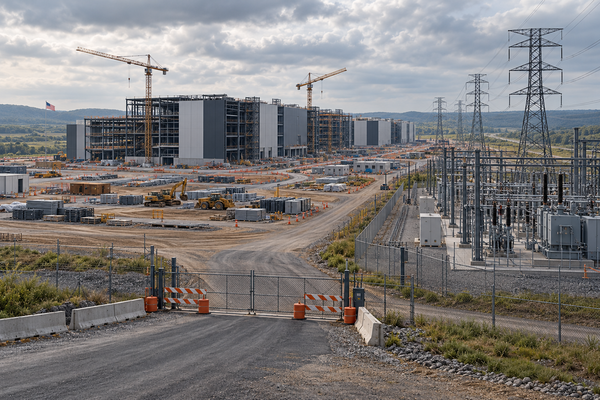
Even after AIDC investment announcements, delays are emerging at the actual infrastructure delivery stage. FT reported that at least 47 large-scale data center projects in the U.S. were delayed, withdrawn or blocked this year. Power procurement, permitting, financing and local opposition were cited as major causes of construction delays.
After AIDC investment announcements, delays are emerging at the actual infrastructure delivery stage. The article said AIDC investments are running into a range of constraints as they move from announcement to construction and operation.
FT reported on the 18th, citing RegLayer data, that at least 47 large-scale data center projects in the U.S. were delayed, withdrawn or blocked this year. The figure of 47 is a conservative estimate focused on large projects.
Power procurement, permitting and financing issues were cited as the main reasons for the construction delays. These problems are affecting construction schedules, highlighting the gap between announced investment amounts and facilities that can actually be put into operation. Bernstein estimated that the share of U.S. planned data center projects that are likely to be realized is about 35%.
Local opposition is affecting data center construction and leading to project delays or stoppages. Data Center Watch tracks anti-data center development trends in the U.S. and said at least 45 projects were delayed or blocked by resident opposition in the second quarter of this year. The investment plans for those projects totaled about USD 68 billion, or about KRW 90 trillion. This tally of 45 projects is separate from RegLayer's count of 47, and the reason for the separate count was explained as differences in survey scope and time period.
In addition, some local communities have introduced temporary restrictions on data center development before operators apply for permits. Data Center Watch said related bills and resolutions were introduced in 30 U.S. state legislatures in the second quarter of this year. Those bills and resolutions address data center siting, power constraints, water constraints and infrastructure cost sharing. Some of the bills and resolutions have been adopted.
Against this backdrop, the key variables for project execution include site location, power procurement methods, water procurement methods and who bears the cost of infrastructure expansion. Permitting is also acting as a variable in project execution.
According to Reuters, there have been cases in which long-term projects have been halted. QTS, the Blackstone-affiliated data center operator, ended its Virginia "Digital Gateway" project in July and withdrew the related application. The "Digital Gateway" project had secured county approval, but local opposition continued for years during the project process, and lawsuits were also filed.
QTS's suspension of "Digital Gateway" shows that even approved projects can struggle to reach actual groundbreaking if local resistance and litigation continue. Even projects justified by large-scale investment and job creation are difficult to build if local acceptance remains unresolved, and construction is also difficult when legal disputes remain unresolved.
Power procurement is emerging as a major obstacle for AIDC projects. Delays in the power supply schedule affect facility handover delays and also affect when developers can recover their investment.
Reuters reported on the 24th of last month a force majeure notice related to Oracle's "Jupiter" data center project in New Mexico. The "Jupiter" project is being developed by Stack Infrastructure, a Blue Owl unit, for OpenAI support. A source cited by Reuters said the schedule had been pushed back by about one year because of delays in securing power, and Blue Owl said the notice did not change the project's financial commitments.
A data center project does not generate revenue simply because the building is finished. Rental income begins in earnest only after the facility is completed, power supply is secured and the customer is handed over the site. As a result, if operations are delayed, the developer's cash recovery timeline is pushed back and the timing of investment returns is delayed as well.
Meanwhile, CipherDigital filed its quarterly report in May and said it planned to deliver its Barbers Lake facility in Texas to FluidStack by September this year. However, there were cases in which design and contract terms were adjusted following changes in customer requirements, and the September disclosure included design changes in response to customer requests and a revised schedule for delivery of individual data halls. The revised delivery schedule calls for phased handovers in the fourth quarter of this year through the first quarter of next year.
Additional cost-sharing terms were also finalized. CipherDigital said it would first bear USD 359.3 million, or about KRW 470 billion, of the initial budget overrun, and that the compensation method for costs exceeding USD 359.3 million would be split 50% to the tenant and take the form of additional rent. The tenant's reimbursement period is the entire 20-year contract term, and rent begins from the delivery date of each data hall. The company said it is proceeding with the project in line with the revised schedule.
This case shows that when assessing the economics of AIDC projects, it is necessary to review not only the size of long-term lease contracts but also the facility delivery schedule, additional costs arising from design changes and cost-sharing terms. Even after securing a customer, the developer still bears costs and execution risks remain until the actual facility is delivered.
An industry source said that future evaluations of AIDC investment plans will place greater emphasis on the power supply timeline, permitting progress, whether financing has been secured and the expected schedule for delivering facilities to customers. The source added that in the competition for AI infrastructure, execution capability through actual operation is emerging as the benchmark.
Source: IT DAILY · Lee Jae-young
Original: https://www.itdaily.kr/news/articleView.html?idxno=242273
References
This article was produced with the help of an automated content generation algorithm.
Source: IT DAILY
View originalThis article was summarized and organized by BizCrush based on the original article from IT DAILY. For exact quotations and full details, please refer to the original article.