K-Battery Trio Bets on AI Power Market as North American ESS Becomes Key to Earnings
TECHWORLD ·
✦ AI Summary
As investment in power infrastructure rises in North America on the back of AIDC and renewable energy expansion, the three K-battery makers — LG Energy Solution, Samsung SDI and SK On — are stepping up their push into the North American ESS market.
LG Energy Solution, Samsung SDI and SK On all posted profits in the second quarter, but their results are expected to diverge in the third quarter because of the impact of subsidies and one-time gains.
The three companies are pursuing higher ESS sales while expanding local production in North America and securing more orders.
As investment in power infrastructure rises in North America on the back of AIDC and renewable energy expansion, the three K-battery makers — LG Energy Solution, Samsung SDI and SK On — are stepping up their push into the North American energy storage system (ESS) market. The three companies are responding with expanded local production and larger order books.
All three posted operating profits in the second quarter. However, their results are expected to diverge in the third quarter. With subsidies affecting quarterly earnings and one-time gains also weighing on results, a key question is whether higher ESS sales can translate into sustained profitability.
Against this backdrop, LG Energy Solution released its preliminary third-quarter results on the 8th. On a consolidated basis, third-quarter sales came to KRW 9.6434 trillion, while operating profit reached KRW 756 billion. That represents a 59.0% increase in sales from a year earlier and a 25.7% increase in operating profit from a year earlier.
LG Energy Solution’s quarterly performance showed a clear improvement trend. Sales were KRW 6.555 trillion in the first quarter and KRW 7.5602 trillion in the second quarter, and third-quarter sales exceeded KRW 9 trillion. Operating loss was KRW 207.8 billion in the first quarter, but the company swung to an operating profit of KRW 113.3 billion in the second quarter, and profit expanded further in the third quarter.
Excluding subsidies, the company moved from a second-quarter loss to a third-quarter profit. Operating loss excluding subsidies was KRW 127.7 billion in the second quarter, while operating profit excluding subsidies was KRW 339.1 billion in the third quarter. However, the company’s total third-quarter operating profit included KRW 416.9 billion in North American production subsidies, and that subsidy item includes the U.S. advanced manufacturing production tax credit (AMPC).
Samsung SDI also turned from a loss in the first quarter to a profit in the second. Samsung SDI posted sales of KRW 3.5764 trillion and an operating loss of KRW 155.6 billion in the first quarter, while second-quarter sales came to KRW 3.7688 trillion and operating profit reached KRW 203.8 billion. Operating profit for the battery business in the second quarter was KRW 159.3 billion, with the main drivers cited as higher sales of premium products, AMPC and tariff refunds.
Brokerage estimates point to higher third-quarter earnings, but analysts also note that one-time factors are behind the improvement. In a report on the 14th, Shinhan Investment analysts Lee Jin-myeong and Kim Myeong-ju estimated Samsung SDI’s third-quarter sales at about KRW 4 trillion and operating profit at KRW 263.8 billion, forecasting a roughly 29% increase in operating profit from the previous quarter. However, the analysts said operating profit included the effect of a one-time settlement related to the end of the GM joint venture, and they projected weak profitability in the core EV battery business.
SK On’s battery business posted an operating loss of KRW 349.2 billion in the first quarter, but swung to an operating profit of KRW 821.8 billion in the second quarter. The improvement was attributed to higher sales volume, larger U.S. tax credits and the recognition of compensation from customers. Hana Securities estimated one-time gains from tariff refunds and compensation from customers at about KRW 1.1 trillion.
However, the brokerage community has raised the possibility of a return to losses in the third quarter. Meritz Securities analyst Noh Woo-ho said in a report on the 14th that he expects SK On’s battery division to post an operating loss of KRW 179.4 billion in the third quarter. Excluding AMPC, the operating loss of the battery division was estimated at KRW 269.4 billion. As a result, analysts said the company still needs to prove a recovery in profitability even after the second-quarter turnaround.
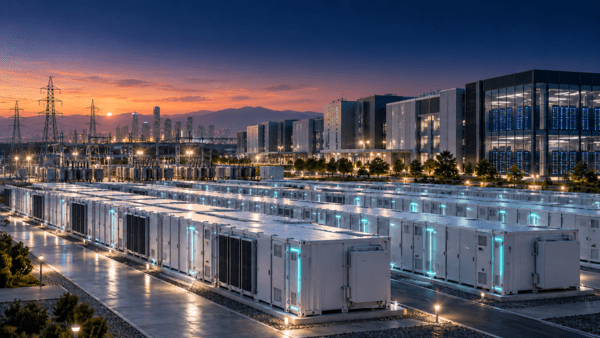
In this environment, the three companies are focusing on North American ESS. The backdrop for that focus is rising power demand and increased investment in storage facilities.
The U.S. Energy Information Administration (EIA) released its Short-Term Energy Outlook on the 6th. The EIA estimated that U.S. power consumption in the third quarter rose 4% from a year earlier, driven by summer cooling demand and other factors. It also forecast that electricity demand in the commercial sector, including data centers, will increase 2.8% next year.
Battery storage installations in the United States have already expanded, and further additions are also planned. Based on EIA data from August, utility-scale battery storage capacity in the United States grew from 43.6 GW at the end of last year to about 52 GW at the end of June this year. Operators have filed plans for additional capacity of 14 GW in the second half of this year and 26 GW next year.
ESS is used to supply power linked to data centers and renewable energy such as solar. ESS operates by charging when power is surplus or cheap and discharging when needed. In data centers, ESS helps smooth sudden changes in electricity use.
Still, issues remain over grid interconnection procedures and cost sharing. In June, the Federal Energy Regulatory Commission (FERC) required six grid operators in its jurisdiction to explain or revise the rules governing interconnection for large power-consuming facilities such as data centers. FERC’s requirements included measures to prevent existing consumers from being burdened with costs in the process of accommodating new demand.
To respond to changes in EV demand and raise plant utilization, battery makers are continuing to develop EV products and work with automakers while converting part of their existing production lines for ESS use to expand their revenue base.
LG Energy Solution is operating five North American ESS production bases as of its announcement last month and plans to expand local production capacity in North America to more than 50 GWh by the end of the year. The company began producing ESS cells at the Tennessee plant of its GM joint venture Ultium Cells in May and also started ESS cell production at its Honda joint venture in June.
Along with production expansion, LG Energy Solution is also pursuing supply contracts. In May, it signed a contract to supply 6 GWh of ESS batteries to DTE Energy, and in July it announced supplies for a solar-ESS project involving Google and Cypress Creek Energy. It is also providing design, operation and maintenance support through its U.S. systems integration subsidiary Vertech, and last month it joined Nvidia’s AI factory qualification program, the “DSX Ready.”
Samsung SDI is converting some production lines at its U.S. joint plant with Stellantis for ESS use and preparing mass production of prismatic LFP batteries. Shinhan Investment Securities projected that Samsung SDI’s third-quarter ESS sales will increase 39% from the previous quarter to about KRW 1.1 trillion, citing deferred domestic shipments and higher U.S. deliveries.
Samsung SDI is also continuing EV battery development. In August, Samsung SDI signed a joint development agreement with GM for next-generation prismatic batteries for EVs and announced that GM would acquire the GM stake in the U.S. joint venture Synergy Cells. As a result, the joint plant will be converted into a wholly owned production base, but Samsung SDI and GM will continue collaborating on next-generation product development.
SK On completed the process of winding down its BlueOval SK joint venture with Ford in the second quarter and launched its standalone factory, “SK On Tennessee.” In August, SK On signed a contract to supply LFP battery cells to U.S. ESS company NeoVolta Power, with deliveries scheduled from next year through 2031 and total supply volume of 9 GWh. However, revenue recognition for the new order will lag because deliveries begin next year.
Samsung SDI and SK On are securing supply chains for LFP cathode materials to support production expansion. After signing a mid- to long-term supply contract with L&F, Samsung SDI also signed a KRW 6 trillion long-term supply contract with POSCO Future M on the 6th of this month. SK On also signed an LFP cathode material supply contract with POSCO Future M last month for 2027-2029 worth about KRW 1.1 trillion.
According to a battery industry source, the ESS market is expanding as data center construction increases on the back of AI proliferation. The source said all three battery makers are moving ahead with their North American push. However, the source added that it remains unclear how much this market expansion will translate into improved earnings for each company.
Accordingly, analysts say the three K-battery makers will need to expand shipments in line with upcoming customer project schedules. They also need to manage production-line conversion costs and utilization rates. In addition, along with higher ESS sales, improving profit and loss excluding subsidies and one-time gains is being cited as a key challenge.
Source: TECHWORLD · Kim Seung-gi
Original: https://www.epnc.co.kr/news/articleView.html?idxno=408341
References
This article was produced with the help of an automated content generation algorithm.
Source: TECHWORLD
View originalThis article was summarized and organized by BizCrush based on the original article from TECHWORLD. For exact quotations and full details, please refer to the original article.