[DigiKey TechForum] Guide to Implementing Negative Voltage Rails for System Power Design 1: Defining Ground and the Need for Bidirectional Power
TECHWORLD ·
✦ AI Summary
Voltage is the potential difference between two points, and GND is artificially defined as the 0V reference point.
Negative voltage is a voltage at a potential lower than GND, and it can be created according to the reference point setting even without a special power supply.
With only a positive supply, the negative half-cycle of an AC signal can be clipped, so op-amp, audio, and precision instrumentation circuits require symmetrical positive and negative supplies.
The meaning of voltage is the potential difference between two points. In this context, ground (GND) is used as the 0V reference.
GND is an artificially defined 0V reference point. Therefore, the GND setting can be assigned arbitrarily.
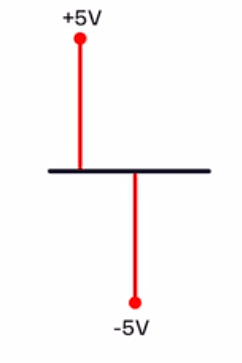
+5V means a potential 5V higher than ground. Conversely, -5V means a potential 5V lower than ground.
Negative voltage refers to a voltage at a potential lower than GND. The essence of negative voltage is also that it is at a lower potential than the reference ground.
For this reason, obtaining negative voltage does not require a special power supply. The key is not an absolute separate power source, but how to create a potential lower than the reference point.
The characteristics of AC signals lie in their positive and negative changes around the 0V reference. Because the signal moves above and below 0V, potential changes occur around the reference point.
In this regard, the limitation of a single power rail appears as difficulty in handling the entire waveform intact. In other words, with only a single supply, it is difficult to fully process the entire waveform of a signal that changes in positive and negative directions around 0V.
As a result, the main application circuits cited are most analog circuits, communication circuits, and driver circuits. These circuits require both positive and negative voltages.
If the concept of negative voltage is misunderstood, op-amp output clipping can occur, interface communication errors can arise, and device bias may be set abnormally. For this reason, accurate understanding of the concept of negative voltage is necessary as a prerequisite for power supply circuit design.
In op-amps and audio analog circuits, both positive and negative voltages are needed. This is because microphone, audio signal, and sensor output characteristics are AC signals that include both positive and negative half-cycles.
If only a positive voltage is supplied, the negative half-cycle of the waveform is cut off. As a result, signal distortion can occur.
By contrast, if positive and negative voltages are supplied symmetrically, the entire waveform can be amplified. Such symmetrical positive and negative voltage supply is essential for precise analog signal acquisition.
These characteristics are especially important in audio power amplifiers, medical signal acquisition devices, and high-precision sensors. They also apply to the analog front end of oscilloscopes.
In addition, signal conditioning circuits in Class B audio amplifiers and precision instruments are also included among the main application areas.
The voltages typically used in bidirectional power supplies are ±12V or ±15V.
When processing AC signals on the premise of such a bidirectional power configuration, the presence of the negative voltage rail is important.
If the negative voltage rail is absent, the negative half-cycle of the AC signal may be cut off.
As a result of the absence of such a negative voltage rail, the signal-to-noise ratio (SNR) may also decline significantly.
For this reason, low-noise negative voltage power supplies are needed in high-fidelity audio systems.
For the original source, refer to DigiKey's TechForum/Article.
Source: TECHWORLD · Lee Gwang-jae
Original: https://www.epnc.co.kr/news/articleView.html?idxno=408290
References
This article was produced with the help of an automated content generation algorithm.
Source: TECHWORLD
View originalThis article was summarized and organized by BizCrush based on the original article from TECHWORLD. For exact quotations and full details, please refer to the original article.