Miqcube Solution Earns Top S Grade in Manufacturing AI Development Capability Assessment
TECHWORLD · · 1 views
✦ AI Summary
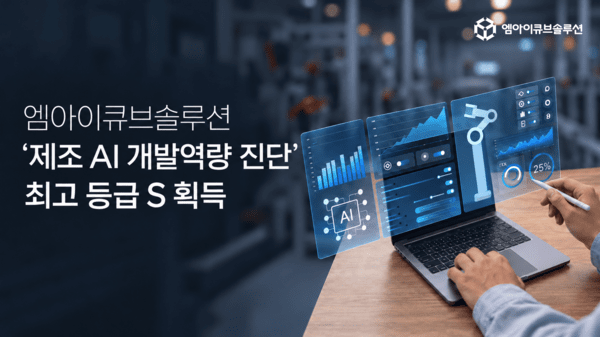
MiQube Solution announced on the 19th that it participated in the Ministry of SMEs and Startups' "2026 Smart Factory Supplier Capability Assessment Support Project," underwent a manufacturing AI development capability assessment, and received the top S grade.
SmartAI is an MLOps platform built on data collection and analysis from manufacturing sites, and it applies quality prediction, anomaly detection, predictive maintenance, process optimization, inspection automation, digital twins, and agentic AI.
The company said evaluation across technology, performance, and operations was supported by 7 registered patents and 7 applications, proof of concept (PoC) conversions to paid contracts and mass-production line deployments, and 24-hour failure response and AI model retraining support.
MiQube Solution announced on the 19th that it participated in the Ministry of SMEs and Startups' "2026 Smart Factory Supplier Capability Assessment Support Project," underwent a "Manufacturing AI Development Capability Assessment" for its manufacturing-specialized AI platform "SmartAI," and received the top S grade.
The "Manufacturing AI Development Capability Assessment" is an evaluation system for manufacturing AI solutions offered by smart factory suppliers. The assessment covers three areas: technology, performance, and operations, and the grading system runs from S to D across five levels.
The S-grade criteria require capabilities in automation, optimization, prediction, and data analysis. An S-grade solution is a manufacturing AI solution at the stage of autonomous adaptation and evolution, and the S grade is valid for 2 years from the date of confirmation.
SmartAI is an MLOps-based platform built on data collection and analysis from manufacturing sites. SmartAI supports quality prediction, anomaly detection, predictive maintenance, process optimization, and inspection automation, and applies AI simulation, digital twins based on 3D monitoring, and agentic AI. Through this, it determines process conditions and provides real-time feedback to equipment.
The technology-area evaluation focused on the system for defining manufacturing-site problems, the development system that reflects workers' experience and expertise in AI algorithms, manufacturing data standardization, data quality management, and the ability to detect and respond to changes in data characteristics caused by changes in process conditions and equipment status. The name for this change in data characteristics is "data drift."
In terms of AI model operations, the evaluation assessed whether the company had an MLOps pipeline linking data collection, training, and deployment, as well as a system for monitoring model performance. It also included a supply structure that simultaneously supports SaaS and on-premises deployment, management of computing resources, explainable AI for visualizing the basis for AI prediction results, and safety control functions to protect the system in the event of a failure.
Key evaluation factors included connectivity with existing manufacturing systems and scalability. SmartAI was designed based on standard API-based integration with manufacturing software and heterogeneous equipment, as well as a modular architecture, and was built so that its scope can be expanded to other processes and factories.
In technical terms, MiQube Solution holds 7 registered patents and 7 patent applications related to manufacturing AI, and it presented evaluation grounds through external organizations' AI model performance assessments and technology validation based on system integration cases.
On the performance side, actual project achievements in applying the system to manufacturing sites and the effects of those applications were included in the performance-area evaluation, and the company demonstrated business viability by securing cases of paid contract conversions after proof of concept (PoC) and cases of application to mass-production lines after proof of concept (PoC).
On the operations side, maintenance capabilities and customer support capabilities were included in the operations-area evaluation, and the company described its operational capabilities through 24-hour failure response, real-time monitoring, regular performance inspection support, AI model retraining support, AI model tuning support, dedicated team operations, step-by-step training program operations, and an improvement system that incorporates customer feedback.
CEO Shim Hyo-jun said the significance of earning the S grade lies in the comprehensive recognition of the company's AI technology, its achievements in generating value from manufacturing-site data, and its stable operational capabilities, and he mentioned plans to further advance SmartAI and expand autonomous manufacturing environments.
Source: TECHWORLD · Kim Seung-gi
Original: https://www.epnc.co.kr/news/articleView.html?idxno=408370
References
This article was produced with the help of an automated content generation algorithm.
Source: TECHWORLD
View originalThis article was summarized and organized by BizCrush based on the original article from TECHWORLD. For exact quotations and full details, please refer to the original article.