Nvidia Takes Aim at the Local AI Market With 'RTX Spark' to Tackle AI Subscription Costs
IT DAILY ·
✦ AI Summary
Nvidia unveiled RTX Spark, an edge superchip that packages a Blackwell GPU and a Grace CPU into a single unit.
ASUS, Dell, HP, Lenovo, MS, and MSI also rolled out Windows laptop lineups equipped with it.
The product family emphasizes up to 128GB of unified memory and 1 PFLOPS of AI compute performance, highlighting a setup for running LLMs and intelligent agents locally.
Nvidia unveiled 'RTX Spark,' an edge superchip that packages a Blackwell GPU and a Grace CPU into a single unit, aiming to target the local AI market and ease the burden of AI subscription fees. Nvidia positioned it as a product that concentrates high-capacity memory and high-performance AI computing in a personal PC.
ASUS, Dell, HP, Lenovo, MS, and MSI simultaneously unveiled Windows laptop lineups equipped with RTX Spark. The product family was billed as a 'personal edge workstation.'
The lineup's specifications include up to 128GB of unified memory and 1 PFLOPS of AI compute performance. Based on this configuration, Nvidia said it aims to reduce dependence on external cloud services and enable LLMs and intelligent agents to run independently on the device itself.
At the site, memory architecture was cited as the biggest differentiator of the architecture that makes these goals possible. Conventional discrete graphics cards use graphics-only memory (GDDR).
By contrast, the RTX Spark superchip adopts LPDDR-based high-capacity unified memory. Officials said its bandwidth is lower than the latest GDDR, but the key advantage lies not in speed, but in the larger volume of data it can load at once.
Existing top-end desktop GPUs struggle to run large 70B-class models locally with large amounts of Context because of memory limitations. The desktop flagship RTX 5090 has 32GB of VRAM, while the weight size of a 70B model at 4-bit quantization is about 35GB. As a result, a standalone RTX 5090 cannot host a 70B-class model, and if Context memory for processing several thousand pages of documents is added, it cannot run at all.
By contrast, a 128GB unified-memory model can allocate about 100GB to the GPU area. According to officials at the site, this configuration can run Qwen 3.8 and NVIDIA Nemotron 74B. It can also process several thousand pages of documents as Context.
Officials at the site said the peak speed is somewhat slower. But the key difference is that the entire workflow can be completed locally.
The power design was also built around a lower TDP. The CPU+GPU maximum power consumption TDP is around 80W, and instead of a large adapter of 240W or more, it uses a small 100W to 120W adapter. This small adapter plugs directly into a standard wall outlet, and the entire system can be powered by the small adapter. It can also edit 8K video on battery power alone, and render a 3D scene of 90GB on battery power alone.
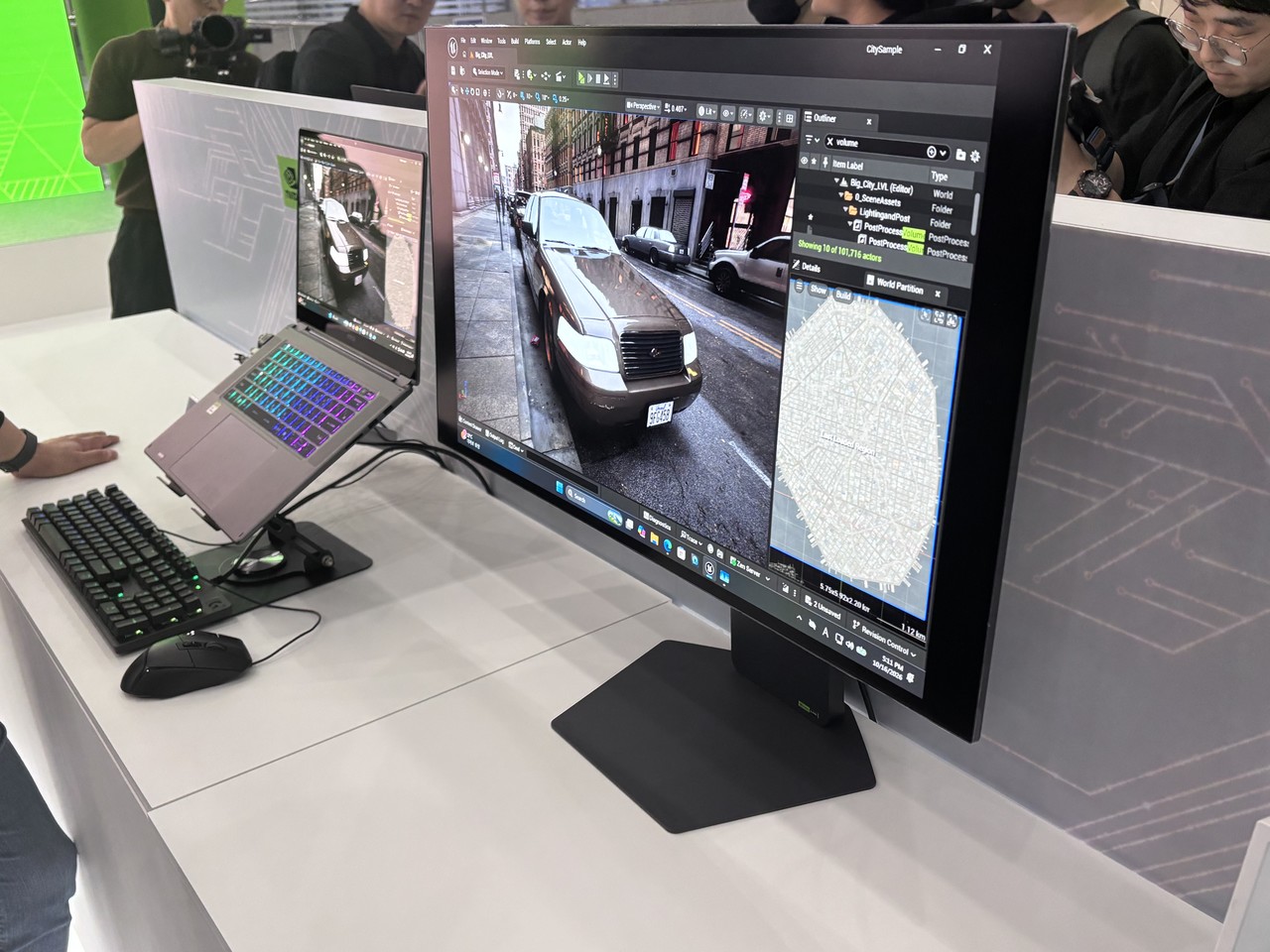
Photos from the RTX Spark launch event were provided by reporter Kwon Young-seok. As demand for local AI adoption rises among companies, the event highlighted its high practical utility.
At the event, the company emphasized that this product was built on Windows OS, in contrast to earlier publicly unveiled Linux-based AI dedicated devices. The device was introduced as being able to run AI agents that can stay active in the background, such as Hermes, and perform background tasks like document organization and coding.
At the same time, it was explained that users can work on Office documents, browse the web, and use Adobe tools on the front end, giving it usability similar to a PC they already use every day. As a result, the ability to keep AI agents running at all times while also handling ordinary PC tasks was seen as a strength, and this was said to connect to a hybrid workflow.
This hybrid workflow was presented as leading to blocking data leaks inside the company and optimizing total cost of ownership (TCO). Technical staff at the site said cloud token costs can amount to several hundred dollars per month, adding that it is more cost-effective to handle routine repetitive work and data setup with an on-device local LLM, and to offload only high-difficulty reasoning to the cloud.
Technical staff at the site said this approach is suitable for small and midsize companies that face a heavy burden in building their own AI servers. They also said it is a safe and practical edge AI alternative because it can be deployed by department without leaking sensitive data outside the company.
Source: IT DAILY · Kwon Young-seok
Original: https://www.itdaily.kr/news/articleView.html?idxno=242261
References
This article was produced with the help of an automated content generation algorithm.
Source: IT DAILY
View originalThis article was summarized and organized by BizCrush based on the original article from IT DAILY. For exact quotations and full details, please refer to the original article.