Okestro: “Virtualization Transition Criteria Shift From Stability to Scalability”
TECHWORLD ·
✦ AI Summary
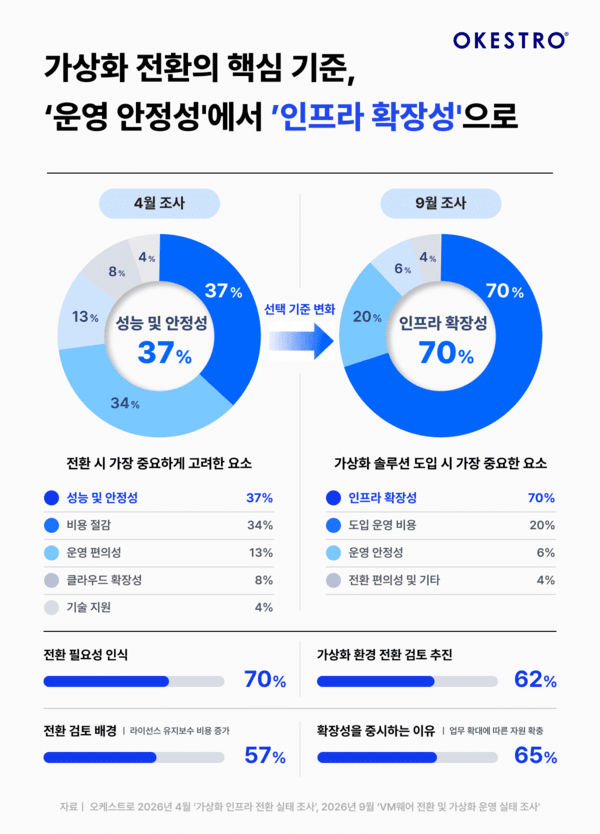
Okestro announced on the 16th the results of its “VMware Transition and Virtualization Operations Survey” conducted last September.
The survey targeted 13,541 IT workers at companies and public institutions, and 62% of respondents said they were reviewing, planning, or carrying out a transition.
“Infrastructure scalability” was the top solution selection criterion at 70%, while “increasing license and maintenance costs” ranked first as the reason for transition at 57%.
Okestro announced on the 16th the results of its “VMware Transition and Virtualization Operations Survey” conducted last September. The survey targeted 13,541 IT workers at companies and public institutions.
The survey found that companies’ virtualization infrastructure transition criteria have shifted from a focus on performance and stability to a focus on scalability. In a survey in April, “performance and stability” accounted for 37% as the top consideration for transitions, but in this survey, 70% of respondents selected “infrastructure scalability” as the top solution selection criterion.
The proportion of respondents who said they were reviewing, planning, or carrying out a transition to a virtualization environment stood at 62%. As for why they were considering a transition, “increasing license and maintenance costs” ranked first at 57%.
However, at the actual solution selection stage, scalability was valued more than cost. In the actual solution selection items, “infrastructure scalability” came in at 70% and “adoption and operating costs” at 20%, and Okestro said the transition criteria for virtualization are changing from stability to scalability.
In the responses, the need to expand computing resources in line with business growth ranked first as the core of scalability needs at 65%. It was followed by securing operational flexibility for infrastructure over the mid to long term at 46%, and expansion into AI and cloud environments at 41%.
On the technology side, maintaining existing systems emerged as a premise, and parallel operation of existing workloads and new workloads ranked first among technical requirements at 68%. Compatibility with existing server and storage environments came in second at 61%. This indicates strong demand for maintaining the existing environment while accommodating new business and AI workloads at the same time.
As for the direction of future infrastructure advancement, integrated operation of multi- and hybrid cloud environments ranked first at 42%. AI infrastructure and GPU operating environments ranked second at 35%, and Kubernetes-based cloud-native environments ranked third at 31%. Accordingly, demand for advancement centered on multi- and hybrid cloud, AI and GPU, and cloud-native environments continued.
In response, Okestro is focusing on the server virtualization solution “CONTRABASS.” CONTRABASS supports the use of existing server and storage environments, and it also supports computing resource expansion and GPU resource management.
The offerings also include VIOLA and OKESTRO CMP. VIOLA is a Kubernetes-based cloud-native platform, and OKESTRO CMP is a multi- and hybrid cloud management platform. CONCERTO A.I. is also being provided. CONCERTO A.I. is an AI inference operations platform that supports AI service operations based on distributed serving and GPU and NPU resource allocation.
Kim Beom-jae, CEO of Okestro, said the role of corporate IT infrastructure is changing from a foundation for maintaining current operations to a core competitive strength that supports business growth and technological innovation. He added that, while aiming for vendor and technology independence, the company wants to support flexible expansion into cloud and AI areas in virtualization environments based on this configuration and broaden technology options.
Source: TECHWORLD · Kim Seung-gi
Original: https://www.epnc.co.kr/news/articleView.html?idxno=408334
References
This article was produced with the help of an automated content generation algorithm.
Source: TECHWORLD
View originalThis article was summarized and organized by BizCrush based on the original article from TECHWORLD. For exact quotations and full details, please refer to the original article.