StoneStone to Handle OT Industrial Equipment Security in MSIT Physical AI Project
TECHWORLD ·
✦ AI Summary
StoneStone said on the 16th that it will participate as a joint research and development institution in a state-funded project led by the Ministry of Science and ICT and the National IT Industry Promotion Agency (NIPA).
The project is titled 'Development of Multi-Layer Security Technology Based on Physical AI for Collaborative Intelligence Systems,' and the technology to be developed is Physical AI multi-layer security technology for dark factory environments.
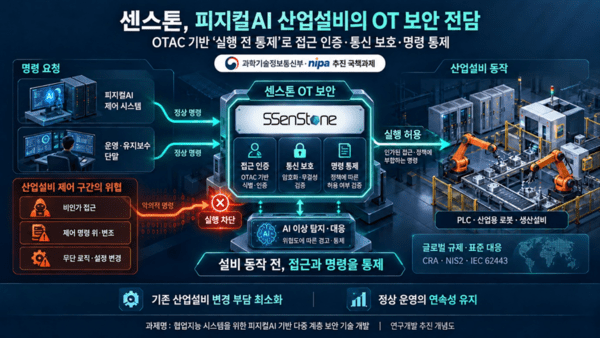
StoneStone will be responsible for developing OT segment security technology, OTAC-based OT endpoint protection, control command analysis and control, and AI-based anomaly detection and response technology.
StoneStone said on the 16th that it will participate as a joint research and development institution in a state-funded project led by the Ministry of Science and ICT and the National IT Industry Promotion Agency (NIPA). The project is titled "Development of Multi-Layer Security Technology Based on Physical AI for Collaborative Intelligence Systems." The technology to be developed is Physical AI multi-layer security technology for dark factory environments.
The project aims to build security in multiple layers, including the OT segment where Physical AI commands are carried out through actual industrial equipment operations. StoneStone will be responsible for developing security technology for the OT segment where Physical AI commands lead to actual industrial equipment operations.
StoneStone has formed a consortium with RaonSecure, Jeonbuk National University, and Sogang University, with RaonSecure serving as the lead institution. Based on its proprietary technology, OTAC (One-Time Authentication Code), StoneStone will be responsible for protecting the OT endpoint segment within the consortium. It will also develop control command analysis and control technology, as well as AI-based anomaly detection and response technology.
OTAC is a one-way dynamic token technology. The OTAC method does not require real-time two-way communication with a server, and it generates a dynamic authentication code on the client side. The generated code is transmitted in one direction. The authentication targets are users, devices, and commands.
Through this project, StoneStone will expand the scope of application for OTAC-based identification and authentication. The expanded areas are OT communication protection and command-level control.
StoneStone said that monitoring- and detection-centered responses alone have limitations in blocking unauthorized control commands from being linked to actual equipment operations. It also stressed the need for authentication for equipment access and emphasized the need for pre-execution verification and control over whether control commands are allowed.
Yu Chang-hoon, CEO of StoneStone, said that in a Physical AI environment, it is necessary to verify the source and integrity of commands delivered to actual industrial equipment. He also said that trust in whether commands are permitted in a Physical AI environment is needed. He added that through this project, the company will push ahead with completing a global top-tier OT security standard model that can be immediately applied to existing industrial equipment, and expressed its determination to lead an ecosystem that supports the safe global expansion of the manufacturing and robotics industries.
Source: TECHWORLD · Lee Gwang-jae
Original: https://www.epnc.co.kr/news/articleView.html?idxno=408323
References
This article was produced with the help of an automated content generation algorithm.
Source: TECHWORLD
View originalThis article was summarized and organized by BizCrush based on the original article from TECHWORLD. For exact quotations and full details, please refer to the original article.