[KES 2026] College Student-Developed App 'Peer' Eases the Mind ... Delivers Comfort Through AI Diary Analysis and Flower Meanings
TECHWORLD ·
✦ AI Summary
At KES 2026, product exhibits from students, startups, and large companies continued, and students from Sungkkyul University’s Department of Media Software also introduced on-site services.
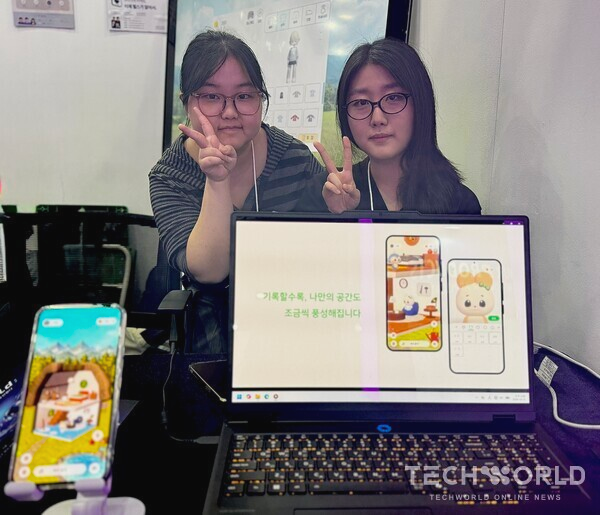
The college development team 'Saesoom' unveiled the AI emotional care service 'Peer (Peer),' explaining that it was planned to help ease feelings of isolation among young single-person households.
Peer offers diary-based emotion analysis, AI conversations, weekly reports, a 3D healing space, and decorating features, and provides information on professional counseling institutions when signs of psychological crisis are detected.
At KES 2026 (Korea Electronics Show 2026), IT technologies such as AX, robotics, mobility, XR, and spatial computing were unveiled. On the 13th, the exhibition hall at COEX saw a steady stream of product exhibits from students, startups, and large companies, and students from the Department of Media Software at Sungkkyul University also introduced their on-site service. On the 15th, the college development team 'Saesoom' took the interview spot at the KES 2026 venue.
'Saesoom' introduced its AI emotional care service 'Peer (Peer).' 'Peer' targets young single-person households and was planned with the goal of easing feelings of isolation among them. The team said it devised the service to support users who live alone and struggle to express their emotions.
'Peer' can be used as a way to record emotions casually in everyday life, helping users check their own mental state. Its core features are AI emotion analysis that goes beyond simple diary writing and conversations with AI. The service was designed to reduce the difficulty of expressing emotions and support emotional stability.
Song Chae-hyeon, a member of the Saesoom team, said the continued increase in single-person households is bringing social isolation and emotional loneliness to the fore. He said he judged that a service aimed at people who bottle up their feelings alone or do not receive enough comfort was needed, and explained that the team aimed to create a service where users could casually open their hearts in daily life.
Accordingly, Peer was designed so that when a user writes a diary entry, AI analyzes the content. AI classifies emotions into three stages — positive, neutral, and negative — and recommends flowers and flower meanings that match each emotion. Song Chae-hyeon said the service was designed to deliver comforting messages through a range of flower meanings tailored to the user's emotions. Peer's features consist of AI-based emotion diary analysis, customized flower and flower-meaning recommendations, and conversations with an AI friend.
Google's 'Gemini 2.5 Flash' is applied in this process. This AI model is used to analyze user diary and conversation content, classify emotions, and generate customized responses. Along with this, Peer also provides weekly emotion reports, a 3D healing space, and decorating features.
The AI friend 'Moa' holds text and voice conversations with users and generates responses based on contextual analysis of the conversation. It also extracts the emotion type and intensity from responses and reflects that emotional information on the character's facial expression in real time. This is in line with the design goal of increasing users' sense of familiarity.
'Moa' also provides a weekly report. The report organizes the week's diaries and emotional flow, and also offers empathetic feedback on the content along with small, practical tips that can be applied in real life. The report is generated through AI's automatic analysis of user records, and the generation cycle is every Monday.
A 3D healing space and decorating features were also applied. Jeon Ye-ju said that AI conversation for emotion management could feel like homework or counseling, so the team planned the service so that users could rest comfortably in their own space and naturally reflect on their emotions.
Peer also offers features that take users' psychological safety into account. If signs of a psychological crisis are detected during conversation, information on professional counseling institutions is provided immediately. The team also considered concerns that overreliance on AI comfort could reduce real-world social interaction.
Song Chae-hyeon said the planning intent for the AI friend Peer was not to completely replace real human relationships, but to serve as a cushion for the mind that helps organize emotions users could not express in daily life. He also explained that as applied elements for this purpose, the team reflected suggestions for real-world action missions based on weekly reports and a limit on the number of diary entries per day.
Song Chae-hyeon said he hopes the app's comfort experience will help restore a sense of emotional breathing room. He added that, based on that effect, he also hopes it will have positive influence on real-life interpersonal relationships and daily living.
The Saesoom team said it gained a range of achievements in the process of developing Peer for its graduation exhibition. Song Chae-hyeon and Jeon Ye-ju explained that they handled the entire process themselves, from planning to Unity client development and backend AI system construction connecting FastAPI and the Gemini API, and said this also strengthened their development capabilities.
The Saesoom team said the most important point it reaffirmed during this development process was the importance of service design. Song Chae-hyeon and Jeon Ye-ju said they considered not only technical implementation but also users' psychology and emotional interaction, and explained that this experience became an opportunity for deep deliberation about the positive value of technology and for growth.
Source: TECHWORLD · Kim Hye-jin
Original: https://www.epnc.co.kr/news/articleView.html?idxno=408288
References
This article was produced with the help of an automated content generation algorithm.
Source: TECHWORLD
View originalThis article was summarized and organized by BizCrush based on the original article from TECHWORLD. For exact quotations and full details, please refer to the original article.