[Audit] Workers Left Out of AI Jobs Impact Survey as All High-Impact AI Staff Hold Other Posts
IT DAILY ·
✦ AI Summary
Kim Seon-min said during the audit that workers were excluded from NIA's AI social impact survey.
She said the survey included only executives and HR managers from 500 companies, while a worker survey was left out.
Kim Hyung-chul, head of NIA, and Um Yul, director of AI Policy at the Ministry of Science and ICT, said they would improve things next year, hold a roundtable in December to expand labor participation, and set up governance.
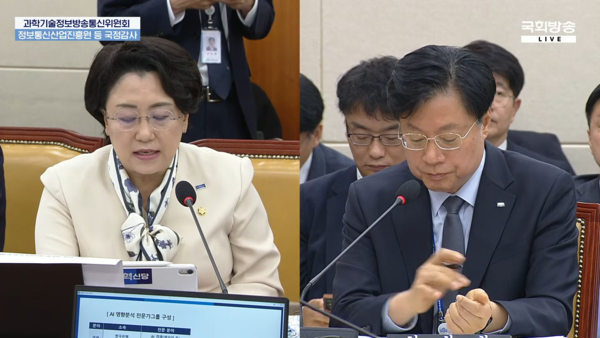
Kim Seon-min, a lawmaker from the Rebuilding Korea Party, reviewed the Korea National Information Society Agency's (NIA) AI social impact survey and its system for handling high-impact AI work during an audit of the National Assembly's Science, ICT, Broadcasting and Communications Committee on the 15th in Yeouido, Seoul. The key issue at this year's audit was that workers were excluded from the design of the AI jobs impact survey.
At the audit, Kim outlined the structure of NIA's AI social impact survey and said that executives and HR managers from 500 companies were included among those targeted by the survey, which is scheduled for release in December. She raised the point that only corporate respondents were included even though the survey is meant to address job impacts.
Kim pointed out that a worker survey that had been included in the original plan was left out of the final design. As a result, the exclusion of workers from the AI jobs impact survey design emerged as a key issue at the audit.
Kim also said that among the 7 experts reviewing the survey questions, only 1 specialized in employment impacts, noting that expertise on employment effects was limited even at the questionnaire review stage. According to the photo caption, Kim Seon-min of the Rebuilding Korea Party questioned Kim Hyung-chul, head of NIA, during the audit of the Science, ICT, Broadcasting and Communications Committee on the 15th.
Kim said that actual workers' opinions were not reflected in the AI social impact survey process. In response, Kim Hyung-chul, head of NIA, said he would push for improvements next year and try to reflect those opinions.
Kim also said the policy linkage system for the results of the AI social impact survey was insufficient. He noted that AI's impact extends across jobs and people's daily lives and spans multiple ministries.
He also argued that data and expertise from each ministry and related agency need to be brought together. He further said that roles need to be divided and that a dedicated system is needed to take responsibility for connecting the survey results to policy, calling on the Ministry of Science and ICT to establish policy linkage governance by next year.
Um Yul, director of AI Policy at the Ministry of Science and ICT, said in response that the ministry would hold a roundtable in December to expand labor participation and set up a governance framework.
Kim Seon-min presented the staffing status for NIA's high-impact AI work. The final decision on whether something qualifies as high-impact AI is made by the Ministry of Science and ICT, while NIA handles support for judgment, case accumulation and practical work to supplement the standards.
Controversy has arisen over the staffing of NIA's support work for judging whether an AI system qualifies as high-impact AI. NIA's role is to support judgment, accumulate cases and handle practical work to supplement the standards.
There are 8 staff members assigned to the work. However, all 8 are also handling other duties at the same time.
According to the project plan, the share of work assigned to high-impact AI is 30%. Kim asked on what basis 30% of high-impact AI work was assigned to 8 people who were already carrying out their existing duties. NIA head Kim acknowledged the staffing shortage.
Kim criticized the mismatch between the urgency of building an AI governance framework in the project plan and the fact that all staff members are concurrently handling other duties. She also criticized the failure to reflect the importance of high-impact AI in staffing operations.
The speaker emphasized the need to examine how AI expansion is changing people's lives and said necessary safeguards must also be put in place as a response. The speaker then described these tasks as top priorities for the Ministry of Science and ICT and NIA.
Source: IT DAILY · Yang Seung-gap
Original: https://www.itdaily.kr/news/articleView.html?idxno=242233
References
This article was produced with the help of an automated content generation algorithm.
Source: IT DAILY
View originalThis article was summarized and organized by BizCrush based on the original article from IT DAILY. For exact quotations and full details, please refer to the original article.