SDV Shifts Automotive Electronics, Shrinking ECUs and Integrating Functions
IT DAILY ·
✦ AI Summary
As SDVs spread, automotive electronic components are shifting from a function-centric structure to one centered on location within the vehicle.
The conventional domain architecture organizes controllers by function, while the zonal architecture groups sensors and actuators by zone and connects them to zone controllers.
BMW and Hyundai Motor Group are applying zonal and CODA architectures to reduce controllers and wiring, while maintaining local control for devices that require fast response.
As software-defined vehicles (SDVs) spread, the way automotive electronic components are organized is shifting from function-centric to vehicle-location-centric. ECUs that had been distributed by function are being reduced, while major computing tasks are being concentrated in a central computer. As a result, controllers and wiring are also moving toward reduction.
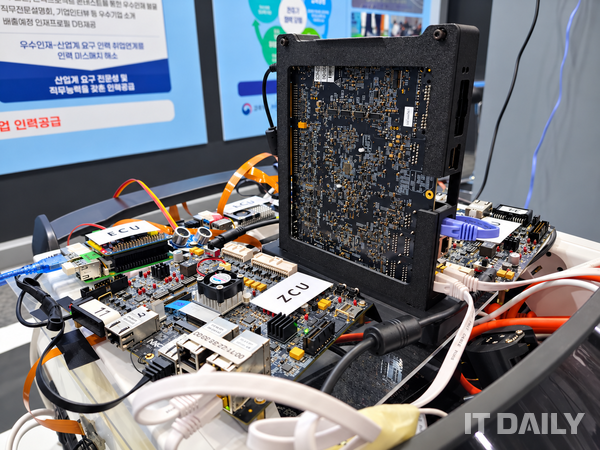
This change was visible at the Mobility Convergence Hall of the Korea Electronics Show (KES 2026), held on the 14th at COEX in Seoul. At the site, researchers from Sungkyunkwan University compared the existing "domain architecture" and "zonal architecture" as a way to examine changes in a vehicle's electrical and electronic (E/E) structure. The conventional domain architecture organizes controllers by function, such as braking, body, and infotainment.
By contrast, the zonal architecture groups physically nearby sensors and actuators by zone and connects those grouped devices to a zone controller. Communication, power distribution, sensor control, and actuator control functions are integrated into that zone controller. In the zonal architecture, the main computing entity is a central high-performance computer, and wiring that once had to run across the entire vehicle to connect function-specific controllers can be reduced.
Sungkyunkwan University researchers displayed an automotive electrical and electronic circuit board at the KES 2026 Mobility Convergence Hall. Photo and article credit: Kim Byeong-ju.
In automotive electrical and electronic architectures, the zonal architecture is being applied in mass production. It reduces wiring length and weight.
BMW has applied the zonal architecture to its next-generation vehicle, the "Neue Klasse." The wiring harness is divided into four zones: front, center, rear, and roof. The zone controller handles the aggregation of data flows from electronic devices in each zone. Major function-related computing is handled by four high-performance computers.
BMW said the amount of wiring used in the zonal wiring harness has been reduced by about 600 m compared with the previous generation. It also said the zonal wiring harness is 30% lighter than the previous generation. BMW said this is because the architecture connects electronic devices by zone, shortening wiring and making the configuration lighter.
In South Korea, Hyundai Motor Group is developing an electrical and electronic structure for SDVs called CODA (Computing & I/O Domain-based Architecture). The CODA architecture integrates physically close controllers by zone. Major computing is concentrated in a high-performance vehicle computer (HPVC).
Hyundai Motor Group said that under CODA, the number of controllers falls by about 66% compared with the existing setup. It also said the controller-sensor and connector wiring harness falls by 28%. However, reducing controllers and simplifying the role of automotive electronic components are separate issues.
Some of the functions handled by multiple ECUs are transferred to the central computer and zone controllers. With CODA, controllers and wiring are reduced, but as some functions move to the central computer and zone controllers, the responsibilities of the zone controllers expand.
The zone controller is responsible for transmitting peripheral device data to the central computer. It also handles power distribution, sensor input, and actuator control.
Accordingly, multiple semiconductors are incorporated into the zone controller. Components used in the zone controller include a microcontroller (MCU), automotive communication semiconductors, and power management and switching semiconductors.
Power distribution methods are also changing. BMW has applied a smart electronic fuse (eFuse) to the Neue Klasse. The smart electronic fuse (eFuse) replaces up to 150 conventional fuses. This makes it possible to cut power to unnecessary devices depending on vehicle state, such as driving, parking, and charging, and as a result the wiring can be made thinner and lighter.
As vehicle electronic architectures shift to a more centralized model, the scope of response required from automotive semiconductor companies is also expanding. The target of that response is broadening from individual ECUs to include central computers and multifunction integrated zone controllers.
However, it is not possible to transfer every vehicle function to the central computer. Devices that require rapid response, such as inverters, need direct control from close range.
This can be seen in the electric vehicle inverter from S&S displayed at the KES 2026 Mobility Convergence Hall. At KES, S&S, a first-tier supplier to Hyundai Mobis, unveiled a 100-kW electric vehicle inverter for advanced development.
An S&S representative said that parts where response time is critical, such as gate drivers for controlling power semiconductor switching, use a direct connection structure to reduce communication delays. This is an example showing why local, nearby control is maintained for devices that require high-speed response.
Photo credit: Kim Byeong-ju. An S&S electric vehicle inverter was on display at the KES 2026 Mobility Convergence Hall.
Source: IT DAILY · Kim Byeong-ju
Original: https://www.itdaily.kr/news/articleView.html?idxno=242217
References
This article was produced with the help of an automated content generation algorithm.
Source: IT DAILY
View originalThis article was summarized and organized by BizCrush based on the original article from IT DAILY. For exact quotations and full details, please refer to the original article.