VESSL AI Pushes to Secure 200,000 GPUs by 2030 in Global Neo-Cloud Expansion
TECHWORLD ·
✦ AI Summary
VESSL AI said it will expand its neo-cloud business by seeking to secure 200,000 GPUs by 2030.
The company also presented plans to establish AIDC hubs in 8 regions nationwide by 2028 and secure 100MW of power in 2027 and 500MW in 2028.
It plans to improve GPU operating efficiency through Fluid Computing and D2E, and expand into token-based inference services.
VESSL AI is moving to secure 200,000 GPUs by 2030 as it steps up its push into the global neo-cloud market. The company is taking domestic AI data center (AIDC) expansion as its strategy and seeking to expand large-scale AI training and inference services based on its own GPU operations technology.
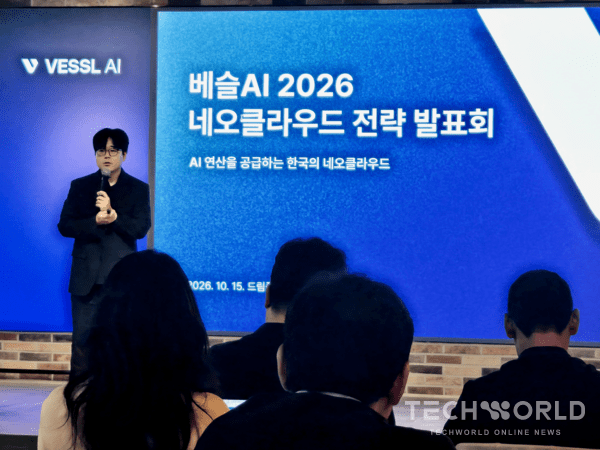
VESSL AI held the "2026 Neo-Cloud Strategy Presentation" at Dreamplus Gangnam in Seoul on the 15th. At the event, the company unveiled its mid- to long-term business plan and technology roadmap. CEO Ahn Jae-man presented its expansion and investment strategies, while CTO Jeon Ji-hwan presented GPU operations technology and inference service results.
CEO Ahn pointed to the spread of agentic AI as the background for growth in the neo-cloud market. He said computing demand is surging as AI agents increasingly carry out long-duration tasks. He also identified HBM production and data center power supply as constraints, arguing that the importance of AI-computing-specialized infrastructure is growing.
VESSL AI began in 2020 as an MLOps platform company. It later developed software to manage the training and deployment environment of GPUs owned by customers, and also secured technology to operate GPUs across multiple data centers in an integrated way. Based on this technology, the company expanded into the neo-cloud business, directly supplying AI computing resources.
Ahn said neo-cloud is a cloud service specialized for large-scale training and inference. He also explained that neo-cloud is not a business that can be done simply by installing GPUs in data centers. He emphasized that technology is needed to execute large-scale training and inference stably and efficiently.
Ahn said that if the number of people working with AI increases, computing demand will expand dozens of times to hundreds of times. He explained that the company is pursuing the neo-cloud business on the assumption that such demand will rise.
VESSL AI is seeking to secure 200,000 GPUs. It also set a target of KRW 2 trillion in revenue for 2028.
VESSL AI announced contract revenue of KRW 130 billion as of the first half of this year and forecast contract revenue of KRW 250 billion by year-end. It then set a contract revenue target of KRW 700 billion for 2027, and more than KRW 2 trillion for 2028. Along with that, it outlined its mid- to long-term growth plan based on annual contract revenue targets.
In line with this, it plans to gradually expand the amount of GPUs it secures. VESSL AI plans to increase its GPU inventory to 10,000 by the end of this year, to 50,000 in 2027, and to 200,000 in 2030. On funding for GPU procurement, it is in talks with 8 financial institutions in the United States, Singapore, and Korea over KRW 400 billion in GPU financing, and plans to expand GPU financing to KRW 2 trillion next year.
It also outlined plans for domestic AI data center hubs, power, and facility expansion. VESSL AI plans to secure domestic AI data center hubs in 8 regions nationwide by 2028. Its data center power plan is 100MW in 2027 and 500MW in 2028, and it intends to build facilities capable of accommodating next-generation GPUs.
VESSL AI is also working with SK Telecom (SKT), NHN Cloud, and Samsung SDS to expand its GPU supply chain. Together with SKT, it has secured infrastructure for more than 1,000 NVIDIA B200 GPUs, and it has signed a GPU supply contract with NHN Cloud. With Samsung SDS, it is pursuing the buildout of an AI factory based on Samsung Cloud Platform (SCP).
The company supplies the GPUs it has secured to AI development companies in Korea and abroad. In particular, it aims to expand overseas revenue through a strategy that connects training and inference demand in Silicon Valley in the United States to domestic data centers.
At the core of this strategy is VESSL AI's key technology, "Fluid Computing." Fluid Computing is a technology that manages GPUs distributed across multiple data centers as if they were a single resource pool.
This technology automatically places GPUs suitable for training and inference tasks. CTO Jeon described it as a concept for operating data centers scattered across the country and around the world as a single GPU.
Fluid Computing also carries out task placement based on GPU type and available resources, using a technology that selects the optimal GPU for each user task. It can also reassign GPUs used for training to inference, reducing idle time.
In addition, Fluid Computing includes GPU and network anomaly detection features. The company said the technology has reduced manual work by about 30% and preemptively detected more than 80% of failures.
CTO Jeon said that given the frequent failures in GPU infrastructure, it is impossible for people to respond manually to every problem. He explained that the company is working to automate the process of preemptively detecting failures and replacing GPUs likely to develop problems.
The company then introduced "Direct-to-Expert (D2E)," a strategy for optimizing infrastructure tailored to customer AI workloads. It explained that the D2E approach involves AI model and infrastructure experts jointly analyzing customers' training and inference environments and adjusting network communications and GPU placement. The company said D2E improved token processing efficiency per GPU by up to 2.7 times.
As a real-world example, it pointed to Upstage LLM "Solar Pro 4." VESSL AI is participating in the operation of training and inference services for "Solar Pro 4," and said it processes up to 155 billion tokens a day. It also said that after inference optimization, cache hit rates rose from 46% to 94%, and generation time per output token was cut from 35 ms to 14 ms.
VESSL AI is expanding its business based on its operational experience. The expansion direction is to widen its offering from GPU time supply to token-based inference services.
The company plans to open a cluster based on NVIDIA's "DGX Vera Rubin NVL72" in the first half of 2027. It then plans to build an AI factory in 2028 that operates domestic NPU and GPU systems in parallel.
As it competes with global neo-cloud companies, VESSL AI highlighted its proprietary software capabilities and partner-centric infrastructure operations as its differentiators. Ahn explained that global neo-cloud companies have grown rapidly through large debt-based capital raising and facility investment.
Ahn said VESSL AI is jointly using partner data centers and relatively reducing the burden of assets and liabilities by leveraging external infrastructure. He also said that using partner data centers allows the company to pursue an asset-light business model.
VESSL AI is positioning its ability to supply flexible computing resources tailored to each customer AI workload as a competitive edge. Because the GPU requirements differ by stage — pretraining, post-training, and inference — it says allocating resources to match actual tasks is more cost-effective than long-term fixed contracts.
Ahn said that even if the hourly GPU price is similar to or slightly higher than that of competitors, customers tend to choose this approach because the total cost is lower. He said this is an example of how an operating model that flexibly allocates GPU resources according to the stage of the AI task, rather than locking them in fixed arrangements, is presented as a cost advantage.
VESSL AI has already been running AI development and operations software alongside its GPU infrastructure business, and Ahn said the company intends to expand into a full-stack business encompassing AI infrastructure and software. VESSL AI plans to broaden its scope into AI factories and inference services, and has also set a policy to expand its neo-cloud business.
VESSL AI plans to pursue both domestic GPU infrastructure expansion and overseas customer acquisition. However, the company identified future challenges as raising large-scale funds, executing its data center acquisition plans, and linking GPU operating efficiency to stable revenue and improved profitability.
Source: TECHWORLD · Kim Seung-gi
Original: https://www.epnc.co.kr/news/articleView.html?idxno=408261
References
This article was produced with the help of an automated content generation algorithm.
Source: TECHWORLD
View originalThis article was summarized and organized by BizCrush based on the original article from TECHWORLD. For exact quotations and full details, please refer to the original article.