Half of Rural and Village Bus Fleets Lack Wi-Fi, With 3,504 Vehicles Undeployed Nationwide
IT DAILY ·
✦ AI Summary
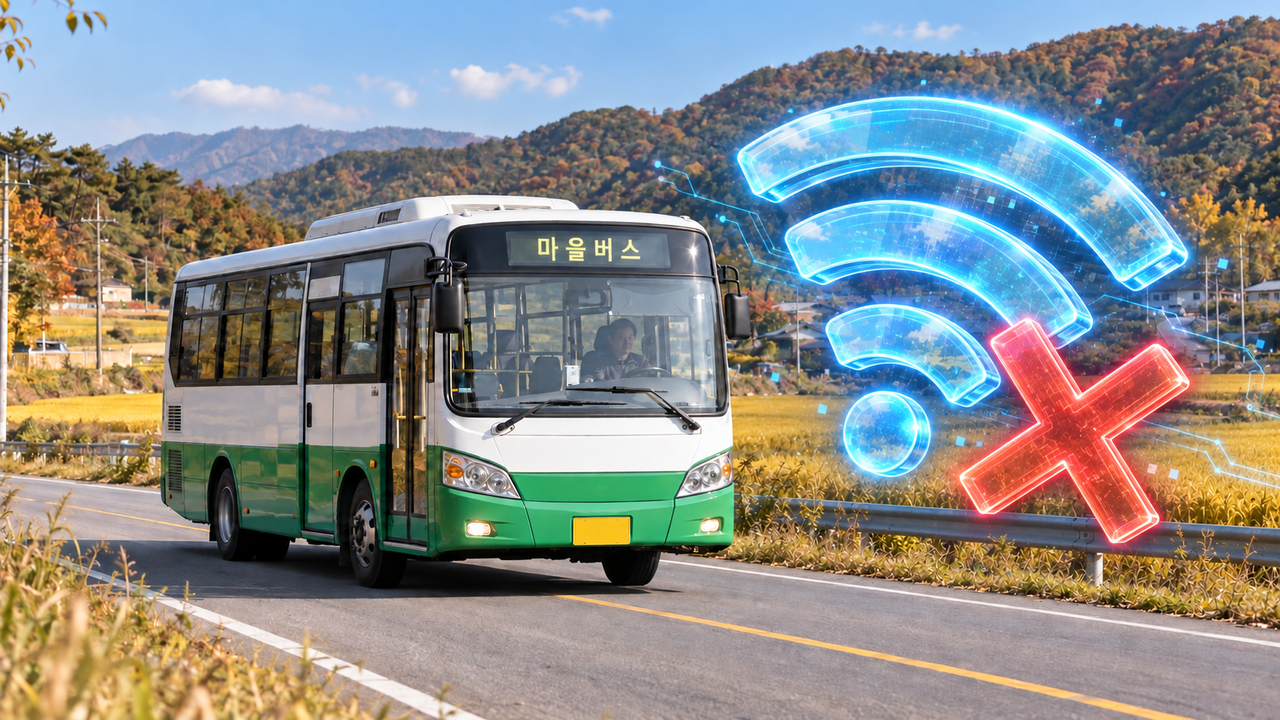
This year, the number of rural and village buses nationwide was tallied at 6,997.
The number of vehicles not equipped with Wi-Fi was 3,504, accounting for 50.1%.
The NIA conducted a pilot project from May to July 2024 to provide 5G-based public Wi-Fi on 90 rural and village buses across 7 cities and provinces and 16 cities and counties.
Rep. Lee Joo-hee of the National Assembly's Science, ICT, Broadcasting and Communications Committee disclosed data submitted by the National Information Society Agency (NIA) on the 14th and tallied the status of Wi-Fi deployment on rural and village buses nationwide. This year, the number of rural and village buses nationwide was tallied at 6,997.
Of these, 3,504 vehicles had not been equipped with Wi-Fi, accounting for 50.1%. Roughly half of rural and village buses were found to be running without Wi-Fi.
Looking in detail, among 1,530 rural buses, 947 had not been equipped with Wi-Fi, for a non-deployment rate of 61.9%. Among village buses, 2,557 of 5,467 vehicles had not been equipped with Wi-Fi, for a non-deployment rate of 46.8%. The non-deployment rate for rural buses was higher than that for village buses.
Among vehicles with Wi-Fi installed, 15% were found to be based on LTE rather than 5G. Village buses are primarily under the jurisdiction of local governments, are operated by private businesses, and are standee-type vehicles. Rural buses play a role similar to village buses and are classified into express-seat, seat, and general types.
Of the 3,493 vehicles currently equipped with Wi-Fi, 534 were operating on an LTE basis, or 15.3%. This is not 5G.
Against this backdrop, the NIA conducted a pilot project from May to July 2024 to provide 5G-based public Wi-Fi on 90 rural and village buses across 7 cities and provinces and 16 cities and counties.
As a result of the pilot operation, average monthly data usage per bus was tallied at 90 GB. Usage per user was 10 MB, 60.9% higher than the 6 MB seen on city buses. Total usage was lower than on city buses, but data usage per user was higher.
User evaluations were also positive. Of 450 survey respondents, 393 said the service needed to continue, accounting for 87.3%. Of 287 respondents who actually used Wi-Fi, 230 said they were satisfied with the service, for a satisfaction rate of 80.1%.
Reasons for wanting the service to continue included the lack of places offering free internet access and the ability to reduce communication costs.
Rep. Lee also said rural and village buses are everyday transportation used by residents to get to school, hospitals and markets, and opposed concentrating telecommunications welfare benefits only on routes with many users. She said the government and local governments must secure the necessary budget and prevent digital service access from being left behind depending on place of residence.
Source: IT DAILY · Seong Won-young
Original: https://www.itdaily.kr/news/articleView.html?idxno=242214
References
This article was produced with the help of an automated content generation algorithm.
Source: IT DAILY
View originalThis article was summarized and organized by BizCrush based on the original article from IT DAILY. For exact quotations and full details, please refer to the original article.