Dell Technologies Expands Dell AI Data Platform Features to Support Enterprise AI Operations
IT DAILY ·
✦ AI Summary
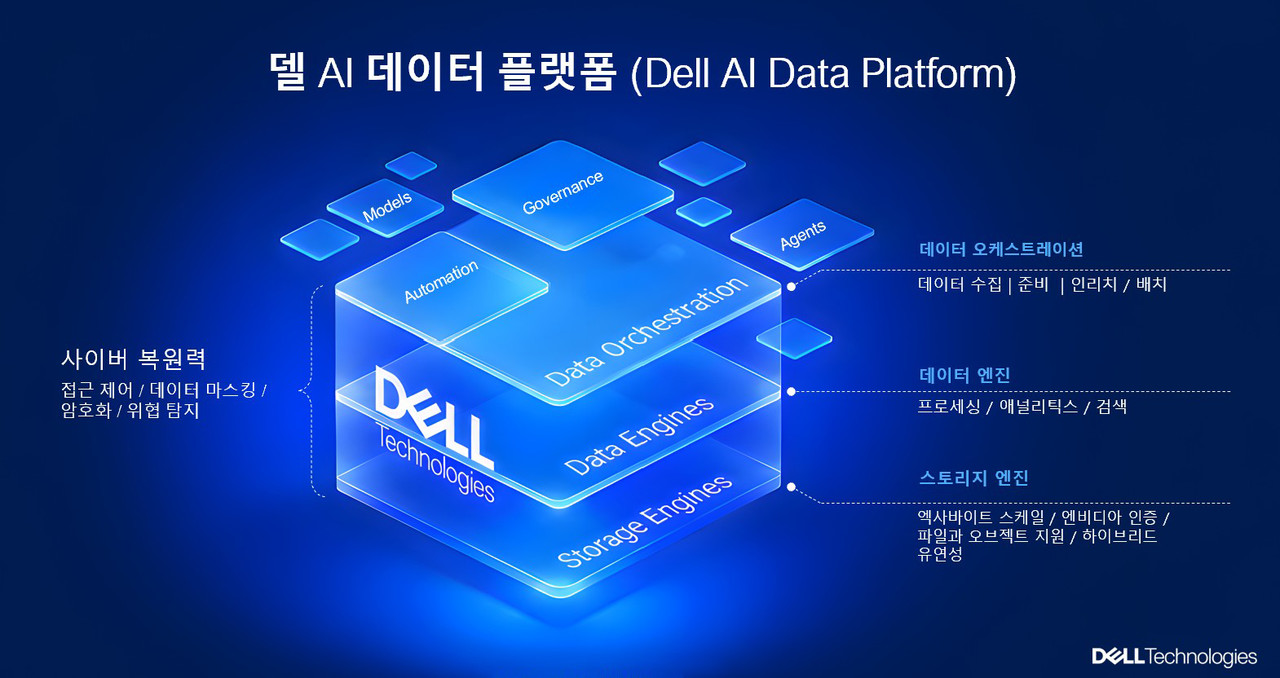
Dell Technologies said on the 15th that it has significantly expanded the capabilities of the Dell AI Data Platform.
The expansion aims to provide trusted business context for enterprise AI applications and agents.
Dell said it added three new features and strengthened processing performance and multi-tenant security.
Dell Technologies announced on the 15th that it has significantly expanded the capabilities of the Dell AI Data Platform. The goal of this expansion is to provide enterprise AI applications and agents with trusted business context.
Dell Technologies said many companies are currently experiencing bottlenecks in adopting AI in practice not because of the model itself, but because of distributed data environments. Accordingly, it broadened the platform's capabilities in a way that identifies data fragmentation as an obstacle to enterprise AI operations and addresses it.
The focus of this update is on integrating and connecting fragmented data within enterprises. Dell Technologies said its goal is to improve the quality of AI agent responses, reduce token usage and compute costs, and support the transition of AI workloads into Production.
At present, key internal assets are distributed across on-premises storage, heterogeneous DBs, and the cloud, and remain in unstructured form. This structure, in which enterprise data is scattered across multiple storage environments and left unstructured, was identified as the problem.
In such an environment, AI agents must repeatedly search with each query. Dell Technologies explained that this leads to response delays, hallucinations, and excessive waste of compute resources, worsening both response quality and cost efficiency for AI agents.
Dell added three new features to address problems across the data pipeline. Among them, the Unified Semantic Layer standardizes terminology across heterogeneous systems into common business concepts, while support for NVIDIA Auto Ontology helps build knowledge graphs.
The Enterprise Knowledge Graph maps relationships between structured and unstructured data, and also maps Lineage. Dell said that by combining this with Knowledge Agents, it can provide relevant context so that, when anomalies occur, related part deployments can be traced back and delivery orders can also be traced back. Knowledge Agents also perform optimal advisory functions by reflecting domain-specific detailed rules and security standards.
These features are built inside customers' own data centers. This helps securely protect core corporate confidential data and provides an open environment that is not tied to any specific AI model or infrastructure vendor.
Dell said it has improved data pipeline processing performance and security governance. It applied Apache Arrow and NVIDIA cuDF acceleration technologies to the Dell Data Processing Engine. As a result, the Dell Data Processing Engine's performance improved by an average of about 4 times compared with CPU-only operation, and by up to 20 times for batch processing workloads. This performance improvement shortened data preparation time.
On the storage side, Dell strengthened multi-tenant security through Dell PowerScale, its scale-out storage. Dell PowerScale supports isolation for up to 500 tenants in a single cluster. It also applies mTLS encryption for NFS traffic and RBAC. As a result of these security features, multi-tenant security was strengthened.
Dell supports precise measurement of object storage performance through the Dell Storage Performance Tool. Yum Sang-mo, president of Dell Technologies Korea, said that contextless data is merely noise, and that if AI agents cannot determine the meaning and interconnectedness of information, it is difficult to implement truly intelligent services. He added that he believes the Dell AI Data Platform will provide enterprise assets with consistent business context under governance and security controls, maximize the value of accumulated data, and drive the shift to full-scale enterprise AI operations.
Source: IT DAILY · Kwon Young-seok
Original: https://www.itdaily.kr/news/articleView.html?idxno=242204
References
This article was produced with the help of an automated content generation algorithm.
Source: IT DAILY
View originalThis article was summarized and organized by BizCrush based on the original article from IT DAILY. For exact quotations and full details, please refer to the original article.