FADU Unveils 'FS-SSD' Targeting AI Data Centers, Reshaping Storage Architecture
TECHWORLD ·
✦ AI Summary
FADU said on the 15th that it had unveiled next-generation technology to improve storage operation efficiency in AI data centers.
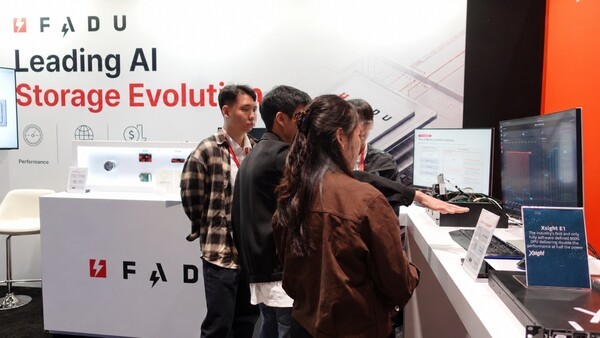
At the "2026 OCP Global Summit," held from October 12 to 15 at the San Jose Convention Center in California, FADU unveiled FS-SSD and next-generation storage solutions.
FADU said the performance of a 16TB SSD equipped with its sixth-generation SSD controller, "FC6161," was up to 2.5 times better than existing Gen5.
FADU said on the 15th that it had unveiled next-generation technology designed to improve storage operation efficiency in AI data centers. At the "2026 OCP Global Summit," held from October 12 to 15 at the San Jose Convention Center in California, FADU unveiled FS-SSD and next-generation storage solutions.
The OCP Global Summit is an annual event hosted by the Open Compute Project. The Open Compute Project is an open data center technology community, and this year's theme was "Scaling Innovation for the AI Era." Global big tech companies, semiconductor makers, server manufacturers, and infrastructure manufacturers took part in the event.
FADU has been active as an OCP member company since 2022. This year, it operated a standalone booth and introduced related technologies there.
Centering on FS-SSD, which allows SSDs to directly understand and manage files, FADU has equipped its sixth-generation SSD controller with file-processing firmware. The architecture is designed to handle tasks previously performed by the server CPU and operating system inside the SSD. Tasks processed inside the SSD include file lookup, access permission verification, and file-to-address translation.
FADU also adopted a method of embedding file requests in standard NVMe commands to create an access structure that bypasses the CPU. As a result, GPUs, DPUs, and other servers connected over the network can access the SSD directly without going through the CPU. The direct access function is intended for file read and write operations.
The purpose of this structure is to reduce storage bottlenecks in AI training and inference. With the spread of generative AI and AI inference, repeated reading of training data and checkpoint saving are increasing. In existing systems, when a GPU opens a file, it must go through the CPU and the host file system, which can cause processing delays and increase CPU load.
Through FS-SSD, FADU plans to shorten the data processing path and reduce the CPU, memory, and software layers that handle file services in storage servers. The company aims to cut power consumption and costs while improving both performance and power efficiency in AI data centers. It also seeks to build a storage architecture that can improve performance and power efficiency at the same time.
Going forward, FADU plans to develop FS-SSD into a DPU-based hostless storage server and further into scalable file storage. As a way to pursue this, it plans to provide reference designs to OEM and ODM partners.
At the event, FADU demonstrated its sixth-generation SSD controller technology. In the Gen6 exhibition area at its booth, the company showcased real-time performance using a 16TB SSD powered by the "FC6161" controller, and said the product's performance was up to 2.5 times better than existing Gen5.
FADU highlighted improved power efficiency by presenting power figures for its Gen6 controller and finished SSD. It said the power consumption of a finished SSD based on the Gen6 controller is less than 28W for sequential writes and less than 5W in standby. It added that the controller itself consumes less than 6W for reads and about 7W for writes.
FADU announced that, along with improved performance, performance per watt has improved significantly compared with existing Gen5. It also noted that power delivery and cooling burdens are increasing in AI data centers.
In response, FADU presented a strategy to strengthen its market competitiveness with high-performance, low-power storage technology. Nam Yi-hyun, CEO of FADU, said AI data centers require power efficiency, stable latency, power management, and cooling. He added that, based on its controller technology recognized in the global market, the company aims to leap forward as a leading AI storage solutions company together with FS-SSD.
Source: TECHWORLD · Park Kyu-chan
Original: https://www.epnc.co.kr/news/articleView.html?idxno=408211
References
This article was produced with the help of an automated content generation algorithm.
Source: TECHWORLD
View originalThis article was summarized and organized by BizCrush based on the original article from TECHWORLD. For exact quotations and full details, please refer to the original article.