DeepX NPU Delivers Vision and Language AI on 3W of Power, Introduced by Raspberry Pi
TECHWORLD ·
✦ AI Summary
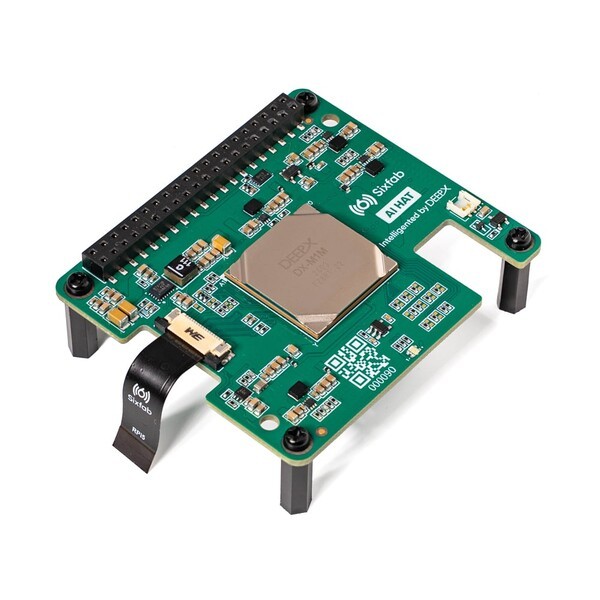
Raspberry Pi recently published a technology introduction piece on DeepX and Sixfab in its official newsroom. The featured product was the "Sixfab AI HAT+" AI accelerator board for the Raspberry Pi 5 with the DX-M1M installed. The content covered how to run AI on-device, its possible applications, and its up to 25TOPS performance and about 3W power consumption.
Raspberry Pi recently published a technology introduction piece on DeepX and Sixfab in its official newsroom, introducing DeepX NPU technology. Sixfab is an official design partner of DeepX, and the featured product was the "Sixfab AI HAT+" AI accelerator board for the Raspberry Pi 5 with the DX-M1M installed.
According to what DeepX announced on the 15th, the content covered how to run AI on-device and its possible applications. Raspberry Pi introduced a way to run AI on-device through a board for the Raspberry Pi 5 equipped with the DX-M1M.
The technology was highlighted for offering up to 25TOPS of compute performance and about 3W of NPU power consumption. The DX-M1M delivers up to 25TOPS, and the DX-M1M NPU itself consumes about 3W under a typical continuous-operation environment; this roughly 3W figure excludes the power consumption of the Raspberry Pi main unit and peripherals.
Based on these characteristics, its implementable range was presented as spanning from image recognition to vision-language AI. Its low power consumption and low heat generation were also introduced as helping reduce cooling burdens on small devices and as favorable for continuous AI operation.
The use case for DeepX NPU is expanding beyond object detection to contextual understanding and explainable AI. In this structure, CNNs detect objects and anomalies in images, a small vision-language model (VLM) interprets scene context, and a small language model (SLM) understands commands and organizes the analysis results into short sentences.
As an example system applying this combination, a workbench camera detects output errors from a 3D printer, analyzes the scene, and then explains the problem to the user. Such a configuration can be extended to production line quality monitoring, robot environment awareness, smart space situation analysis, and other physical AI applications.
These functions can be handled through an edge AI approach that runs AI directly on the device. Edge AI has the advantage of reducing reliance on external data transmission and network connectivity, thereby improving real-time response capability and easing privacy concerns during data transmission.
DeepX provides model conversion and optimization tools, runtime software, video processing tools, and preoptimized AI models to support AI application implementation. The goal is to connect hardware, AI models, and software tools that developers are already familiar with.
DeepX runtime and model formats are used as a common foundation across the Sixfab AI HAT+, edge AI expansion boards, and the industrial AI gateway "ALPON X5 AI." As a result, AI models verified on development boards can be applied to industrial products, and software continuity is a defining feature.
This is part of an open ecosystem strategy built on support that spans initial technology verification, prototyping, and mass production. DeepX is establishing a structure that maintains continuity across both the development stage and the industrial deployment stage.
DeepX is collaborating with global hardware and AI software ecosystems such as Raspberry Pi, Baidu's AI framework PaddlePaddle, and the AI video analytics platform Ultralytics. Through this, it plans to lower barriers for developers adopting AI semiconductors and expand its customer base in global markets.
The key to ecosystem expansion is presented as enabling Raspberry Pi-based developers to test AI and carry it through to productization. This means that developers around the world using Raspberry Pi can experiment with AI, and the results of those experiments can also potentially evolve into real products. This is cited as a factor that broadens the meaning of ecosystem expansion.
Technologies chosen during development may later lead to industrial product development. Accordingly, securing a developer base is expected to affect long-term business expansion. A DeepX official said that a condition for the spread of physical AI is making it easy for developers around the world to implement the AI functions they need and connect them to real products.
In this context, DeepX and Sixfab launched the Sixfab AI HAT+, an AI accelerator board for the Raspberry Pi 5 with the DX-M1M installed, last June. It is currently selling a product with up to 25TOPS, and a 13TOPS version is scheduled to launch by the end of this year. A DeepX official said the company plans to support the productization of experiments that begin on Raspberry Pi for the global market, and that its support covers the development environment from semiconductors and software to mass production.
Source: TECHWORLD · Park Kyu-chan
Original: https://www.epnc.co.kr/news/articleView.html?idxno=408212
References
This article was produced with the help of an automated content generation algorithm.
Source: TECHWORLD
View originalThis article was summarized and organized by BizCrush based on the original article from TECHWORLD. For exact quotations and full details, please refer to the original article.