iTcenPNS, Palo Alto Networks, and Enki Whitehat Team Up on AI Security Business
TECHWORLD ·
✦ AI Summary
iTcenPNS, Palo Alto Networks, and Enki Whitehat have signed an MOU to cooperate on AI security business.
The three companies will respond to cyber threats arising from the spread of generative AI and AI agents, and will develop joint solutions and offensive security services, initially targeting the financial sector.
Palo Alto Networks will provide its AI security platform and automation platform, Enki Whitehat will provide attack validation and AI-based penetration testing technologies, and iTcenPNS will handle commercialization and customer and partner networks.
iTcenPNS, Palo Alto Networks, and Enki Whitehat will collaborate on AI security business. The three companies agreed to jointly respond to cyber threats arising from the spread of generative AI and AI agents.
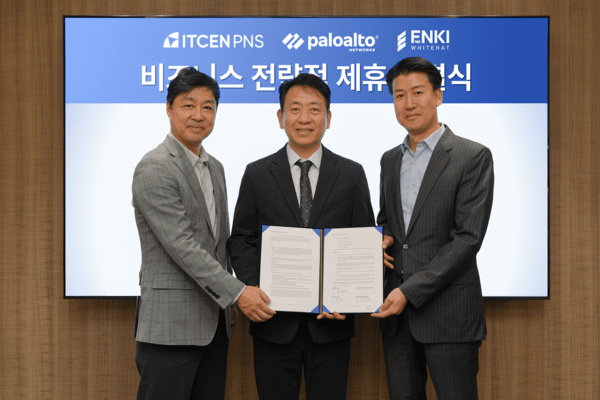
iTcenPNS announced that it had signed a memorandum of understanding (MOU) with Palo Alto Networks and Enki Whitehat. The MOU aims to address security threats in the frontier AI era and advance domestic security operations systems.
The three companies will pursue a vulnerability validation model from an attacker's perspective. The model will be linked with AI-based detection, analysis, and response systems, with the financial sector as the initial target. The core of the partnership lies in combining iTcenPNS's commercialization capabilities, customer base, and partner network with Palo Alto Networks' AI-based integrated security platform and Enki Whitehat's attack validation and AI-based penetration testing technologies.
Based on this, the three companies plan to jointly develop customized AI threat response solutions for domestic customers. They also plan to jointly develop offensive security services.
This business will initially target the financial sector, which handles sensitive data such as personal information and financial transaction data, and will carry out AI red teaming, AI vulnerability and agent security validation, security policy checks based on attack simulations, and the establishment of AI-based security operations systems. After securing experience applying the approach in the financial sector, the companies plan to expand cooperation to other industries.
Palo Alto Networks will provide network security, AI security, and integrated security operations automation platform capabilities in this project. Prisma AIRS, the security tool for AI environments, will inspect and protect threats across the full development-to-operations lifecycle of AI models, applications, data, and agents. Cortex will also be used to support integration with security operations automation.
The system linked to the joint business is structured to connect AI red team, runtime security, and agent security functions with attack validation results. It will operate in a flow that identifies vulnerabilities, analyzes risks, applies policies, and then links to detection and response.
Parksang-gyu, CEO of Palo Alto Networks Korea, said that as the speed of both attacks and defenses rises with AI, security operations methods for companies, including those in the financial sector, need fundamental change.
Enki Whitehat will be responsible for validating the feasibility of actual attacks from an attacker's perspective. Using OFFen, its offensive integrated security platform, and OFFen RED, its AI-based penetration testing automation solution, Enki Whitehat will inspect potential attack paths and vulnerabilities in IT systems and AI services. In this process, it will draw on security validation experience accumulated in the financial sector and the practical attack capabilities of white-hat hackers. In addition, during the adoption of AI services, threats such as prompt injection, data leakage, excessive privilege use, and misuse of AI agents will be subject to validation.
Parksang-gyu, CEO of Palo Alto Networks Korea, said the company plans to support the transition of domestic financial customers to AI-based security operations by linking Enki Whitehat's attack validation capabilities with Palo Alto Networks' AI security technologies.
Lee Seong-gwon, CEO of Enki Whitehat, stressed that to respond to the advancement of AI-based attacks, it is important to continuously validate security levels from the perspective of an actual attacker. He said the company intends to establish a preemptive security model that connects the practical attack capabilities of white-hat hackers and AI-based penetration testing technologies with a global security platform.
iTcenPNS will be responsible for combining the two companies' technologies and commercializing them to fit domestic customer environments. Using the AI Security Innovation Center, iTcenPNS plans to establish customer PoC and technical validation environments and build a business framework that links attack validation, security consulting, and solution deployment and operations.
The three companies plan to link Enki Whitehat's attack validation results to Palo Alto Networks' network security, Cortex, and Prisma AIRS. Through this, they aim to build a system that connects vulnerability and attack feasibility checks to risk analysis, security policy application, detection, response, and revalidation, and to shift security operations from a post-incident response focus to continuous validation and response.
This collaboration will be pursued in parallel with cooperation in technology and human resources. The parties will share the latest cyber threat and attack technique information as well as AI security technology information, and will promote joint training, seminars, and workshops. Through this, they plan to develop specialists in AI security, offensive security, and security operations.
They also plan to identify joint customers and develop technical content based on business results and application experience secured in the financial sector, while expanding partner cooperation. Going forward, they intend to expand the AI-based security operations model and the attack validation model to other industries such as manufacturing and the public sector.
Park Won-gyu, CEO of iTcenPNS, said that the development of frontier AI is accelerating innovation in domestic industries while also bringing changes in the speed and complexity of cyber threats. He said the company will pursue a combination of Palo Alto Networks' global AI security platform, Enki Whitehat's attack validation capabilities, and iTcenPNS's commercialization and technical support capabilities, and will push ahead with AI-based innovation in customers' security operations systems. He also said the company is determined to lead the shift in South Korea's security paradigm.
Source: TECHWORLD · Kim Seung-gi
Original: https://www.epnc.co.kr/news/articleView.html?idxno=408202
References
This article was produced with the help of an automated content generation algorithm.
Source: TECHWORLD
View originalThis article was summarized and organized by BizCrush based on the original article from TECHWORLD. For exact quotations and full details, please refer to the original article.