Samsung Electronics Moves to Secure 6G Lead in Silicon Valley, Unveils AI and Satellite Communications Technologies
TECHWORLD ·
✦ AI Summary
Samsung Electronics will hold Partner Day and the Silicon Valley Future Wireless Summit 2026 in Mountain View, California, on the 14th and 15th.
The event will cover AI and satellite communications technologies, the direction of software-based network evolution for the AI era, and 6G technology development challenges.
Samsung Electronics will unveil key 6G technologies such as AI RAN, X-MIMO, D-MIMO, and ISAC, and will also present the results of joint development and verification with global partners.
Samsung Electronics is seeking to expand cooperation on next-generation network technologies in Silicon Valley. The company announced its event plans on the 15th.
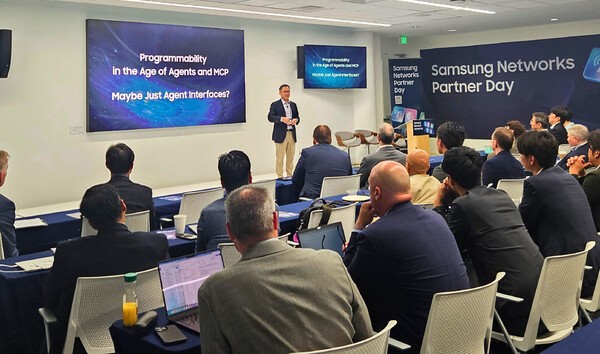
The event will be held on the 14th and 15th local time in Mountain View, California. During this period, Samsung Electronics will host "Partner Day" and the "Silicon Valley Future Wireless Summit 2026."
The purpose of the event is to push ahead with securing leadership in 6G. At the event, AI and satellite communications technologies will be unveiled, and more than 100 telecommunications experts, including representatives from mobile carriers, manufacturers, government agencies, and academia, will discuss the direction of software-based network evolution in the AI era, 6G technology development challenges, and new business opportunities in the telecommunications industry.
At Partner Day on the 14th, global cooperation measures for network evolution in the AI era and the creation of new value were the main agenda items.
In the keynote speech, Samsung Electronics assessed changes across AI infrastructure and said telecommunications networks are at a structural turning point. It then presented a next-generation network combining AI and virtualization technologies. The company said the next-generation network will help overcome the limitations of existing telecommunications and serve as a key foundation for realizing new communication methods.
Participants shared the technologies and operational directions needed for future AI-based networks. They also discussed ways to develop the industry ecosystem based on experience accumulated through the commercialization of virtualized networks. The discussion also covered ways to move away from the existing business structure centered on connectivity services, as well as ways to discover new services and growth opportunities through network use.
Park Jung-ho, head of the Strategy Marketing Team at Samsung Electronics' Network Business Division and vice president, said networks in the AI era must identify the demand for a wide range of new services. He added that they must evolve into intelligent infrastructure that offers optimal answers through flexible, virtualization-based changes.
The speaker said Samsung Electronics will pursue the integration of advanced AI technologies based on the achievement of successfully commercializing virtualized networks on a large scale with global partners. He also expressed the company’s determination to make telecommunications infrastructure a new growth engine and lead the path toward a shared leap forward for the industry.
The Silicon Valley Future Wireless Summit 2026 will be held on the 15th. The summit consists of sessions on AI-native 6G networks, sessions on expanding 6G coverage based on satellite communications, and sessions on hyperconnectivity linking the real and virtual worlds.
In the AI-native 6G network session, participants will discuss ways to improve network performance and operational efficiency using AI. Key agenda items will also include technical challenges and industry cooperation measures for developing 6G networks into intelligent infrastructure.
In the satellite communications-based 6G coverage expansion session, participants will discuss the status and outlook for low-Earth-orbit satellite constellations, as well as the technical barriers to space communications and ways to solve them. The session will also cover 3GPP's non-terrestrial network (NTN) standards and 3GPP's non-terrestrial network (NTN) technology roadmap.
The hyperconnectivity session, themed around connecting the real and virtual worlds, will focus on technologies that recognize physical space and link it with digital services. The session will highlight integrated sensing and communication (ISAC) and physical AI as the technologies under discussion. These technologies handle physical-space recognition and linkage to digital services.
Among them, ISAC is introduced as a concept that simultaneously performs communications and sensing using the same frequency band and hardware. ISAC is described as one of the core technologies for next-generation 6G networks.
Samsung Electronics will unveil key 6G technologies at this event. These technologies were co-developed and verified with global partners. The items to be unveiled are AI-based radio access network (AI RAN), X-MIMO, D-MIMO, and integrated sensing and communication (ISAC). AI RAN is a radio access network combined with AI that improves communications performance and network operating efficiency. X-MIMO is a technology that uses multiple antennas to enhance communications capacity and performance. D-MIMO is a technology that improves communications performance based on a distributed multiple-input multiple-output system.
Samsung Electronics plans to disclose technology demonstrations and actual verification results. Verification items include communications performance when AI is applied across all layers of the radio access network, transmission performance in the 7 GHz band, a candidate frequency for 6G, user-perceived performance at cell edges, and sensing performance using base station infrastructure. Through this, the company plans to showcase its capabilities in technologies for realizing next-generation networks, including AI-based network optimization, high-performance wireless communications, and integrated sensing and communication.
These technology development and verification efforts are taking place as Samsung Electronics expands 6G and AI-based communications technology development through cooperation with global mobile carriers, research institutions, and consortia. Rather than acting alone, Samsung Electronics aims to demonstrate its capabilities in realizing next-generation networks based on expanded cooperation with related partners.
This year, Samsung Electronics began collaborating with LG Uplus to develop ISAC technology. It also carried out on-site verification of related technologies with Verizon at a major global sports event in Dallas, the U.S. In addition, it strengthened research cooperation with major domestic and overseas telecom operators such as SoftBank, NTT Docomo, KDDI Research, KT, and SK Telecom.
Samsung Electronics plans to refine core 6G technologies through joint research and technology verification with global partners. It will also pursue the development of next-generation telecommunications infrastructure that combines AI and software-centric networks.
Jeong Jin-guk, head of the Next Generation Communications Research Center at Samsung Research, Samsung Electronics, and vice president, said Samsung Electronics will lead the development of key network technologies for realizing 6G through close cooperation with partners in the telecommunications industry. He added that the company plans to concentrate its advanced research capabilities on the development of next-generation communications technologies for carriers and users.
Source: TECHWORLD · Park Gyu-chan
Original: https://www.epnc.co.kr/news/articleView.html?idxno=408209
References
This article was produced with the help of an automated content generation algorithm.
Source: TECHWORLD
View originalThis article was summarized and organized by BizCrush based on the original article from TECHWORLD. For exact quotations and full details, please refer to the original article.