Teradata: “A Context Gap Is Hindering AI Use... Data Meaning Must Be Connected”
IT DAILY ·
✦ AI Summary
It was argued that AI use requires context in which data reflects business meaning and relationships.
It was explained that a data catalog alone may be insufficient to organize business meaning and interpretation methods.
Teradata announced the 'Terra Context Engine,' which connects context, along with its investment plans for the Korean market.
A context gap has been identified as a factor hampering AI use. It was presented as a prerequisite for delivering meaningful AI results that data reflect business meaning and relationships. Even when data has been accumulated sufficiently, it is difficult to produce reliable results if the context needed for interpretation is lacking.
Teradata, a global data and AI company, held a group interview in Yeouido, Seoul, on the 14th. Teradata provides enterprise data management, analytics, and AI enablement services.
At the event, Teradata emphasized the need to connect data to its business meaning and to manage change history as well. The point was that securing interpretable context is more important than the amount of data itself.
Josh Abbott, Teradata vice president for Asia Pacific and Japan, said AI model performance has improved and the problems AI can solve have increased. He also pointed out that the scope of data fed into AI is excessive.
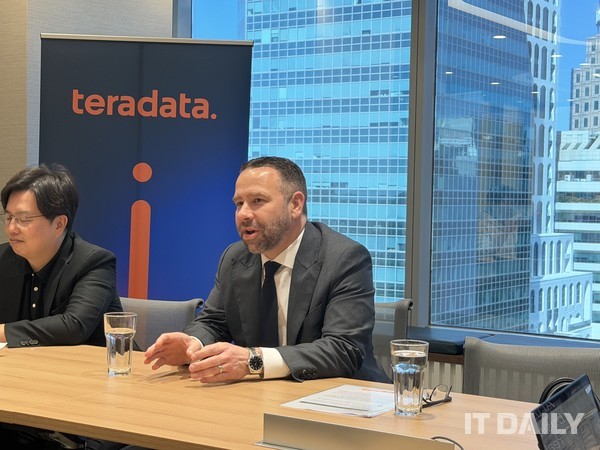
Josh Abbott, Teradata vice president for Asia Pacific and Japan, said there is a problem in that the meaning of AI input data is ambiguous. A photo was also provided showing Josh Abbott, Teradata vice president for Asia Pacific and Japan, taking questions at the group interview in Yeouido, Seoul, on the 14th.
Abbott said that even with a data management framework in place, a context gap can remain between data and its business meaning. Simply having a data catalog can identify where data is located and how it is being used. However, he said a data catalog alone may be insufficient for organizing business meaning and interpretation methods.
As an example of this gap, Teradata cited a result from reviewing several million data columns for a major customer in the Asia-Pacific region. In that review, the share of columns that included business meaning was less than 1%.
In addition, data passes through many intermediate stages from the source to the final point of use. As a result, the complexity of tracing movement, transformation paths, and meaning increases. Abbott said that trying to determine meaning based only on data attributes can cause confusion. He then explained that identifying who is using what and understanding meaning are separate issues.
Abbott stressed that continuous management is needed even after context has been secured. That is because the meaning of data can vary by system. He also noted that interpretations valid in one environment may be unsuitable in another business.
He stressed the need to detect changes when they occur in data products. He also emphasized the need to record all changes in a knowledge graph and manage versioning.
As a core strategy to reduce the previously raised gap in change management for data products, Teradata introduced the 'Terra Context Engine.'
Abbott explained that the 'Terra Context Engine' connects the history of data movement and transformation with business meaning and relationships. He said the engine's role is to provide the context needed for AI use.
Abbott also said it continuously manages context by tracking changes. He then introduced 'Terra,' an agentic coworker that performs enterprise data tasks based on natural language.
He also introduced 'Terra Harness,' an execution layer that coordinates the tools, data, and models needed for tasks. He said it was designed to be vendor- and model-neutral for customer convenience. He also explained that both in-house AI models and external frontier models can be used.
Teradata disclosed its investment plans for the Korean market. The company said its investment direction in Korea will prioritize technical workforce support for responding to proof-of-concept (PoC) demand, including for context engines. Josh Abbott, Teradata vice president for Asia Pacific and Japan, said he sees AI momentum in Korea as stronger than in other countries, and explained that the first investment is to provide technical staff that can immediately support customer PoC requests.
Teradata also said it is preparing to hire personnel in areas such as marketing. It added that it is also preparing to expand its partner ecosystem.
This report summarizes the main Q&A from the group interview. Among the topics raised, the questions focused on the difference between Terra Context Engine and existing data catalogs and semantic layers.
Vice President Josh Abbott presented the key distinction of Terra Context Engine as understanding the meaning of data, going beyond simply identifying its existence. He explained that while existing tools focus on identifying where data is and who is using what data, that is different from knowing the meaning of the data.
He said that simply organizing several million data items and attributes can create confusion in understanding business meaning. He also pointed out that even if you know who is using which data, there remains the problem of not knowing the meaning of the data.
The original purpose of a catalog is to add context, but there is a limitation in that the actual reflection of context may be insufficient. A context engine emerged to address that limitation, and its scope was described as going beyond an additional feature to a catalog.
The question concerned how to reduce context loss in the course of passing through multiple systems, and whether it is possible to verify that the connection between source data and business context is correct. In response, it was said that the difficulty of solving each problem differs. Use cases involving dashboards replicated in multiple places are relatively easy to address, but cases in which the meaning of data differs across data lakes, data warehouses, and databases require a more complex review.
He also explained that a meaning that is valid in one environment may be unsuitable in another context. For that reason, process information and changes need to be recorded in a knowledge graph, and version management for changes is also necessary, he said.
He also said one of the main purposes of the context engine is to create AI-usable data products. Even after building an ontology layer, changes in data products must still be captured, and those changes must also be tracked continuously, he explained.
Verification is carried out through detailed reviews of metadata and data. Some parts of the verification process can be automated, but additional verification may be needed and human judgment may also be required. The level of human involvement is a customer choice, and what humans resolve is recorded in the context engine to prevent information loss.
Source: IT DAILY · Yang Seung-gap
Original: https://www.itdaily.kr/news/articleView.html?idxno=242196
References
This article was produced with the help of an automated content generation algorithm.
Source: IT DAILY
View originalThis article was summarized and organized by BizCrush based on the original article from IT DAILY. For exact quotations and full details, please refer to the original article.