ASML Says 2028 Production Capacity Would Still Fall Short as It Weighs Further Expansion Amid AI Demand
IT DAILY ·
✦ AI Summary
ASML said demand for lithography equipment used in advanced semiconductors is expected to outpace its existing expansion plans as investment in AI chips increases.
The company said its 2027-2028 supply plans alone would not be enough to fully meet customer demand, and it is reviewing options to further expand 2028 capacity.
ASML reported third-quarter 2026 total net sales of EUR 11.662 billion, while shipments of new lithography systems rose to 113 units.
ASML said it expects demand for lithography equipment used in advanced semiconductors to outpace its current expansion plans as investment in AI chips continues. The company said its planned production capacity for 2027-2028 alone would not be enough to meet all customer demand, and it has begun reviewing options to further expand 2028 capacity. Its demand outlook has now been extended through 2030, and some customers are showing interest in placing orders for equipment to be delivered in 2029 and 2030.
As Samsung Electronics and SK hynix also step up investment in advanced DRAM production facilities, ASML’s supply capacity is emerging as a key issue for South Korea’s semiconductor industry.
ASML said on the 14th that total net sales for the third quarter of 2026 came to EUR 11.662 billion. That was up about 25% from EUR 9.326 billion in total net sales in the previous quarter, marking a record quarterly high. Net income for the third quarter of 2026 was EUR 4.96 billion, the gross margin was 57.5%, and shipments of new lithography systems rose to 113 units from 86 in the previous quarter.
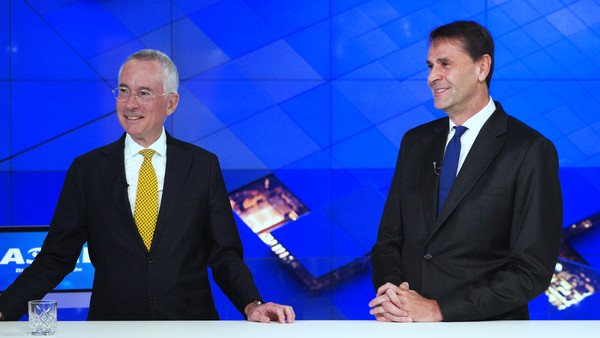
The people in the photo are ASML CFO Roger Dassen and CEO Christophe Fouquet.
CEO Christophe Fouquet said customer expectations for short- and medium-term demand for ASML equipment kept rising, based on forecasts for the scale and duration of AI-related investment. He said some customers also showed interest in orders for equipment to be delivered in 2029 and 2030.
Accordingly, ASML plans to significantly expand production capacity. Based on what it disclosed when reporting second-quarter results, the company said it was reviewing a plan to expand 2027 Low-NA EUV production capacity by 30% from 2026 production capacity, while also reviewing a plan to expand 2027 DUV immersion tool production capacity by 30%.
ASML also said at the time of its second-quarter results disclosure that it was reviewing an additional 30% expansion in 2028 Low-NA EUV production capacity, as well as an additional 30% expansion in 2028 DUV immersion tool production capacity.
However, demand expectations strengthened further in the third quarter. CEO Fouquet said quarterly order trends have improved since the start of the year, and that the current 2027 and 2028 supply plans alone are likely to fall short of meeting customer demand. ASML is therefore reviewing ways to further expand 2028 capacity beyond its existing plans.
Demand for ASML equipment is stretching farther out than firm orders, and actual equipment discussions are also being pushed back. According to Reuters, a significant number of orders flowed into ASML’s 2028 volume, and some customers showed interest in 2029 orders. Some customers also expressed interest in 2030 orders, and the 2029-2030 volume is distinguished from firm orders as the stage of order interest.
ASML is pursuing new equipment production increases and higher productivity for existing tools to respond to the supply shortage. The company is upgrading existing tools while supplying new equipment with higher throughput, with the goal of boosting customers’ wafer production capacity.
Revenue from installed base management related to this also increased. Third-quarter installed base management revenue, including maintenance, repairs and performance improvements, came to EUR 3.289 billion, up from EUR 2.762 billion in the previous quarter.
ASML’s production expansion plans are also linked to trends in South Korea’s semiconductor industry. Samsung Electronics and SK hynix are expanding investment in production facilities to meet AI memory demand, and are using EUV for advanced DRAM miniaturization.
Samsung Electronics and SK hynix are pursuing the introduction and use of High-NA EUV for next-generation DRAM. Samsung Electronics and ASML are expanding cooperation on next-generation lithography technology, and Samsung Electronics plans to introduce High-NA EUV for mass production of advanced DRAM in 2028. High-NA EUV is a next-generation lithography technology for drawing finer circuits, based on a higher numerical aperture (NA) than existing EUV.
SK hynix brought ASML’s production-use High-NA EUV tool, the 'EXE:5200B,' into its Icheon M16 facility last year and is using it for next-generation DRAM development. Samsung Electronics and SK hynix continue to invest in leading-edge DRAM. As a result, ASML’s medium- to long-term equipment supply capacity is emerging as a major variable supporting capacity expansion in South Korea.
However, ASML did not disclose which customers showed interest in equipment orders for 2029-2030. Samsung Electronics’ and SK hynix’s investment plans are being cited as background for continued domestic demand for advanced lithography equipment, but it has not been confirmed whether Samsung Electronics and SK hynix are the parties involved in the long-term order discussions ASML mentioned.
ASML’s third-quarter revenue from installed base management was EUR 3.289 billion, exceeding the company’s forecast. Regarding this, CEO Fouquet said demand for upgrades aimed at improving productivity remained solid.
Based on this, the company expects fourth-quarter total net sales of EUR 14.2-15.2 billion and a fourth-quarter gross margin of about 57%. It also raised the lower end of its full-year total net sales outlook by EUR 1 billion, from EUR 43-45 billion to EUR 44-45 billion, and projected a full-year gross margin of about 56%.
Source: IT DAILY · Kim Byeong-ju
Original: https://www.itdaily.kr/news/articleView.html?idxno=242192
References
This article was produced with the help of an automated content generation algorithm.
Source: IT DAILY
View originalThis article was summarized and organized by BizCrush based on the original article from IT DAILY. For exact quotations and full details, please refer to the original article.