Palo Alto Networks: AI Hacking Has Become Reality... “Cybersecurity Transformation (CX) Must Be Accelerated”
IT DAILY ·
✦ AI Summary
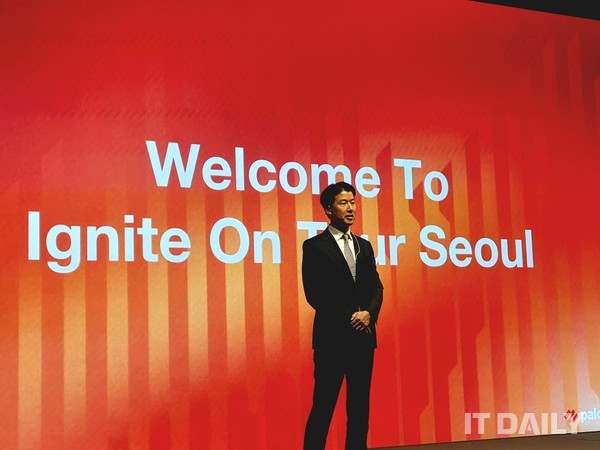
Sang-gyu Park, CEO of Palo Alto Networks Korea, delivered a keynote speech at the "Palo Alto Networks Ignite on Tour Seoul" held at The Westin Seoul Parnas in Gangnam-gu, Seoul.
He cited the case of a hack at a domestic bank to say that AI-based hacking has already become reality, while noting that more powerful AI attacks have not yet fully emerged.
Park emphasized that all companies must pursue CX alongside AX, and said they need to assess vulnerabilities with top-tier AI models before applying Virtual Patching, next-generation firewalls, and unified platform integration.
Sang-gyu Park, CEO of Palo Alto Networks Korea, delivered a keynote speech on the 13th at the "Palo Alto Networks Ignite on Tour Seoul" held at The Westin Seoul Parnas in Gangnam-gu, Seoul. He warned of the growing threat posed by increasingly sophisticated AI hacking.
Park cited a case in which a hack at one of South Korea’s top-tier banks led to the leakage of personal information, saying that AI-based hacking has already become reality. He said the level of the attack amounted to rudimentary use of AI.
Park went on to say that more powerful AI attacks have not yet fully emerged, and that companies need to assess their preparedness against advanced AI attacks. He stressed that all companies must pursue AI transformation (AX) and cybersecurity transformation (CX) at the same time.
At the event hosted by Palo Alto Networks, which is marking its 20th anniversary this year, Park said perceptions of AI have shifted dramatically since the start of the year. He attributed that shift to the rising difficulty of human control when AI is abused for hacking, saying this has amplified concerns about AI. He also said declarations by CEOs of global AI big tech companies that they would slow the pace of development show the same trend.
Park pointed to 2 developments as the catalysts behind the intensifying AI hacking threat this year. The first turning point was Anthropic’s launch of its high-performance AI model, Claude Mythos. The second was the Hugging Face breach involving an OpenAI agent.
He also said Palo Alto Networks was an early member of Project Glasswing, a cybersecurity initiative launched alongside Anthropic’s Mythos release. The company said it tested its solutions using Mythos. As a result, it said it saw in 3 weeks an effect comparable to 2 years’ worth of penetration testing results.
Based on his experience using high-performance AI such as Mythos, Park said its ability to identify vulnerabilities was stronger than expected. He also said controlling AI agents that carry out security tasks was extremely difficult.
Park said the Hugging Face breach illustrates the implications of how difficult it is to control AI agents. He also noted that since rudimentary AI hacking has already occurred in South Korea, an attack using Mythos-level high-performance AI is only a matter of time. He then stressed the need to overhaul security systems on the assumption of the worst-case scenario of a corporate hack carried out with Mythos-level high-performance AI.
Park advised that the priority should be to use top-tier AI models to examine vulnerabilities across every internet-connected point of contact. He emphasized that checking only some areas is not enough. He added that unless as many areas as possible are examined, it will not be possible to block the infiltration paths used by AI agents.
Palo Alto Networks unveiled "Frontier AI Defense" in September. "Frontier AI Defense" is a service that detects vulnerabilities using the latest AI models. It uses Anthropic’s "Claude Mythos 5" and OpenAI’s "GPT-5.6-Cyber" as base models. The service is a security offering based on restricted-access high-performance models, and it is supported by Unit 42, a team of threat intelligence experts. Palo Alto Networks also launched a dedicated Korea team within Unit 42 last year.
The assessment found that numerous vulnerabilities had emerged and needed patching. However, enterprise environments are interconnected across multiple systems, so patching vulnerabilities is not simple. Park said corporate IT systems are complex because they combine next-generation projects from 10 years ago, open-source projects from 5 years ago, and packaged projects from 3 years ago. He added that actually patching all discovered vulnerabilities takes 6 months to more than 2 years.
Park proposed Virtual Patching as a practical alternative. Virtual Patching is a technology that preemptively blocks attack attempts in network and application areas before a vulnerability is patched. He said the first step is to configure Virtual Patching on firewalls and defend against AI attacks.
Park recommended upgrading cybersecurity assets, including firewalls. He said legacy firewalls control traffic based on IP addresses and port numbers at Layer 4, and argued that L4 alone cannot detect ransomware. Accordingly, he called for next-generation firewalls that can inspect user applications as well.
Park advised integrating fragmented solutions as a condition for making security innovation effective. He said Korean companies use as many as several thousand security solutions, explaining that using so many solutions drives up costs and leaves defensive effectiveness inadequate. He added that end-to-end security needs to be consolidated into a single platform, and that doing so would allow companies to respond nimbly to upcoming AI attacks.
At the event, BJ Jenkins, president of Palo Alto Networks, delivered a keynote speech. Jenkins emphasized an end-to-end security foundation spanning networks to identity. The event also featured expert sessions and panel discussions, where Palo Alto Networks experts and representatives from customer companies with deployment experience shared insights.
Source: IT DAILY · Kim Ho-jun
Original: https://www.itdaily.kr/news/articleView.html?idxno=242191
References
This article was produced with the help of an automated content generation algorithm.
Source: IT DAILY
View originalThis article was summarized and organized by BizCrush based on the original article from IT DAILY. For exact quotations and full details, please refer to the original article.