“Only 30% of GPUs Are Running”: NetApp Pitches a Fix for the Data Supply Bottleneck
IT DAILY ·
✦ AI Summary
NetApp proposed a Zero-Copy strategy centered on easing the metadata bottleneck and using source data without moving it.
At a press briefing on the 14th, Korean NetApp unveiled NetApp Novus, a next-generation storage architecture for large-scale AI factories, and an enterprise data platform strategy to support agentic AI.
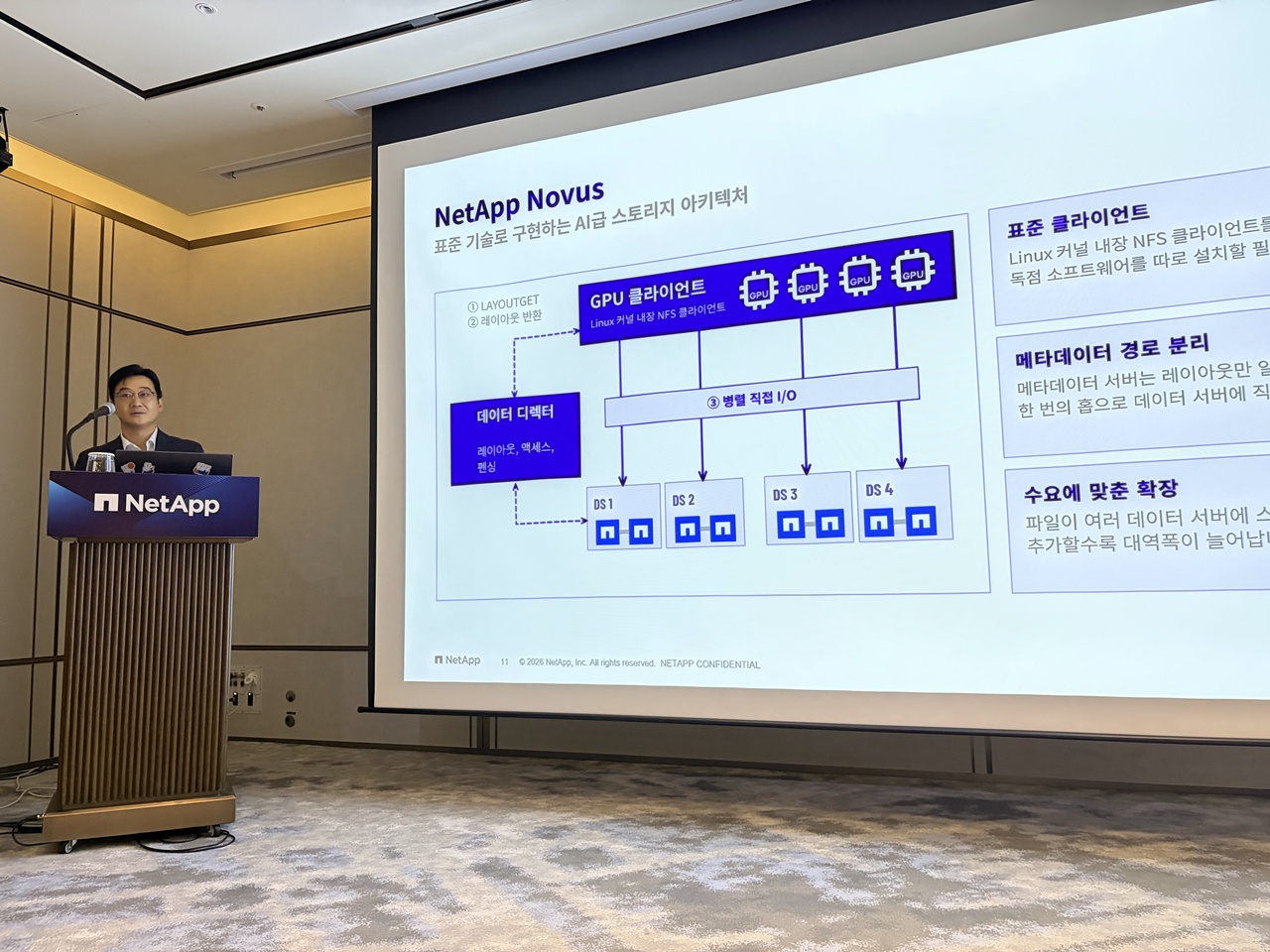
Kang Yeon-sik, executive vice president of Korean NetApp, explained that Novus separates the metadata path from the data storage path, and that NetApp AIDE and the integrated management platform handle data utilization and governance in the upper layer.
NetApp has moved to target the AI infrastructure market with a Zero-Copy strategy centered on easing the metadata bottleneck and using source data without moving it. NetApp said it identified data as the root cause of declining AI infrastructure efficiency, and in particular proposed a strategy to reduce the bottleneck in metadata processing.
Korean NetApp held a press briefing on the 14th. At the event, it unveiled NetApp Novus, a next-generation storage architecture for large-scale AI factories, and an enterprise data platform strategy to support agentic AI.
The presentation was delivered by Kang Yeon-sik, executive vice president of Korean NetApp. Kang introduced the relevant strategy from the perspective of reducing bottlenecks in data, especially metadata processing.
Yoo Jae-seong, CEO of Korean NetApp, said there is an enterprise ROI crisis beneath the global AI investment boom. He explained that companies are securing GPU through large-scale CAPEX, but the expected business results have not been felt sufficiently.
Yoo said this situation is leading to uncertainty for companies. In that context, he pointed to data as the starting point of infrastructure bottlenecks.
A severe infrastructure idle-rate problem has been cited as a key cause of AI infrastructure issues. Even after high-performance GPUs are deployed, computation resources are left idle as data pipelines continue to fail to supply data in time. In particular, there have been many cases in which GPU utilization falls below 30% because of data supply bottlenecks.
Behind this problem is the fact that more than 90% of AI workloads are concentrated across the pipeline, including data collection, cleansing, and preprocessing. In addition, enterprise data is distributed across on-premises, multicloud, and heterogeneous storage environments, which generates significant cost and latency in the process of aggregating distributed data, and Data Gravity also emerges in the process. For autonomous agentic AI, which is spreading recently, security risks such as unauthorized data access and possible resource corruption are also being raised.
Yoo said companies' biggest concern is uncertainty over whether massive infrastructure investment will translate into tangible results. Accordingly, he said the company plans to reduce data infrastructure idle rates and combine a cost-efficient hybrid architecture with a flexible business model. He also expressed an intention to preemptively offset customers' investment risk.
At the event, Korean NetApp unveiled NetApp Novus, a next-generation AI storage architecture for large-scale GPU clusters. The Korean NetApp presentation at the event was delivered by Kang Yeon-sik, executive vice president of Korean NetApp.
Kang said NetApp Novus was designed to resolve data bottlenecks in large-scale GPU clusters. He said the throughput of the latest GPUs is at the level of several terabytes per second.
Kang then explained that because the supply speed of conventional storage falls short of this, GPU utilization becomes inefficient. He also said AI factory environments operate at power levels in the gigawatt (GW) range and with hundreds of thousands of GPUs.
Kang said the key bottleneck in AI factories is not bandwidth but metadata processing. As examples of metadata processing, he cited checking the location and permissions of hundreds of millions of files.
Accordingly, Novus was designed to separate the metadata path from the data storage path. It also independently separated protocol request handling, file state and Lock management, and the file location catalog process to prevent a bottleneck in one workload from spreading across the system. The photo shows Yoo Jae-seong, CEO of Korean NetApp, speaking at the event. The photo was taken by reporter Kwon Young-seok.
The metadata software, Novus Data Director, is built on a Supermicro infrastructure. Metadata servers can be scaled independently in a linear fashion. Data nodes connect to ONTAP storage based on AFF A90. This architecture scales while maintaining a single namespace, with scalability supported from more than exabytes (EB) to zettabyte (ZB) scale.
In operational structure, Novus stands out for its open-standard-protocol-based Agentless architecture. Examples of existing high-performance parallel file systems include DDN and Weka. Under conventional methods, installing a dedicated client agent on each GPU host is mandatory. As a result, frequent patching and management overhead arise when operating tens of thousands of nodes.
Novus is said to have significantly reduced operational burden by removing host-side agents. It is also expected to improve GPU utilization through sequential read throughput performance of up to more than 100TB/s.
Kang said that in Korea, even if the infrastructure is not a big tech-scale deployment with hundreds of thousands of cards, operational limits of agent-installed storage become apparent once a GPU cluster exceeds tens of thousands of cards on a single-vendor basis. He then explained that Novus is an architecture that eliminates both the metadata bottleneck and agent overhead at the same time. He also said he expects Novus to become a next-generation standard that will maximize cost efficiency per token in AI factories.
The person in the photo is Kang Yeon-sik, executive vice president of Korean NetApp. Kang Yeon-sik, executive vice president of Korean NetApp, served as the presenter at the event.
Kang Yeon-sik, executive vice president of Korean NetApp, explained the roles of the lower and upper layers of the infrastructure separately. He said Novus handles the physical performance bottleneck in the lower layer of the infrastructure, while data utilization and governance in the upper layer are handled by NetApp AI Data Engine (AIDE) and the integrated management platform.
As an alternative for using distributed data in AI, NetApp proposed a Zero-Copy operating model. NetApp said that if source data is duplicated or moved, costs increase, security vulnerabilities arise, and synchronization is delayed. It also said synchronization delays were presented as a factor that amplifies the risk of AI model Hallucination.
Accordingly, NetApp said it connects AI utilization and management functions by scanning and integrating only metadata while keeping the original locations of source data in NFS, SMB, and S3 unchanged. It said this approach makes it possible to maintain existing access-control permissions without moving the source data.
The metadata exploration scope of NetApp AIDE covers ONTAP, StorageGRID, and third-party heterogeneous storage. Based on this, the supported functions presented were RAG, semantic search, and building ontological knowledge graphs.
Policy guardrails were applied to defend against the uncontrollable risks of agentic AI. The autonomous scope of AI agents was limited to provisioning and similar actions within storage policies set by administrators. For infrastructure-critical tasks such as volume deletion, independent execution by agents was blocked.
For tasks such as volume deletion, administrator approval is mandatory, creating a control mechanism. For public-sector and financial environments, NetApp provides NetApp Console Local, an air-gapped model with internet connectivity blocked, to respond to network separation and data sovereignty requirements.
Cyber resilience was also strengthened at the same time. It supports real-time ransomware detection at the storage level and immutable snapshot creation, and directly integrates NetApp protection technology with the Commvault console. It also performs data validation in an isolated clean room and supports safe recovery based on an isolated clean room. As a result, recovery time has been shortened from days or weeks to minutes.
In addition, native support for OCI has been added following AWS, Azure, and GCP. Through this, integration of core mission-critical workloads in a hybrid multicloud environment has been completed.
Kang explained that the key to data management in the AI era is not whether data resides on-premises or in the cloud, but whether control is based on consistent security and governance regardless of data location. He then proposed a direction in which data is controlled with the same security and governance regardless of the environment, adding that the company will provide safe integration with AI agents without forcing data migration and will also provide a complete guardrail capable of immediate recovery when a threat occurs.
Source: IT DAILY · Kwon Young-seok
Original: https://www.itdaily.kr/news/articleView.html?idxno=242181
References
This article was produced with the help of an automated content generation algorithm.
Source: IT DAILY
View originalThis article was summarized and organized by BizCrush based on the original article from IT DAILY. For exact quotations and full details, please refer to the original article.