NetApp Strengthens AI Data Infrastructure Strategy, Unveils
TECHWORLD · · 1 views
✦ AI Summary
NetApp unveiled its AI data infrastructure strategy in step with the expanding use of AI.
The strategy focuses on easing data bottlenecks and fragmentation across large-scale AI factories, enterprise agentic AI, and hybrid multicloud.
NetApp also introduced Novus, AIDE, new hybrid multicloud features, and an expanded partnership with Commvault.
NetApp unveiled its AI data infrastructure strategy to match the growing scope of AI use. The strategy covers large-scale AI factories, enterprise agentic AI, and hybrid multicloud. NetApp said it is focusing the strategy on easing data bottlenecks and fragmentation as AI infrastructure expands.
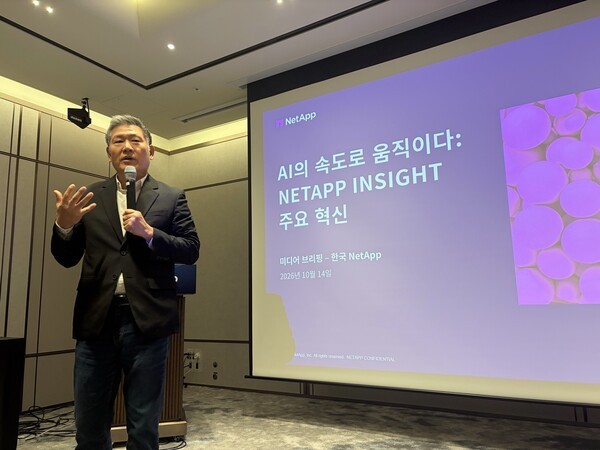
On the 14th, NetApp held the "NetApp Insight 2026 press briefing" and introduced its related strategy. At the event, NetApp unveiled "NetApp Novus," storage for large-scale GPU environments, AI Data Engine (AIDE), and new hybrid multicloud features.
NetApp presented an approach for supplying data to GPU at high speed in large-scale AI environments. Through this, it aims to improve storage performance for data delivery to GPU.
In enterprise environments, it presented an approach that supports AI use without making separate copies of company data. NetApp said it would enable AI use while maintaining existing data locations and management systems, and it emphasized strengthening data management and operations functions for that purpose.
Novus is storage aimed at large-scale AI infrastructure operators such as neoclouds and GPUaaS providers. It is designed to separate the metadata path from the data path so that performance, capacity, and concurrent processing scale can each expand independently, and it targets a zettabyte-scale file system and throughput of more than 100TB/s.
The initial version consists of "NetApp Novus Data Director," metadata software, and data services for "NetApp ONTAP" based on AFF A90. This initial version manages large-scale AI datasets based on a single NFS namespace and is built to scale metadata, bandwidth, and capacity independently.
NetApp said it believes that as AI factory scale grows, bottlenecks may arise when storage cannot supply enough data to GPU, and that such bottlenecks can reduce infrastructure utilization. Accordingly, NetApp plans to use Novus to continuously supply data even in environments deploying hundreds of thousands of GPU and, based on that, raise utilization of computing resources.
NetApp said it is strengthening data access methods for enterprise agentic AI use and providing "NetApp AI Data Engine, AIDE." AIDE expands metadata discovery to ONTAP, StorageGRID, and third-party storage. AIDE supports discovery and analysis in place, without data replication or migration.
As a result, customers can assess their holdings while keeping data in place across NFS, SMB, and S3 storage. They can also check security risks and storage utilization. This is a Zero-Copy approach that preserves existing access rights and governance rather than moving data to separate storage for AI use.
NetApp plans to add AI-based data understanding and governance analysis, as well as external analytics engine integration, in the future. Its goal is to connect distributed data to contextual information for practical use by AI agents.
NetApp expanded its collaboration with Commvault in AI data protection. NetApp linked its own threat detection capabilities with Commvault's recovery workflow to build a process that runs from threat detection to validation in an isolated environment and secure data recovery.
NetApp said the integration will allow customers to verify that attacked data has been cleaned of threats and shorten recovery times. In the past, recovery work could take several days or several weeks, and the integration aims to reduce that to minutes.
At the same time, NetApp expanded hybrid multicloud operations capabilities to respond to the dispersion of AI workloads across multiple environments. The applicable environments are on-premises, public cloud, sovereign regions, and AI factories, and the same governance standards and cost-control standards are applied across them.
The operational direction is focused on enabling users to choose the most suitable environment for each workload. New features include "NetApp Keystone Sovereign," which addresses data sovereignty requirements; "NetApp Console Autonomous Operations," which supports AI-based operational automation; and "NetApp Console Fleet Management," for managing the entire IT asset base.
This update also includes the addition of "NetApp Console AI ChatOps Interface" and expanded cooperation with Nutanix in virtualization. The new interface enables natural-language-based storage operations, as well as natural-language-based provisioning and policy application. It is also designed so that when customers use their own LLM, the work is carried out within defined storage policies and governance boundaries.
With this product and feature update, NetApp presented a strategy to connect AI infrastructure data delivery, enterprise data use, multicloud operations, and security on a single data platform. It also plans to launch a combined feature with NetApp ONTAP and Nutanix Cloud Infrastructure this fall. The feature aims to preserve existing infrastructure investments and is intended to improve the scalability, security, and operational flexibility of virtualization workloads.
NetApp also presented separate priorities for AI factories and enterprise environments. In AI factories, the focus is on reducing storage bottlenecks. In enterprise environments, the focus is on expanding the scope of AI use while maintaining existing governance and protection systems without moving data.
NetApp announced plans to expand related business in Korea. It said it will pursue business expansion because demand for data management is expected to rise as AI adoption expands in the Korean market alongside AI infrastructure deployment and the spread of agentic AI. With enterprise data environments distributed across on-premises and cloud settings, NetApp presented its goal of ensuring consistent management of distributed data and supporting AI use. Accordingly, NetApp said it will supply Novus, AI Data Engine, and multicloud operations features in an integrated way so that companies can handle data scattered across multiple environments in the same manner and connect it to AI for use.
Source: TECHWORLD · Kim Seung-gi
Original: https://www.epnc.co.kr/news/articleView.html?idxno=408189
References
This article was produced with the help of an automated content generation algorithm.
Source: TECHWORLD
View originalThis article was summarized and organized by BizCrush based on the original article from TECHWORLD. For exact quotations and full details, please refer to the original article.