79% of Korean CIOs Say They Struggle to Supervise and Manage Their Company’s AI Agents
TECHWORLD · · 2 views
✦ AI Summary
Dataiku announced the results of a joint Dataiku-Harris Poll survey of 685 CIOs worldwide, including in Korea.
The survey found that the spread of AI agents inside companies is accelerating, but it also confirmed difficulties in management and performance measurement.
In Korea, 79% of CIOs said they recognize limits in supervising and managing AI agents, while 83% of CIOs worldwide said there is no standardized lifecycle management framework for AI agents.
Dataiku announced the results of a survey of 685 CIOs worldwide, including in Korea. The survey was conducted jointly by Dataiku and Harris Poll, and the report is titled "2026 Global AI Report: CIO Edition."
The survey found that the spread of AI agents inside companies is accelerating. However, it also confirmed that managing AI agents and measuring their performance remain difficult.
In Korea, 79% of CIOs said they recognize limits in supervising and managing their company’s AI agents. Globally, 83% of CIOs said there is no standardized lifecycle management framework for AI agents.
Globally, 47% of CIOs said they had retired more than 20 AI agents this year. In addition, 21% of CIOs said they can separate AI costs by organization, team, or use case and track settlement and line-item details in near real time.
The survey results also showed management gaps alongside the spread of AI agents inside companies. Globally, 67% of CIOs estimated that there are more than 51 AI agents running within their companies. About 90% of CIOs worldwide said they have full traceability for those agents.
However, apart from traceability, the survey found shortcomings in performance measurement, governance, and oversight of unofficial agents. Globally, 72% of CIOs said they do not continuously measure whether the same agent is achieving both its designed operational performance and business outcomes. Globally, 60% said their companies lack a centralized AI governance framework that covers tools and environments across the organization. Globally, 81% said full oversight of agents created outside approved systems and official channels is impossible.
Against this backdrop, CIOs appear to view managed deployment by business unit as a more effective strategy than fully centralized operations. Globally, 91% of CIOs said they prefer directly building within managed environments in each business unit rather than centrally managing all applications and agents.
At the same time, CIOs are also pursuing responses to operational continuity and the risk of model disruption. Globally, 75% of CIOs said they plan to use more or a wider variety of models to ensure AI operational continuity. Globally, 74% said they are reviewing open-source models as a safeguard against future model disruption or unavailability. Globally, 80% said they have already conducted, or plan to conduct, a risk assessment of AI dependencies.
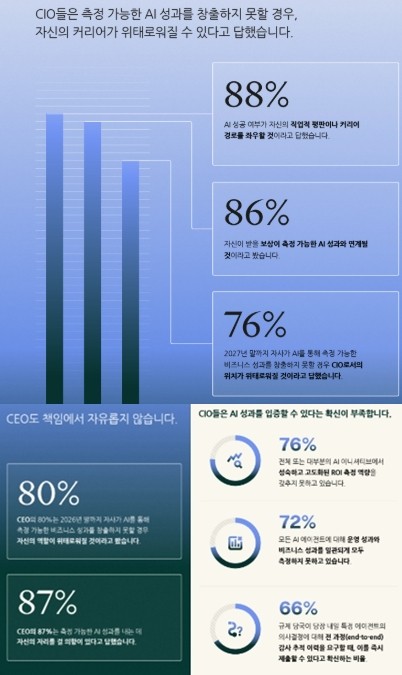
The survey findings show both weak AI-related performance management systems and the rapid pace of adoption in the field. Among CIOs worldwide, 28% said they continuously measure both the operational and business performance of all AI agents. By contrast, 76% of CIOs said they lack a mature, high-level ROI measurement framework covering all or most AI projects within their organizations.
In addition, 84% of CIOs said employees are creating AI agents and applications faster than IT can manage them. The survey results show that while AI adoption and use are moving quickly, management systems are not keeping up sufficiently.
Views on who is responsible when agent problems occur were fragmented. The largest share, 23%, pointed to multiple teams as the responsible party, followed by central IT organizations at 21%, data and AI teams at 20%, and security, risk, and compliance organizations at 18%.
AI performance was also found to affect CIOs’ reputations and careers. 88% of CIOs said AI success affects their professional reputation and career, and 87% said they had heard from the CEO that job security could depend on AI performance.
In a separate CEO survey by Dataiku, executives showed awareness that their roles could be at risk if AI performance is not proven by a set point in time. The share who said the CEO role could be at risk if AI performance falls short by the end of 2026 was 80%.
IT leaders are facing the same pressure. The share who said the CIO role could be at risk if measurable business or AI performance falls short by the end of 2027 was 76%.
At the same time, boards are demanding stronger proof of measurable AI ROI, the survey found. The share saying board pressure to demonstrate measurable AI ROI has increased was 97%, and 76% of CIOs said the increase in board pressure was significant or moderate.
Under this pressure, the possibility of budget cuts if targets are not met has also been raised. The share saying AI budgets could be cut or frozen if AI performance targets fall short by the end of 2026 was 72%.
Korean CIOs in particular were found to face greater difficulty in measuring the operational and business performance of AI agents. The share of Korean CIOs struggling to measure AI agent operational and business performance was higher than that of global CIOs.
The survey also shows that Korean CIOs see the foundation for systematically measuring AI performance as weak. In Korea, 79% of CIOs said they cannot continuously measure the operational and business performance of all AI agents. Also, 15% of Korean CIOs said they have a mature, high-level ROI measurement framework covering all or most AI initiatives.
The survey also showed that the pace of AI development in the field is outstripping IT management capabilities. In Korea, 87% of CIOs said employees are developing AI agents and applications faster than the IT department can manage them.
At the same time, both CEOs and CIOs appear to connect measurable AI performance with the stability of their own positions. In a separate CEO survey by Dataiku, 93% of Korean CEOs said their roles could be at risk if they fail to generate measurable AI performance by the end of 2026. Meanwhile, 80% of Korean CIOs said they would stake their jobs on generating measurable AI performance.
The sense of crisis among Korean CEOs was higher than the overall CEO average. Korean CEOs at 93% were above the overall CEO response rate of 80%. In addition, 76% of Korean CIOs said their roles could be at risk if they fail to generate measurable AI performance by the end of 2027.
Florian Douetteau, cofounder and CEO of Dataiku, said the debate over AI agents has focused too much on autonomy, while discussion of how to handle autonomous systems has been lacking. He said autonomous systems require management, not just monitoring, explaining that monitoring means checking whether an agent is functioning, while management means deciding whether to allow that agent to keep operating. He added that, in practice, no one can stop AI agents right now and stressed that trustworthy control is the key to maximizing and sustaining AI performance.
Source: TECHWORLD · Lee Gwang-jae
Original: https://www.epnc.co.kr/news/articleView.html?idxno=408190
References
This article was produced with the help of an automated content generation algorithm.
Source: TECHWORLD
View originalThis article was summarized and organized by BizCrush based on the original article from TECHWORLD. For exact quotations and full details, please refer to the original article.