Netflix Tops KRW 1 Trillion in Domestic Revenue, But 81% Goes to U.S. Headquarters
IT DAILY · · 1 views
✦ AI Summary
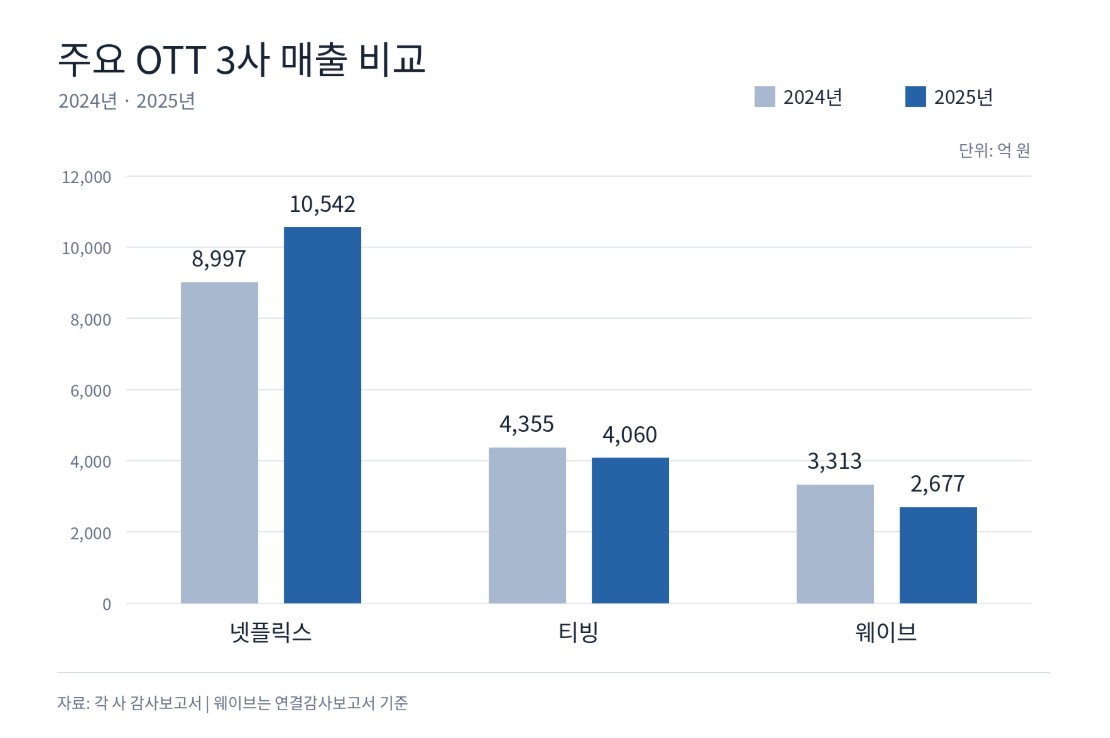
According to an analysis of Netflix Services Korea's audit report, domestic revenue last year was KRW 1.0542 trillion.
Of that, KRW 853.9 billion, or 81.0%, was paid to Netflix, Inc. in the U.S., leaving the domestic subsidiary with operating profit of KRW 20.3 billion and an operating margin of 1.9%.
By contrast, Tving posted an operating loss of KRW 69.8 billion and Wavve posted an operating loss of KRW 12.2 billion, while the industry called for an expansion of performance-linked revenue sharing.
While domestic OTT companies recorded losses, Netflix posted more than KRW 1 trillion in revenue in South Korea last year. On the 14th, Rep. Han Jun-ho of the Democratic Party of Korea analyzed Netflix Services Korea's audit report and found that Netflix's domestic revenue last year came to KRW 1.0542 trillion. That was 1.7 times higher than 2021, when domestic revenue stood at KRW 631.7 billion, marking a 5-year increase in revenue since 2021.
Rep. Han Jun-ho is a member of the National Assembly's Science, ICT, Broadcasting and Communications Committee. The analysis showed that 81% of Netflix's revenue was paid to its overseas headquarters, leaving the domestic subsidiary with operating profit of only KRW 20.3 billion.
Against this backdrop, it was pointed out that Korean content producers find it difficult to secure additional profits even when a hit emerges.
Industry players said a revenue-sharing structure that can guarantee returns on box-office success is needed.
As most of the revenue earned by Netflix's Korean subsidiary was treated as expenses paid to headquarters, domestic profitability remained low. Of last year's KRW 1.0542 trillion in revenue, KRW 853.9 billion, or 81.0%, was paid to Netflix, Inc. in the U.S. under the name of 'consideration for subscription membership purchases.' As a result, the domestic subsidiary's operating profit was KRW 20.3 billion, and its operating margin was 1.9%.
By contrast, domestic OTT services continued to post losses. Tving reported an operating loss of KRW 69.8 billion last year, and Wavve reported an operating loss of KRW 12.2 billion.
Netflix held the edge in its user base. According to the Broadcasting and Media Communications Commission's ('Bammi-tongwi') '2025 Broadcasting Media Usage Behavior Survey,' Netflix's paid usage rate was 46.7%, while Tving's was 13.0%. Netflix's paid usage rate was 3.6 times that of Tving.
Amid this structure, the lawmaker said Netflix's growth has been built on Korean content, but the share returned to producers is limited. He also pointed out that Netflix has secured a large share of the IP for original works with no source material. 'Squid Game' ranks first all-time in Netflix's TV category, and Netflix holds the IP rights to 'Squid Game.'
Under the current structure, Netflix covers all production costs, while producers receive a 3% to 10% margin on those costs as compensation. Under this model, it is difficult for a work's success to translate into additional revenue for the producer.
For this reason, the industry is calling for the expansion of a performance-linked revenue-sharing structure. The goal is to allow producers to receive additional compensation in proportion to box-office success.
The lawmaker said K-content contributed to Netflix's rise to No. 1 in South Korea. He added that compensation for producers is limited to a 3% to 10% margin on production costs regardless of a work's success, and said additional rewards based on performance are needed, along with responsibility commensurate with that influence.
Source: IT DAILY · Seong Won-young
Original: https://www.itdaily.kr/news/articleView.html?idxno=242179
References
This article was produced with the help of an automated content generation algorithm.
Source: IT DAILY
View originalThis article was summarized and organized by BizCrush based on the original article from IT DAILY. For exact quotations and full details, please refer to the original article.